
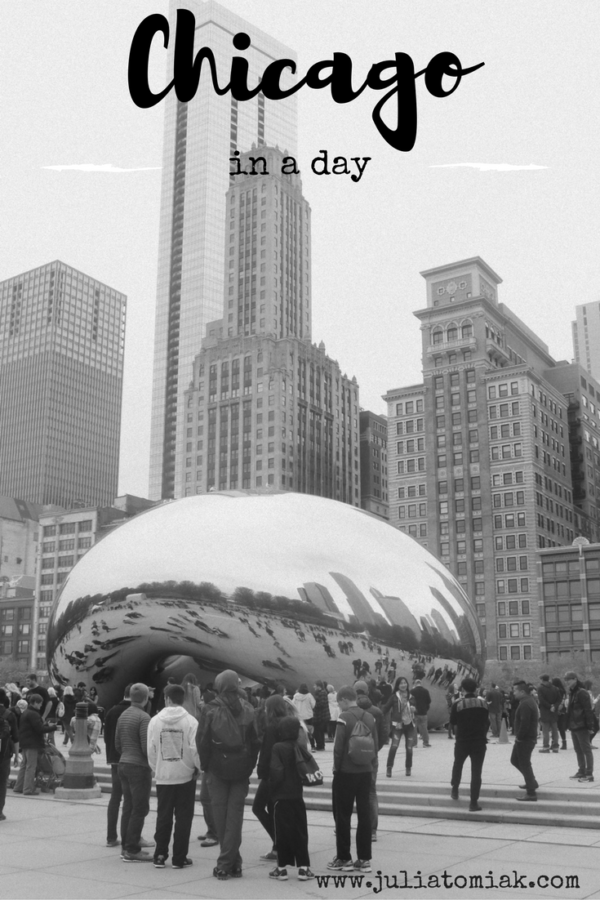
Chicago in a Day

If you have the chance to visit Chicago, you should definitely take it. But please, go when it’s warm (like June or later) and allow more than one day to see all the fabulous art and culture Chicago offers.

Our tiny high school Scholastic Bowl team qualified to take part in the NAQT National Tournament in Chicago last week. This was a fabulous opportunity for kids from our little corner of southwest Virginia to experience the culture of a big city and compete against students from multiple states. We had a blast, and the 12 hour drive (one way) was definitely worth it.  We hit the ground running when we got back, and I’m still exhausted, but here are a few tips I picked up about visiting Chicago.

One day isn’t enough

Because the school was paying, and we had to dedicate a day to competition, we only had one day to play in Chicago. 🙁 Definitely not enough. When I go back, (which I must), I want at least four days, or ideally, a week-long stay in a VRBO. We used public transportation, another way for kids to experience city life, but that came with unexpected delays. (Like an intoxicated, unresponsive passenger that had to be removed from our L train by a rescue squad. Don’t drink, kids, it only causes trouble.)

Find discounts for attractions

My family used City Passes in San Francisco, a huge help with expenses. You can get those in Chicago as well. Since we only had one day to sight see, I opted for the Go Chicago Card, which allowed us to choose two attractions and get a 20% discount. These passes usually help you bypass long ticket lines as well.

Transportation
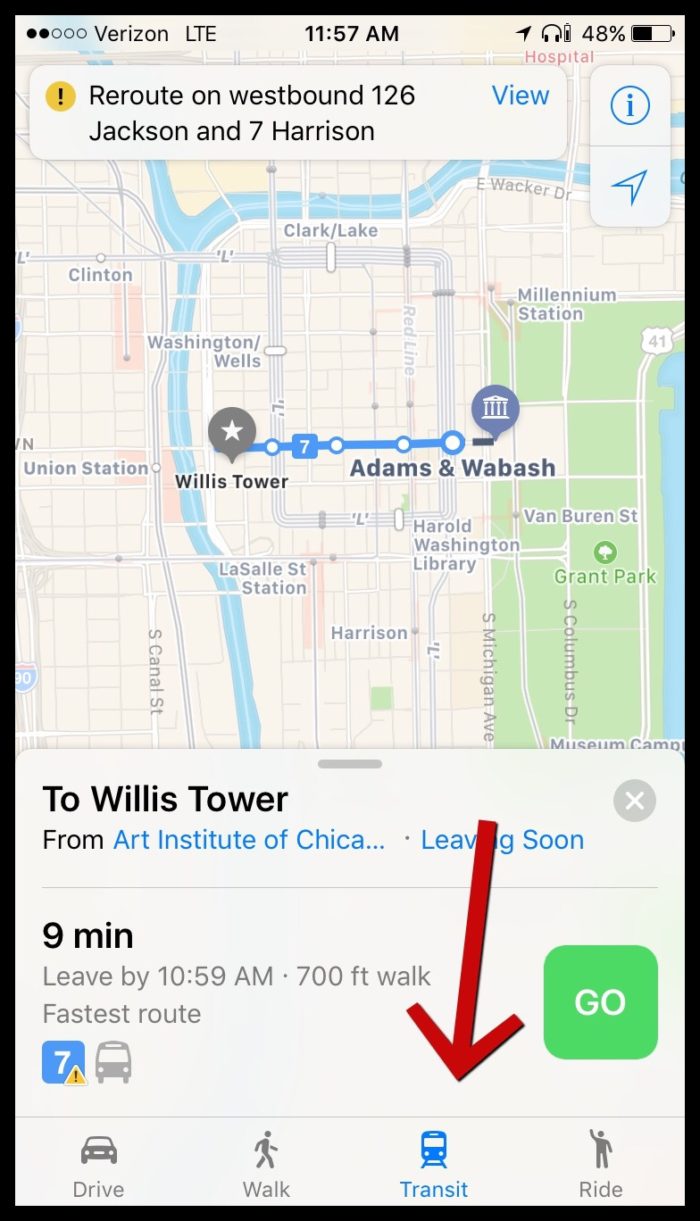
The transit option tells you which rail and bus lines you need.

We used the L (“elevated train”), not the bus lines (only because I didn’t have time to figure them out). The L was clean and safe, although we only rode during daylight. Our hotel was out by O’Hare Airport, and it took nearly an hour to get to downtown from there.

I highly recommend the one day CTA (Chicago Transit Authority) pass. For $10, we got unlimited rides on the L (and on buses if we had needed them). There’s also a three-day pass for $20. Overall, the system was pretty easy to figure out, although several train lines run through “The Loop” in the middle of downtown, and not all lines travel to all stations, which could be confusing. I like using the “transit” option on iPhone Maps” to give me a travel plan that includes public transportation options.

Go when it’s warm
Chicago has so many beautiful outdoor spaces- the River Walk, Millennium Park, Grant Park, the Navy Pier, and the lake front beaches – that it would be great to visit when the weather is warm. During our visit in late April, it was overcast with highs in the 50s (fairly typical for April). Closer to the lake felt even chillier. Good friends of mine who visited in the summer enjoyed warm weather activities like bike and kayak tours. When we go back, I’d definitely like to do that.

Art lovers take note!

There is much to please the art enthusiast’s eye in The Windy City. In fact, 2017 is the Year of Public Art in Chicago.  Fascinating architecture and sculpture fill the city spaces. We visited The Art Institute of Chicago, which has the largest collection of Impressionist paintings outside of France and many other famous pieces (American Gothic, Whistler’s Mother). As a girl who grew up outside of DC and its free Smithsonian museums, I was shocked at the ticket price for The Art Institute – $40 for adults! I highly advise using a City Pass or a Go Chicago card to help with expenses. The museum also has free days [look up and link]. We only spent an hour and a half at the Art Institute; I could have easily been there all day.

See the city from UP HIGH

There are two skyscrapers where you can go for a fabulous view of Chicago and beyond:  The Hancock Building and The Willis (formerly the Sears) Tower. Both cost about $20 and feature a high-speed elevator ride to the top. We went to the Willis Tower as it was closer to the other downtown attractions we visited.

When we stepped out of the elevator onto floor 103, we could feel the building shifting in the sky.  There are views from all four sides of the building, as well as a few glass “Ledge” boxes where you can step out onto a clear surface and look down to the street below. I hate heights, but my daughter (also a bit height squeamish) did it, so I had to. I was fine until hubby said to my son, “Look down at the cars.” When I glanced past my feet to the tiny vehicles below, my vestibular system screamed anarchy, and I cleared out of that box. It’s worth a visit, although it’s a tad “touristy”.

Away from downtown

Chicago has multiple neighborhoods worth visiting outside of the downtown tourist destinations. You can hire a free Chicago guide for groups of six or less to take you on a tour of the neighborhood of your choice. We opted to visit Pilsen, a Hispanic neighborhood west of downtown that features many colorful murals on businesses and homes.

Gulliver in Wonderland, Hector Duarte
Part of Gulliver in Wonderland by Hector Duarte

To the great delight of our Scholastic Bowl team coach, who doubles as a Spanish teacher, we visited the home and studio of artist Hector Duarte. His enormous mural Gulliver in Wonderland depicts the plight of immigrants in America. Lucky for us, he was home when we visited, and he graciously spent almost an hour with us, sharing his art and explaining the challenges and emotions immigrants experience.  With everything going on in the news right now, this was a fabulous opportunity for all of us to hear the perspective of a Mexican immigrant. This was one of my favorite parts of the trip, and even hubby, a non-artsy guy, enjoyed it.

Gulliver in Wonderland by Hector Duarte
Gulliver in Wonderland by Hector Duarte.

Have you ever visited Chicago?  What tips can you add to my list?

Thanks for stopping by!



A Poem for Your Pocket

It will only take you ten minutes to do what I ask.

Ten minutes to indulge language and rhythm and creativity, and if you come to this blog, surely you treasure these things.

April is National Poetry Month and today, April 27, 2017, is Poem in Your Pocket Day. Poets.org encourages all lovers of words and poetry to take one of the poems they suggest in their Poem in Your Pocket Day PDF and share it, via printed copies at schools, libraries or transportation centers, or via digital images on Facebook, Twitter, and other social media.

If you’ve pulled up this post on your phone, you’ve already got the poem in your pocket, right?  Now you just have to read it, enjoy it, and share it.  To find other poems to share, visit poets.org for more Poem In Your Pocket ideas.

I liked the theme of this one, given the current climate of conflict in our country and around the world.

When Giving Is All We Have

 by Alberto Ríos

One river gives

Its journey to the next.

We give because someone gave to us.
We give because nobody gave to us.

We give because giving has changed us.
We give because giving could have changed us.

We have been better for it,
We have been wounded by it—

Giving has many faces: It is loud and quiet,
Big, though small, diamond in wood-nails.

Its story is old, the plot worn and the pages too,
But we read this book, anyway, over and again:

Giving is, first and every time, hand to hand,
Mine to yours, yours to mine.

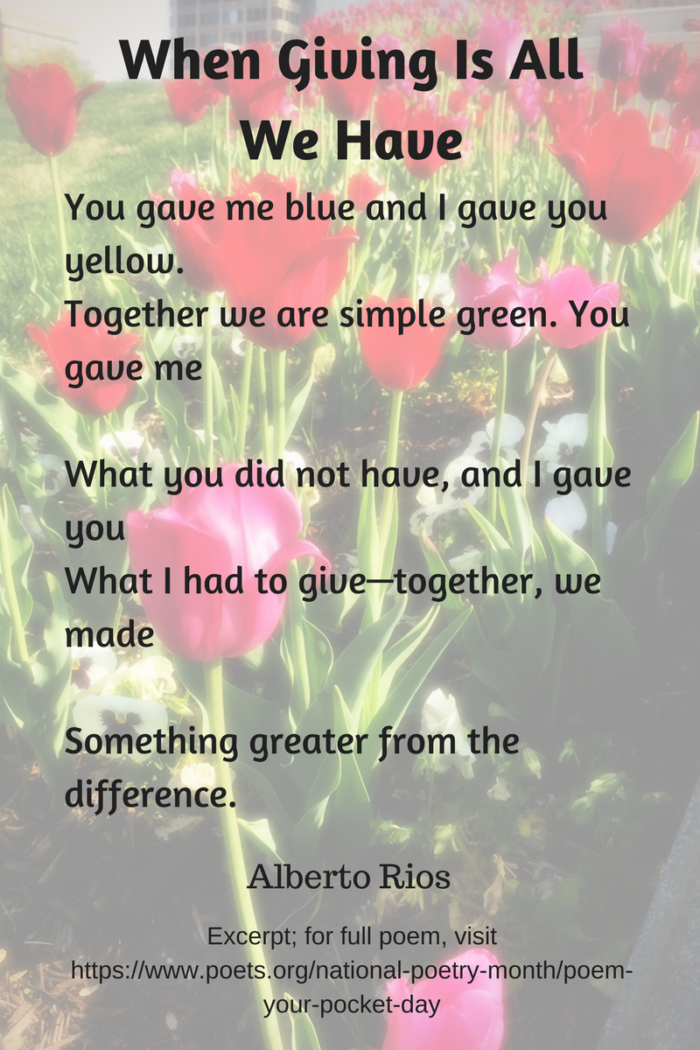
You gave me blue and I gave you yellow.
Together we are simple green. You gave me

What you did not have, and I gave you
What I had to give—together, we made

Something greater from the difference.

Copyright © 2014 by Alberto Ríos

Isn’t it a beauty?  Now, please share it!  I’ve created a “poem graphic” to make it easy for you. 😉

poem


Thanks for stopping by!


The Origin of Hydrangea

hydrangea

I love it when my kids apply things they’ve learned in books to everyday life.  Like, when my youngest son wondered if the hydrangea plant I brought home from Easter Sunday service is named for the mythological monster “Hydra”.

If you wonder about the origins of words too, join the Wondrous Words Wednesday meme at Bermuda Onion.  There, bloggers share new words they’ve learned or some of their favorites.

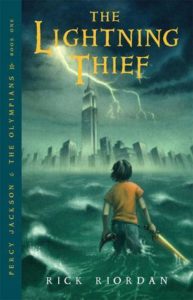
We’ve been listening to The Lightening Thief during our soccer commuting.  When I read the first book a few years ago, I didn’t like it.  Too many crises, not enough character development.  But, I’ve recently decided to give it another try.  I want to learn more mythology, and all the action keeps me awake while driving.  Bonus: I know it’s appropriate for little ears, and my kids enjoy it.  It’s fun sharing books with them.

Anyway, during our listening, Percy recently had to battle a Hydra, a sea-snake type monster with multiple heads.  When one head is sliced off, two more grow back in its place.  (You can see why this would be a challenging monster to defeat, but Percy manages, with help from his friends of course.)  I told my son I doubted the beautiful flowering plant was named for a monster; perhaps the common link came from “hydro” which means water.


Here’s what I learned:

Hydrangeas were first discovered in Japan, and their name comes from the Greek “hydor” (water) plus “angos” (jar or vessel).  This roughly translates to “water barrel”, perhaps because of the cup shape of the flowers and the plant’s need for lots of water. (Thanks Teleflora )

I couldn’t find any official origin for Hydra, but since it’s a water snake, I’m sure it also comes from the Greek hydro, or water.

Word Nerd Workout

Can you think of other words that come from the Greek root “hydor”?  And, if you’ve read The Lightening Thief, what did you think?

Thanks for getting nerdy with me!


Why I Love Monticello

Thomas Jefferson quotes

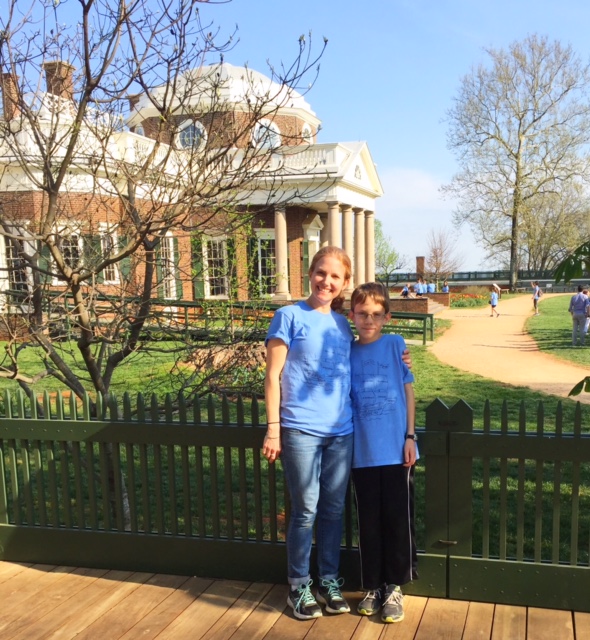
I just got back from my last “trip across Virginia” with the fourth grade at our elementary school.  In 48 hours, we traveled from the west side of the state to the east and visited Richmond, Williamsburg, Jamestown, and Monticello.  Sounds exhausting, doesn’t it?  Well, it was.  But also very, very good.

My last trip across Virginia with child number 4. Bittersweet.

My favorite stop on the trip is always the last one, Monticello.  By the time we get there, the entire crew is exhausted, but being at Jefferson’s home always lifts my spirits. Not just because the tidy gardens appeal to my need for organization and  color. Not just because the view of central Virginia extends for miles from atop the mountain, or that I can see the dome of the Rotunda at my beloved University of Virginia from the side of Jefferson’s house.

What always gets me is the amazing capacity of Jefferson’s mind.  He constantly observed, considered, and created.  For example, he never studied architecture “officially” in school, but he created the first designs for his home based on his study of books about architecture.  Do you know how important this is to a mama who does not have time to enroll in an MFA program or a photography course?  I can read, therefore, I can learn anything I set my mind to.

Monticello is full of Jefferson’s inventions. When the carriage he had used for years, a small and fast model, became too tiring for him to ride in, Jefferson designed a new carriage that he could travel in more comfortably.  He also installed in it a primitive odometer to measure the miles he traveled.  It marked off tenths of miles and a bell chimed at every mile. Did you know that Jefferson was one of the founders of the American Decimal System?  (I didn’t… until Thursday.)

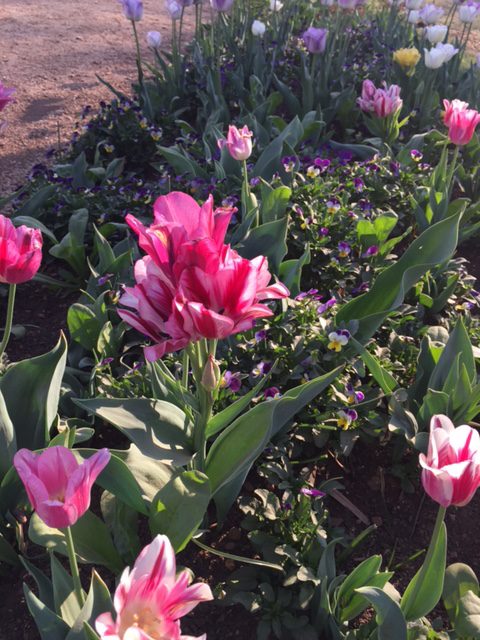
Some of the lovely flowers at Monticello

Officially, Jefferson’s vocation was lawyer, but he didn’t limit his mind to studying the law.  He filled his world with information about weather, history, classical art and architecture, gardening. He was a true Renaissance Man, a person who has wide interests and is expert in several areas.

I won’t claim to be an expert in anything, but this life model that Mr. Jefferson has given us, one that embraces and prioritizes knowledge and creativity, always inspires me.  I don’t have to feel bad that I hold degrees in two different areas of study, and that the vocation I pursue now is completely different.  His legacy assures me it’s okay to have many passions and pursuits, that the most important thing is to keep learning.

I know Jefferson wasn’t perfect. He rewrote the Bible to suit his religious philosophy, (heretical, I can’t deny it), and he was a slave owner and a poor manager of money.  Those flaws are as important to remember as his greatness, but in the end, it’s his pursuit of knowledge that I cling to.

Word Nerd Note: If you also like to pursue varied interests, I’d like to recommend The Portfolio Life, a podcast by Jeff Goins that encourages creative, thoughtful people to pursue their varied passions.

Do you have many passions?  What are they?  How do you keep your mind stimulated?  Also, if anyone can recommend a biography about Thomas Jefferson, I’d love to hear about it.

Thanks for getting nerdy with me,


Vocab from Small Great Things: Specious

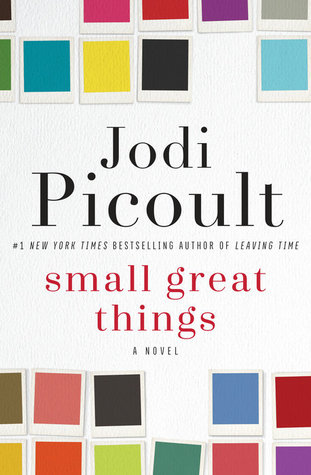
Small Great Things

My book club is reading Small Great Things by Jodi Picoult this month, and so far, it’s a fantastic read.  Ruth, a black nurse working in a labor and delivery ward, is assigned to care for a baby whose parents are white supremacists.  When the baby’s parents complain, Ruth’s supervisor tells Ruth not to care for or even touch the baby.  However, during a hectic shift, when all the other nurses are busy, the baby boy goes into cardiac arrest.

Tragedy strikes, followed closely by litigation. Picoult does a great job of presenting the back story for each character and how their experiences shape their views. She handles the complicated and sensitive issue of race relations with beautiful language and thoughtful insights. I’m looking forward to spending more time with this book. (Which I must, as I’m supposed to have it read by next Tuesday!  I might have to indulge in something called “Reading during the day”.  What a treat!)

Last night, I came across a new word in an exchange of dialogue between one of the lead characters, a public defender, and her mother.

You know when you say things like that it makes me want to get a prescription for Xanax,” my mother sighs.  “I thought that you were going to start looking for a real job when Violet went to school.”

“A, I do have a real job, and B, you’re already taking Xanax, so that’s a specious threat.”

I had to take a trip to Merriam Webster to learn what specious means.

Specious \ˈspē-shəs\ adjective from  Latin speciosus, meaning “beautiful” or “plausible,” and Middle English “visually pleasing”; around the 17th century, specious began to suggest a superficial or deceptive attractiveness

  • having deceptive attraction or allure
  • having a false look of truth or genuineness

Word Nerd Workout

Don’t forget to visit Kathy at Bermuda Onion for the WWW meme!

You could use specious to describe a sketchy argument or reasoning that does not stand up to questioning.  Can you think of a synonym for specious? Mine is “misleading”.

If you like learning about new words, visit Bermuda Onion’s Wondrous Words Wednesday meme.

Thanks for getting nerdy with me!


What I Liked, and Didn’t, About Truly, Madly, Guilty

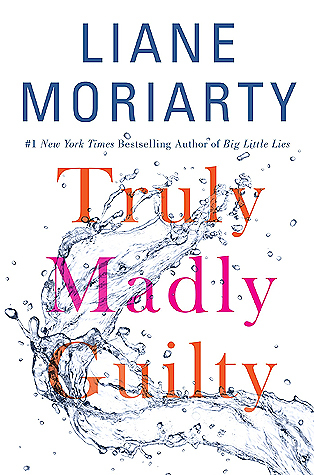
Truly Madly Guilty by Liane Moriarty

Ever since I listened to Big Little Lies last year, I’ve been a huge Liane Moriarty fan. Her books are an appealing mix of humor and reality that touch on every day challenges but also have an intriguing element of mystery. Her latest release, Truly, Madly, Guilty, has gotten mixed reviews. In fact, I know some people who refuse to read it because their friends have hated it. My book club buddy Caroline found the first half of the novel so frustrating, she removed it from our 2017 reading list.

So of course, I had to check it out.

Premise

Truly, Madly, Guilty tells the story of an innocent backyard barbecue gone terribly wrong. Moriarty gives us a main cast of three quirky couples and explores how the events of one Sunday afternoon forces them to reconsider their marriages, their identities, and their parenting skills.

What I liked

As always, Moriarty gives readers well-developed, multidimensional characters. They are obsessive, charismatic, and interesting, and she provides back story for their idiosyncrasies and empathy for their weaknesses. Also, her “reveals” – one big one in the middle and a few smaller ones near the end – were satisfying and surprising. At the end, she does a nice job of tying up seemingly unrelated plot threads. Moriarty has a knack for capturing essential truths about life, like the strain between dysfunctional parents and their adult children, with stunning clarity. I always find a few key lines in her books that make me nod and say, “Exactly!” Truly, Madly, Guilty was no exception.

What I didn’t like

Caroline was right; the first half of Truly, Madly, Guilty is extremely frustrating. The characters keep lamenting the “barbecue in that ridiculous back yard”, but it takes a couple hundred pages (or, for the listener, a couple of hours) to finally learn what happened that was so terrible. Although I appreciate the need to build suspense, Moriarty indulges in lengthy scenes that spend too much time on unnecessary details.

In the January 2017 issue of Writers Digest, Moriarty explains that she structured the book as she did so that readers wouldn’t judge the reactions of the characters. She said, “…some readers did get impatient, and some admitted to me that they flipped ahead… This was a particularly tricky book in terms of structure, and who knows if I got it right.” I think the structure could have worked if she trimmed down her excessive descriptions of everyday life and painted her characters and their relationships more succinctly. For example, the first half of the novel has a long, painful scene about a young family trying to find a lost shoe. The tedious dialogue is punctuated by a child repeatedly asking for a cracker. Instead of piquing my interest in the characters and the dynamics between them, the scene annoyed me as if it were a whiny child itself.

Recommendation

Although I don’t think this is Moriarty’s best book, and I did find the first half trying, in the end, I’m glad I finished it. I laughed, I cried, and I thought seriously about my relationship with my husband and children. To me, that makes a good story.

Word Nerd Notes

I listened to the audio book version, narrated by Caroline Lee, who always does a great job with Moriarty’s books. But perhaps reading the hard copy would be good for this one, since you can skim through some of the slower parts.

Have you read Truly, Madly, Guilty? Why or why isn’t it worth the read? Help my readers decide if they should try it.

Happy reading!