
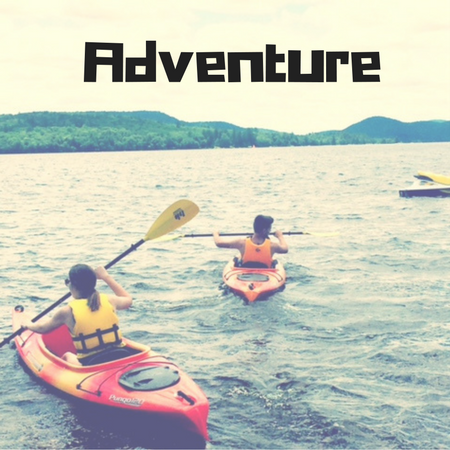
A Word for Summer: Adventure

Adventure. The word comes from the Latin advenire, “to arrive at, reach, arise, develop”, which evolved into the Middle English aventure, meaning “fortune, chance, occurrence, risk, enterprise, wonder.” The modern definition is “an exciting or remarkable experience”.  Have you done anything remarkable this summer? I have.

On a July afternoon, three families traveled to Indian Lake in the Adirondacks in search of adventure. We rented canoes (five of them… we were a big crew) and paddled across the lake seeking cliffs to jump off. The lake was wide, and the sun beat down on my legs.  Sometimes I dunked my hands in the cool water to splash myself and bring relief to my pink skin.  When we reached the opposite side of the lake, we puttered around some islands, consulted people passing by in a pontoon boat, and finally found the cliffs we were looking for:  huge chunks of rock, at least twenty feet tall, begging for swimmers to climb them. We pulled up to what little shore we could find, our metal canoes scraping against the rocks, and tied the boats to the biggest tree trunks in sight. Can I just say that it’s hard to gracefully exit a wobbling canoe? I don’t think I succeeded.

The kids scrambled into the woods, up steep paths covered in pine needles. Before I could summon up the courage to jump from a five foot rock, most of the teens and all the dads had jumped from a 20 foot cliff, shouting “Kachow” or lines from the Lego Batman Movie. (My children are mildly obsessed with this film.) I’m not much of a risk taker. I like structure, and I hate heights.  So I stood there, contemplating the jump, my heart pounding a little faster each time someone hurled himself off the cliff above me. I didn’t want to over think it. I wanted to do something bold. But, did I mention I don’t like heights?

Finally, I decided not wimp out and plunged into the lake from the top of the small rock.  The water was colder than I expected, the kind of cold that sucks the breath out of your lungs. But I did it. I climbed out of the lake with a smile on my face and ventured up to the high spot on the cliff so I could dry in the sun. Then daughter looked at me and said, “Mom, you should jump from here with me.”

Oh dear.

This is the daughter who finished her push ups before me in Cross Fit class and silently mouthed “I beat you.” The one who is reserved and independent, but that day, she wanted to do something with me. “If I can do it, you can,” she said.

I peeked over the edge of the tall cliff we stood on. It was a long way down to the water.  But she wanted me to go with her.

“It’ll be okay, Mom,” daughter said. “You get that tickle in your stomach at first, and then it’s fun. We should shout something, like ‘gingersnap cookies’.”

“I’m never going to get out ‘gingersnap cookies’,” I said.

“It’s farther down than you think, you’ll have plenty of time,” daughter replied. “Ooops. Maybe I shouldn’t have said that.”

I stared at the trees across the lake, knowing I had to take this leap, for me, for daughter, for the sake of adventure. I didn’t let myself think about the height.  “Let’s go,” I said.  My heart beat hard against the sides of my throat, but I ignored it.

Indian Lake
The view of Indian Lake from the cliffs. Sorry for the poor quality. We were focused on our adventure, not photography.

Husband counted us down… “One, two, three!”  Off that rock we jumped, falling down through the air longer than I expected. I tried to yell “Gingersnap cookies” but I only got to “Ging-” before I succumbed to a full throttle scream. My body hit the lake feet first, and I sunk down into the cold, dark water.  When I got my head together, I kicked to the surface and let out a satisfied hoot.  I had done it.

I got out, again smiling, and climbed up through the trees to the top of the cliff to warm myself in the sun.  Husband looked at me and said, “Now you have to go with me.”

Oh dear.

But I did.

I was the only Mom who jumped off of the high cliff that day, and I did it twice. Sometimes, it’s good to do something that scares you.

Which brings me back to my original question. Have you taken a risk yet this summer or done something remarkable? Hurry up… August will be over soon.

Happy adventure!



A Fun Quote for You

It’s a busy week, wrapping up the summer with an EPL soccer game and a visit to a good friend.  Yes, I said wrapping up even though it’s only July.  My kids start school at the beginning of August.  🙁

I received this as quote of the day from Goodreads and loved it.  Some days are just trouble, but we can still smile!


Translating Teen Speak: Meme

I have hit the age when I need to ask my teenagers to explain their vocabulary. I hate that I have hit this age. However, being a lover of words and an appreciator of adolescent wit and humor, I go ahead and ask my teens to translate their language and stoically endure the laughter and eye rolls that ensue.

One word that has caused confusion lately is “meme” (rhymes with beam). Being somewhat Internet savvy, I knew that a meme was a picture/pictures with a theme attached to it that circulates on the Internet. But it seems that’s not the whole story; my kids use the term in other ways.  In the past few months, we’ve heard these phrases in our family:

  • Upon receiving good news from me, eldest son texts: “That’s a nice meme.”
  • When husband walked around on the beach with his jacket hood pulled up, daughter said, “Stop it Dad, you look like the Hooded Kermit Meme.”
  • And during a road trip, apparently my daughter was “turned into a meme.”

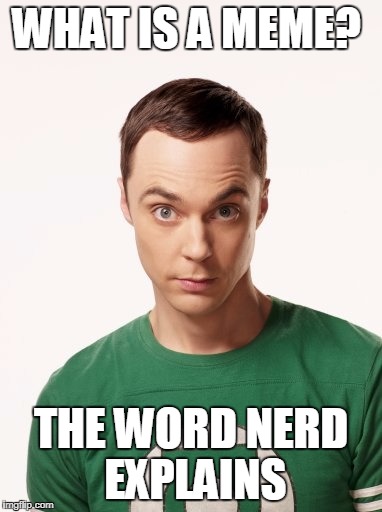
Does any of this make sense to you? Let the Word Nerd Explain. Apparently, the word “Meme” has become enough of a phenomenon that Merriam-Webster now features it in its online dictionary. It was a word of the day last week.

Meme \’mēm\ from the Greek mim meaning to mime or mimic

  • an idea, behavior, style, or usage that spreads from person to person within a culture
  • an amusing or interesting item (such as a captioned picture or video) or genre of items that is spread widely online especially through social media

Are you familiar with Grumpy Cat? That’s a meme.

The British scientist Richard Dawkins first coined this word way back in 1975 to describe a “unit of cultural transmission”. He wanted a single syllable word that sounded like gene. Dawkins wrote:

Memes (discrete units of knowledge, gossip, jokes and so on) are to culture what genes are to life. Just as biological evolution is driven by the survival of the fittest genes in the gene pool, cultural evolution may be driven by the most successful memes. — Richard Dawkins

Thank you Merriam-Webster and Mic.com.  Now, we can use this information to translate the phrases above.

  • My son’s response of “nice meme”: basically, it’s a compliment.
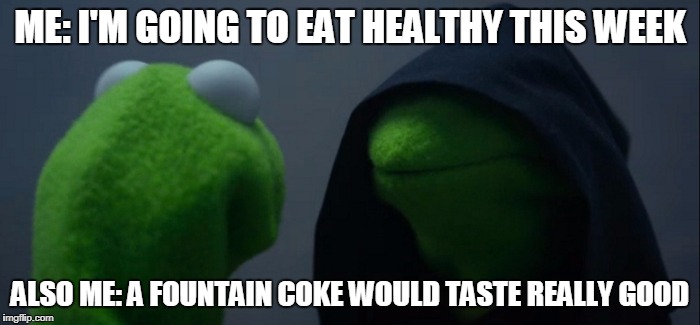
  • The Hooded Kermit Meme: a series of pictures of Kermit the Frog facing his evil Doppleganger dressed up like a Sith Lord. The pictures usually feature captions with a me/ also me theme, like “Me: I should study Also Me: But sleeping is a good option too.” The image originally appeared in the 2014 movie Muppet’s Most Wanted, but 19-year-old Anya Sudarkina used it to go along with a Tweet about the secret urge to steal cute dogs. The Tweet went viral, and Kermit and his evil twin have become very popular. Apparently, the meme appeals to the struggle between good and evil inside all of us.
  • My daughter got turned into a meme because her friends edited pictures of her and added humorous comments about her dietary preferences. (She’s a vegan.) They shared these pictures, or memes, in group chats.
My hooded Kermit meme, compliments of imgflip.com meme generator

Word Nerd Workout

Are you familiar with memes? Got any funny ones to share? How about other fun teen terms?

Don’t forget to visit Kathy at Bermuda Onion for the WWW meme!

If you love learning about new words, visit Kathy’s blog for Wondrous Words Wednesday, which is also considered a meme!  Bloggers share new words they’ve learned or fun ones they love.

Thanks for getting nerdy with me today!

Vocab from a Cafe: Bibble

Bakery

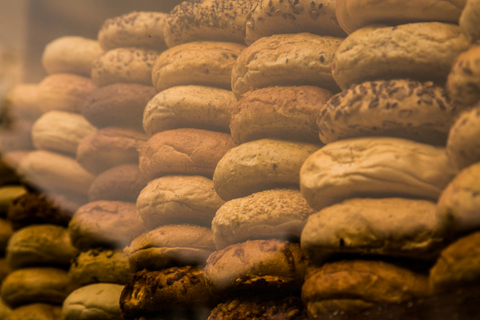
Photo Credit: Tony Webster via Flickr CC-BY

Last week while we were on vacation in the glorious Adirondack mountains of New York, my friend wore a t-shirt from a NYC cafe called “Bibble and Sip”. Besides having fun repeating the word “bibble”, I wondered what it meant. My friend’s daughters, who bought him the shirt, immediately shared the meaning of bibble and all the awesome pastries they tried at the cafe. They also mentioned something about alpacas…

Word Nerd Word

Bibble, verb from Middle English bibben, either from Latin bibō (“I drink”), from Proto-Indo-European *peh₃-, or of imitative origin.

  • To eat and/or drink noisily
  • To tipple.

Or

Bibble from Yiddish

  • To worry

Clearly, the cafe is going for the first definition.  There are definitely a few children in my house who bibble at the dinner table! What a fun word. On the Bibble and Sip website, visitors are encouraged to “BS All You Want”. Check out the website and menu to see some delicious looking desserts and pastries as well as lots of alpacas. Not sure why alpacas are such a big deal there.

Thanks to the Klingenettes for the Word Nerd inspiration and Your Dictionary for the help with word etymology.

Word Nerd Workout

Can you share a fun name of a restaurant you’ve visited on your summer adventures? Someday I hope to get to Bibble and Sip.

Thanks for getting nerdy with me today!


Vacation Reading Ideas

Preparing six people for an eight-day vacation is no small task.  There is laundry to wash, sunscreen to gather, and pet care to arrange.  But in the pre-departure hustle, I cannot forget to pack the most important items: books!

My book club will meet in July to discuss the highly recommended The Wright Brothers by David McCullough, so I’ll be taking that with me to the lake. Unfortunately, I haven’t even cracked open the cover yet; non-fiction does not excite me.  I’m the only person I know who did not like Unbroken and who, *gasp*, did not finish it.  This is why my book club helps me- if it weren’t for those ladies, I’d never break outside of my reading comfort zone.

So, the “magical account of the Wright brothers’ early adventures” will go in my suitcase, but I’m arming myself with back-ups, just in case. The Wright Brothers cover copy promises that it’s “concise, exciting, and fact-packed”, but I’m doubtful.

My “fun” vacation titles include:

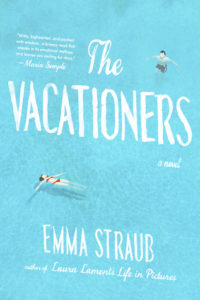
The Vacationers by Emma Straub.  I saw this at Target and picked it up because it is the same color as Where’d You Go Bernadette (one of my all-time favorites) and has people swimming on the cover.  The blurb on the back says it offers all the delight of a “read it with sunglasses on the beach read, made substantial by the exceptional wit, insight, and intelligence of the author.”

The Husband’s Secret by Liane Moriarty.   Ms. Moriarty’s books usually offer an appealing blend of humor, mystery, and insight, so I figure I can’t go wrong here.  I usually listen to her novels on Audible; I will miss the Australian accent of the reader.

Mosquitoland by David Arnold.  A blogging buddy recommended this YA novel a long time ago for its voice.  I’ve just finished two YA novels, Ultimatum and Trampoline, so I feel a bit guilty indulging in another, but hey, this is the genre I write, so I should “study up”, correct?

When I finally finish these books (that will surely not happen in a week; please be patient), I will of course share reviews of them with you.

Have you read any of these books, and if so, what did you think?  Can you suggest any other books good for beach reading?

Thanks for getting nerdy with me!


The Debate Between Who & Whom

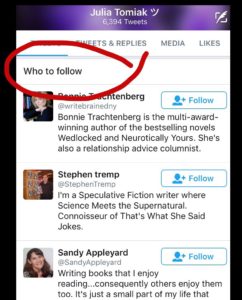
When a grammar issue causes a kerfluffle among Twitter users, this Word Nerd pays attention. Let’s see if you find a problem with this phrase commonly seen on Twitter:

Twitter who to follow
Have you seen this when you’re on Twitter?

Twitter (as well as Instagram, Facebook, and other social media platforms) often suggests users to follow, but sadly, the social media giant is promoting bad grammar. If Twitter wanted to stick to proper grammar, it would give you suggestions for “Whom To Follow”. Here’s why.

When to Use Who vs. Whom

Who

When the word is the subject of the sentence, who should be used. For example

  • Who is going to the party?
  • Who wants some pizza?

Whom

When the word is the object of a preposition or a verb, whom should be used, for example:

  • With whom are you riding to the party? (whom is the object of the preposition with)
  • For whom the bell tolls (whom is the object of the preposition for)

If you’re not sure, you can use a substitution test similar to the one I recommended in my post on when to use I vs Me. Try substituting the pronoun he or him in the sentence and see which one makes the most sense. If he sounds right (he is a subjective pronoun) use who. If him sounds right (him is an objective pronoun) use whom. (They both have “m”s!)

For example, if you’re wondering about the right way to say Who is this cupcake for?, flip the question into a sentence and sub in either he or him.

  • The cupcake is for he vs. The cupcake is for him.

Which sounds better? The second one, using him, because him is the object of the preposition “for”. So the correct form of the question is Whom is this cupcake for?

The Battle between “Whoms and Whos”

Should Twitter suggest “Whom to follow” instead? Most people think that sounds stilted and old-fashioned, which is why “Who to follow” remains. After all, the Internet isn’t known for sticking to rules of grammar, spelling, or punctuation, LOL. 😉  Perhaps “whom” may eventually fall in company with “thou”, which we mostly see these days in the King James Bible or Renaissance texts.

However, die-hard grammar lovers are fighting to save “Whom”. Thomas Steiner, a systems engineer at Google, created a browser plug-in that automatically corrects who to whom when appropriate. And British scriptwriter James T. Harding runs a Facebook group called the “Whom Appreciation Society”.  They think Twitter should stick to proper usage.

Me? I’m embarrassed to admit that I never had a problem with Twitter’s “Who to Follow” until I read the WSJ article “The Bell Tolls for Whom” that inspired this post. I suspect “Whom to follow” would seem too snobby and formal for most users. And the Ghostbuster’s Theme song would sound awfully strange if they changed the lyrics to “Whom you gonna call?”

That said, I worry about the influence of the casual language on the Internet and in text messages. Will spelling and grammar become less important as everyone grows more accustomed to “Internet speak”? I’m afraid so. I think it’s critical to know proper usage, even if exceptions sound better in certain cases. And we should always strive for correct grammar in formal situations, like letters, emails, papers, and articles. Yes, I said emails. Maybe not the ones to your dad, but definitely the ones to your boss, coworkers, or clients.

Word Nerd Workout

Which word should you use in the following sentence, who or whom?

I was very upset to learn that my Aunt June, who/whom I loved dearly, was diagnosed with pancreatic cancer.

For a more detailed explanation of when to use who or whom, visit my post When to Use Who vs. Whom .

Where do you stand on the whom/who debate? Should Twitter stick to proper grammar? Or are you willing to throw grammar rules out the window for what sounds better?

Thanks for getting nerdy with me.