Running Quotes to Inspire

cross country

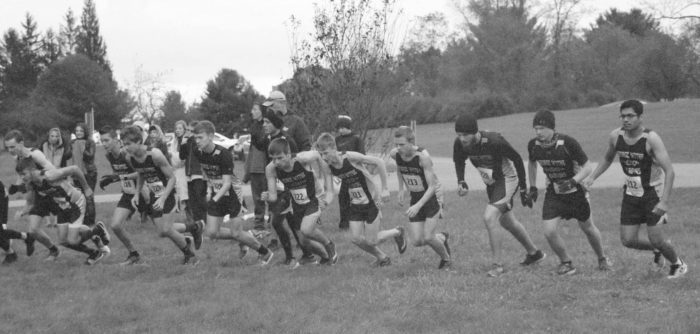
We are entering the last weeks of cross country season.  We’ve been training since June, running trails, climbing hills, and oh, my those 800 repeats.  It’s the final, and very important, stretch now, and my runners need some inspiration.  We’ve got regions on Thursday, and hopefully state the week after that.

Oh, the intensity at the starting line…

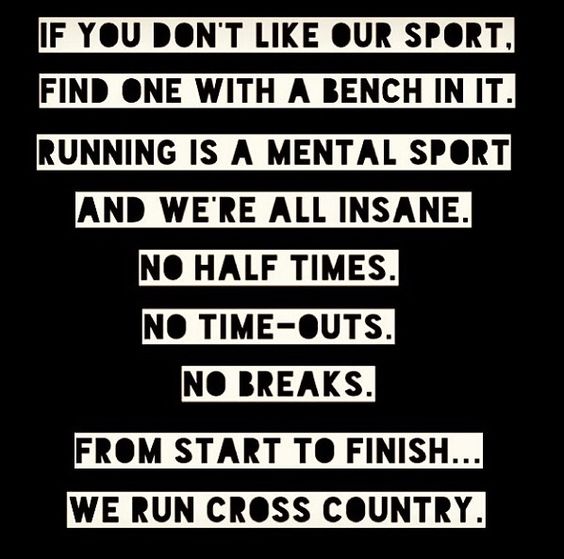
Can you help me?  I’m looking for some good motivational quotes, especially those about running.  Here’s what I’ve found so far.

Running quote - believe

running quote motivation

If you have an inspirational quote to share, please leave it in the comments.  And if you really like one of these, please tell me why.

Thanks for getting inspired with me!


How Bluetooth Got Its Name

In my family, we use Bluetooth connections a lot. I keep a Bluetooth speaker in the kitchen to listen to podcasts and tunes while I cook. The kids hijack the car radio via a Bluetooth connection to their phones. And hubby exercises with Bluetooth earbuds in his ears.

Have you ever wondered where the term “Bluetooth” comes from? It has nothing to do with teeth or the color blue. Instead, think Vikings.
Yep,  Vikings.

In the mid 1990s, tech companies were creating competing and non-compatible standards for wireless communication. Some people in the tech business worried that the fragmented approach to wireless would limit its use by the public. One such person was Jim Kardach, an engineer working on wireless technologies with Intel. He stepped up to serve as a mediator and brought companies together to create a universal standard for low power, short range radio connectivity.

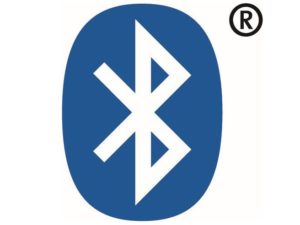
Bluetooth logo
Image credit Intel Free Press via flickr CC-BY-SA

While working on this project, Kardach was reading a book about Medieval Scandinavia and the Vikings. From 958-970 Harald Bluetooth ruled as the Viking King of Denmark. He was famous for uniting parts of Denmark and Norway into one nation and for converting the Danes to Christianity. Kardach borrowed his name as inspiration for the new wireless technology that would unite PC and cellular industries with a short-range wireless link.

The term “Bluetooth” was meant to be a placeholder, but it took off with the press and stuck. The Bluetooth logo is actually the initials of Harald Bluetooth written in Scandanavian runes.

For more background stories on tech names, visit PCWorld.com.

Word Nerd Workout

Did you know the story behind Bluetooth? What are some other tech terms you are curious about? Do you have any interesting terms to share?

Thanks for getting nerdy with me today!


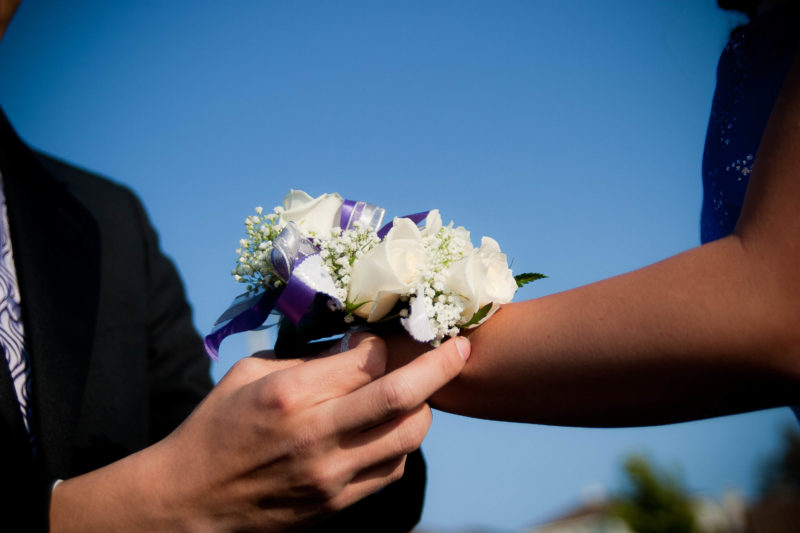
Vocab for Homecoming: Corsage

corsage

Photo credit: Varin via flickr CC-BY

The air is chill at night and the leaves are turning  red.  Yes, it’s fall, and if you live among teenagers, or if you are one, you also know it’s Homecoming season.  All the talk about spirit days and semi-formal dances prompted a question at our dinner table:  What the heck is a corsage?  (If this question reminds you of a High School Musical song, raise your hand!)  😉

corsage     \ kȯr-ˈsäzh  \ noun, from French, bust, bodice, from Old French, bust, from cors body, from Latin corpus

  • the waist or bodice of a dress
  • an arrangement of flowers worn as a fashion accessory on special occasions

People have worn flowers as accessories for many years.  The ancient Greeks wore flowers at weddings because they believed the pleasant scent of the blooms would ward off evil spirits.  Long ago, the bodice of a woman’s dress was called a corsage, and women typically wore flowers on this part of their clothing.  The French called this small, “wearable” bouquet of blossoms a “bouquet de corsage,” which eventually was shortened to corsage.

In the 1900s, women wore corsages on their shoulder instead of on the bodice of their dresses and usually pinned the flowers on upside down.  The tradition of giving a girl a corsage for a formal dance started in the 20th century.  When a boy picked up a girl for a dance, he would bring a gift for her parents.  Usually, this gift was flowers, and the boy would pull out a blossom  for his date and pin it to her dress.   Recently, with the popularity of spaghetti straps and strapless dresses, the corsage has moved to the wrist.

Thank you ProFlowers.com for this interesting history lesson!

Don’t forget to visit Kathy at Bermuda Onion for the WWW meme!

If you like to learn about the history of words, visit Wondrous Words Wednesday at Bermuda Onion.

If you’re interested in more Homecoming trivia, visit my post on the history of Homecoming.  

Do you have an interesting Homecoming tidbit to share?  Who knows what “boutonniere” means? 

Thanks for stopping by!


Teen Read Week: Don’t Get Caught

Teens Top TenLooking for a good YA novel? I’ve got just the thing. This is Teen Read Week, an annual event sponsored by YALSA (Young Adult Library Services Association) to encourage teens to use libraries and read more. The best part about Teen Read Week is the “Teens Top Ten” – teens vote for their favorite books from the year.  There are 26 nominees for 2017, and even though I’m just a few years too old to vote 😉 ,  I like browsing the list to find new books. Since I write YA, I need to read a lot of it too.

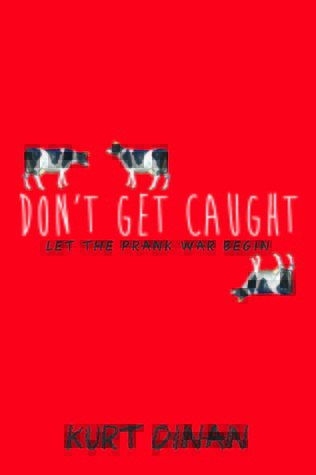
I was happy to see that Don’t Get Caught, a teenage “Oceans Eleven” heist story by Kurt Dinan, made this year’s list. My book club read it this spring, and we all enjoyed it.

Premise

Max Cobb, disdainfully referred to as “Just Max” by one of his popular classmates, doesn’t have  a life. He’s known best for passing out in front of the class in ninth grade and for scoring in the 49th percentile on the ACT three times in a row. But one day, Max receives a curious invitation:

10:00 TONIGHT AT THE WATER TOWER
TELL NO ONE

– CHAOS CLUB

The Chaos Club has a long and notorious history for pulling off hilarious pranks at Asheville High School, including hacking the district’s website so anyone visiting was redirected to BarnYardLove.com. Even though his gut tells him it’s a bad idea, Max decides he’s tired of being “Just Max” and vows to become “Not Max” as he sneaks out of his house in search of adventure, or whatever The Chaos Club has planned.
At the water tower, Max finds a motley and unlikely crew of his classmates who also received invitations. They find another note, follow its directions to climb the water tower, and find themselves in police spotlights and quickly arrested for vandalism. A set up.  But Max doesn’t care, because the Chaos Club has started a prank war, and he’s ready to fight. Armed with a few key rules he knows from heist movies, Max and his companions launch a series of hilarious pranks and end up learning a ton about themselves and each other.

What I liked

Don’t Get Caught is clever, funny, and an enjoyable read if you need something relaxing. It’s got good messages too, about being true to yourself while stepping out of your comfort zone, and also learning to look beyond appearances and reputation.

I also like that Don’t Get Caught was published by Sourcebooks, an independent publisher located outside of Chicago that seeks to promote authors and their work in new and authentic ways.

Finally, if you flip the pages of Don’t Get Caught from front to back, you get to watch a cow do a cart-wheel. (Sourcebooks prides itself on finding new and creative ways to present media.)

Recommendation

If you enjoy a fun underdog story, try Don’t Get Caught. If you like “prank books”, I also recommend The Disreputable History of Frankie Landau-Banks (female protagonist) by E Lockhart and Paper Towns by John Green.

Notes on content

There is some “language” and innuendo, but overall, the content is mild.

Can you recommend another prank/ heist book? Better yet, were you involved in any pranks in high school? If you got an invitation from a “Chaos Club”, would you go? I think I could’ve been talked into some pranking in high school, depending on who asked me to do it!

Don’t forget to visit the Tens Top Ten to vote or get reading ideas!

Happy reading!



Vocab for Book Lovers: Marginalia

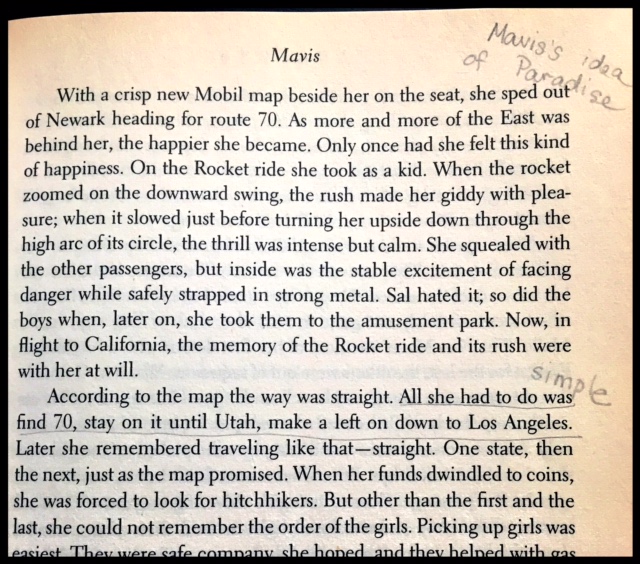
marginalia

Do you keep your books pristine, or do you, like me, prefer to interact with the text?  Do you dog ear and underline, or do you cringe when there is a crease in the binding?

Most of my family members embrace the pristine approach to books.  My oldest son has been known to carry novels around sealed in a zip-lock bag to prevent damage.  My daughter just told me yesterday that she cannot read my copy of Mosquitoland because I dog-eared too many pages, and a dog-eared page is to her as repulsive as a ripped off cover.  In college, my husband wouldn’t even highlight in his text books!

marginalia
I have lots of marginalia in my copy of Paradise, by Toni Morrison, one of my favorite books.

I take care of my books, avoiding stains, tears, and bent covers, but I am a huge fan of “respectful notation”.   If I underline, it’s only in pencil, so that any marks can be removed and ink won’t seep through the pages.  I often write in the margins, but again, only in pencil.  All of this careful note making helps me absorb more of what I’m reading, and it’s fun to look back years later on my thoughts about a novel or textbook.  I love this passage from Poetry: A Survivor’s Guide.

Perform marginalia. Reading without writing in the margins is like walking without moving your arms. You can do it and still reach your destination, but it’ll always feel like you’re missing something essential about the activity.

And there’s the Word Nerd Word for the day: marginalia – there’s actually a term for my thoughtful scribbles!

marginalia plural noun from the Latin margin

  • marginal notes or embellishments, as in a book
  • nonessential items

Marginalia is a relatively new to English; its first known use was in 1819.  A related word, marginalize (verb), was first used in 1970.  Thank you, Merriam-Webster.

Don’t forget to visit Kathy at Bermuda Onion for the WWW meme!

If you like learning about words, visit the Wondrous Words Wednesday meme at Bermuda Onion.  There, bloggers share new words they’ve learned or fun words they love!

Word Nerd Confessions

Do you have marginalia in your books?  What’s your biggest book pet peeve?  Torn covers? Dog ears?

Now, I have to decide if I must buy my daughter her own pristine copy of Mosquitoland.  It’s such a good book, I think I will.  😉

Thanks for getting nerdy with me!


Protecting Freedom of Speech: Banned Books Week 2017

Graphic courtesy of American Library Association

If you pay attention to the news, you know that we are living in a world where we must balance the right of freedom of expression with the responsibility for respecting alternative viewpoints. When someone is murdered during a protest, as Heather Heyer was in Charlottesville, when the President of the United States suggests NFL players who exercise their right to protest should be fired, we must consider when, if at all, it is appropriate to set ground rules for public speech.

In this charged climate surrounding free speech, this week the American Library Association (ALA) highlights the danger of censorship with Banned Books Week. The ALA uses this annual September event to protect open access to information and the freedom of expression. It also upholds readers’ freedom to choose.

In honor of BBW, here are a few terms that I think Word Nerds and readers should know about:

  • Intellectual freedom: the American and democratic ideal that people should be able to hold, receive, and disseminate ideas
  • Censorship: the suppression of ideas that certain people or groups find offensive
  • Informed selection: an inclusive process, by which librarians, teachers, parents, and administrators gather information about materials and determine what is suitable for the readers they serve
  • Self-censorship: a exclusive process by which individuals or institutions try to deny access to or suppress ideas and information that they find offensive
  • A challenge is an attempt to remove materials from a library or school curriculum, based on the objections of a person or group.
  • A ban is a removal of materials based on the objections of a person or group.

Usually, individuals or groups challenge books with good intentions: to protect children.  However, according to the ALA’s Library Bill of Rights, parents should be the only ones with the right and responsibility to restrict access to reading material for their children, and only their own children.  I agree with this stand.

In years past, I have featured a book review of a banned book during this week.  My life has been a little crazy lately, so I don’t have a new review for you, but here are some links to some of those reviews, should you choose to exercise your right to “informed selection”.

Happy reading!