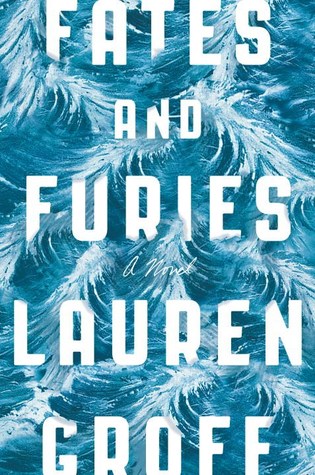
Have you ever picked up a book that’s gotten critical acclaim and fabulous reviews from people online, but by the time you reached chapter three you thought, “I hate this story”? That’s what happened to me, and most of my book club, when we read Fates and Furies by Lauren Groff. I’d seen so much raving about it in my writing circles, I recommended it for our reading list.
I ended up apologizing to my book club. Luckily they are a forgiving bunch.
 Premise
Fates and Furies explores the two sides of marriage between Lotto, a charismatic, aspiring actor, and Mathilde, a quiet, beautiful girl with a mysterious past. From the outside, Lotto and Mathilde’s relationship appears passionate and happy, yet secrets lurk. Broken into two parts, Fates and Furies presents the marriage from the perspective of Lotto first (Fates) and then Mathilde (Furies).
What I liked
Fates and Furies has beautiful prose, layered and complicated, yet easy to read. Groff uses unique, poignant descriptions to capture emotions and truths in brief but powerful language. Some examples:
- On grief: “She could feel the grief coming on fast, shaking the ground like a hurtling train, but she hadn’t been hit by it yet.” And later, “… they deposited her in the bed that still smelled like him. She put her face in the pillow. She lay. She could do nothing. Her whole body had turned inward. [She] had become a fist.”
- On marriage: “They had been married for seventeen years; she lived in the deepest room in his heart.”
These descriptions felt real and true for me, and there are tons of them throughout the novel. They kept me reading.
What I didn’t like
I need a character I can relate to or empathize with when I read a book. I couldn’t find one in Fates and Furies. Most of the characters are self-absorbed and conniving; many of them hide dark secrets. Only Lotto doesn’t try to manipulate the people around him, but that’s because he’s too obsessed with himself and his art to notice much else.
The characters do not have clear goals or objectives, and the story meanders, often jumping back and forth in time. It is a novel primarily concerned with character instead of plot, however, since I didn’t like the characters or see them change, this style didn’t work for me. I’ve seen Fates and Furies described as “Gone Girl with nicer people”. I disagree. Gone Girl is a thriller, with a plot driven, suspenseful story. The characters are just as manipulative and dysfunctional, but the plot kept me interested, at least until the ridiculously twisted ending.
Lotto, after failing as an actor, finds success writing plays. Groff includes snippets from his plays within the narrative. They add insight into Lotto’s mind and add depth to the themes and characters presented in the main story. They also provide allusions to Greek mythology. However, I didn’t enjoy reading them, and some of the book club girls skipped them all together.
There’s a lot of sex. I don’t mind love scenes, it is after all a story about marriage, and the love scenes in Fates and Furies aren’t graphic. But they are plentiful, and often not loving. Most of the characters use sex as a weapon of manipulation, as if sex can solve their problems. It doesn’t. In fact, it creates more.
The characters are haunted by mistakes from their past, even ones they made as children. In general, Lotto and Mathilde seem powerless to change themselves or to rise above their weaknesses. There is one small triumph near the end of “Furies”, but that seems inadequate compared to the darkness that precedes it.
Recommendation
I can only recommend Fates and Furies to writers looking for great examples of descriptive language. Or to anyone who would be attracted to a novel entitled Sex and Suicide, which was how one book clubber nick named this book.
If you’ve read Fates and Furies, what did you think? What’s another highly touted novel you’ve been disappointed in?
Happy reading!




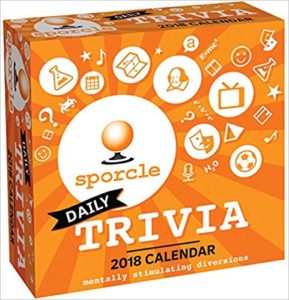 So my puzzler people had to endure boring January breakfasts without any math problems to stimulate their brains. I finally broke down and bought a Sporkle trivia calendar as a substitute, and it’s fun, but not the same. Thankfully, the same time I got the Sporkle, I got Match Wits with Mensa, The Complete Puzzle Book. It’s a two-inch thick volume with puzzles more like what we’re used to from the Page A Day Calendar. The cover claims that it is “the Omnibus edition with over 800 puzzles and brainteasers” which prompted a brainteaser of its own.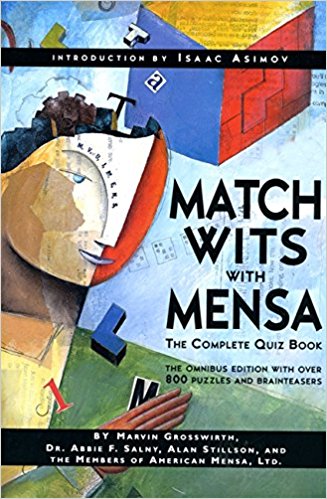

 We don’t have a Target or state of the art school buildings, but we do have something else: people matter here. I’ve seen many examples of this: when friends take care of my children during family emergencies, when people in the community clip and share photos of my kids from the local paper, when adults who aren’t related to my kids attend their sporting and academic events and send them notes of encouragement. Once, when my 15 year old daughter complained about how horrid our town is, I listed the names of 10 people outside of our family who care about her and pray for her.