Important words to know: pandemic and social distancing

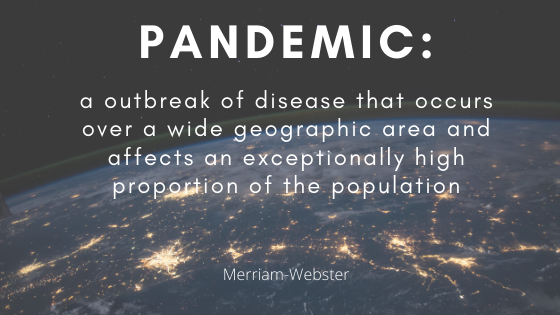
definition of pandemic

After a week of sobering news including university closings and the cancellation of the NCAA tournament, this Word Nerd decided a post on “the story behind trench coat” just wasn’t appropriate. (Although my 13 year old is still curious about it and so am I. Maybe I’ll hit that later.)

Instead, I feel compelled to explore some phrases we are hearing all too often these days: pandemic and social distancing.

Earlier this week, the World Health Organization declared the corona virus a pandemic and urged countries to take more aggressive action against the spread of the disease. To help explain the significance of this, let’s talk pandemic.

Pandemic comes from Latin pandemus, from Greek pandēmos of all the people, from pan (all) + dēmos (people). It describes an outbreak of disease that occurs over a wide geographic area and affects an exceptionally large number of people. (Merriam-Webster). It happens when a new virus or bacterium makes people sick, or when a virus or bacterium spreads rapidly, or both. Notable pandemics of the past include:

  • The Black Death, which killed approximately 75 million people (30-60% of Europe’s population) in the 14th century
  • The Spanish flu, (H1N1) which killed 100 million people worldwide from 1918-1920
  • The Avian flu (H1N1) 2009

While an epidemic is usually limited to a specific country or region, a pandemic crosses international borders. Experts believe increased travel and mobility and antibiotic resistance could cause more pandemics in the future.

In an attempt to subdue the spread of the disease, the CDC is recommending several precautions including “social distancing“, or “remaining out of congregate settings, avoiding mass gatherings and maintaining distance (approximately 6 feet) from others when possible.”

I must admit, a week ago, I was suspicious that social media and confusing messages from news sources and the federal government were causing unnecessary panic. After spending the past two days listening to podcasts and reading articles from reputable sources, I am now prepared to do my part to help stop the spread of this virus. I’ve stocked up on groceries, and my family plans to “lay low” for a while by avoiding places where it is easy to give and receive germs (the gym, restaurants, shopping). We expect schools to announce they will be closing soon; my 19 year old son is already home for an indefinitely extended spring break.

If you have questions or concerns about this new pandemic, I highly recommend the following (they are sources for this post):

How are you responding to the corona virus?

Thanks for getting serious with me,

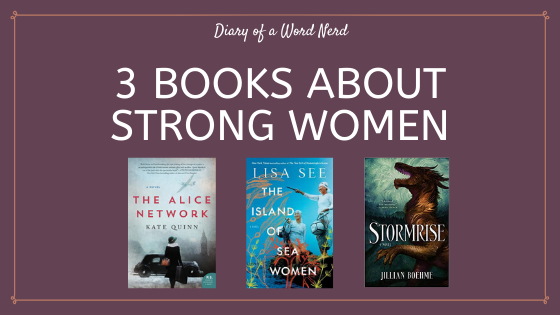
Three books about strong women

I like a good, strong female protagonist. There’s something about a girl exerting physical, mental, or emotional strength that grabs my attention and makes me want to read on. Lucky for me, THREE of the past books I’ve read have had strong, interesting female leads, and you should seriously consider reading about them. It’s Women’s History Month after all. Read about some awesome women!

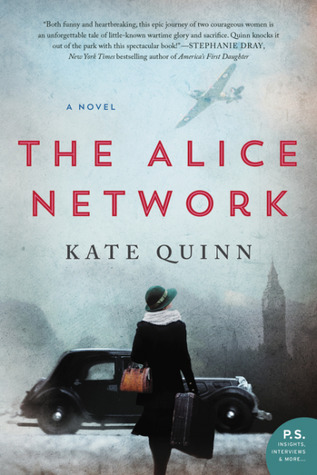
The Alice Network by Kate Quinn

Cover of Alice Network

In the aftermath of WWII, a young American socialite, Charlie, seeks the help of a former British spy, Eva Gardner. The story is told in two narratives and opens with Charlie who is visiting Europe in 1947 to “take care of” an unwanted pregnancy. While she’s so close to France, Charlie’s determined to find her long lost cousin Rose, who no one has heard from since 1945. Charlie enlists the help of the mercurial Eva Gardner, who has mangled fingers and a nasty drinking habit. As Charlie’s story develops, Eva’s unfolds, and we learn about how she was recruited to spy for the Alice Network in France during WWI.

An Alice Network did actually exist, and it was awe inspiring to read about the courage and sacrifice of the women who put themselves in grave danger to gain information for the British government. The Alice Network is fascinating, and at times brutal, in its description of war time atrocities. Eva’s character particularly intrigued me, and Quinn does a good job of presenting a conflicted, intelligent woman scarred by violence and loss. I found Charlie a little whiny and less well developed. She spent too much time describing her feelings instead of letting readers figure it out. Despite that, however, The Alice Network is still a worthwhile read, especially if you like historical fiction.

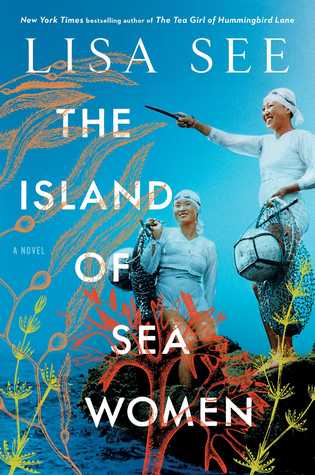
The Island of Sea Women by Lisa See

cover of The Island of Sea Women

The Korean island of Jeju, off the southern coast of the mainland, celebrates an unusual culture. For centuries, women called “haenyeo” have been diving into the sea to harvest food for their families with hardly any equipment besides goggles and flippers. The women exude incredible strength and resilience diving into cold water and holding their breath for up to three minutes. While they perform this difficult physical labor, their husbands stay at home to cook and watch the children. It’s a surprising flip flop of culture.

And yet, do the women really have more power? Many still cannot buy land or attend school or escape abusive husbands. The Island of Sea Women contemplates this as well as important themes of friendship and grief in the story of Young-Sook and Mi-ja, two girls brought together at a young age to learn how to dive in the waters around Jeju and how to navigate the very different lives they must ultimately lead. Spanning from 1937 to 2008, The Island of Sea Women explores the tragedy and loss of war, the power of deep friendship, and the futility of bitterness.

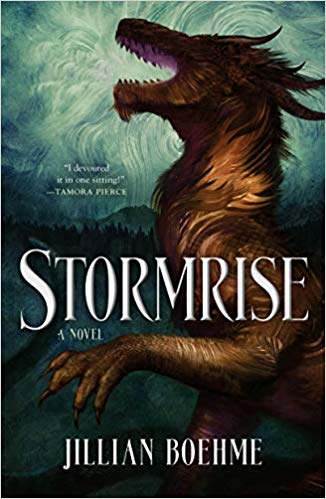
Stormrise by Jillian Boehme

Stormrise cover

This debut YA fantasy from Jillian Boehme tells the story of Rain, an excellent Neshu warrior who will never be allowed to fight because she’s a girl. When nomads invade her country and a draft calls one male from each household, Rain sneaks off to the army camps in place of her father, who is too old too fight, and her twin brother, who does not have the mental capacity to fight thanks to an illness he suffered as a child. Rain uses magical dragon powder to disguise herself as a boy, but the powder leads her to a powerful secret that could be crucial to fighting off the nomads.

Stormrise reminded me a lot of Mulan, but the dragons in this story are much more powerful and mysterious than Mulan’s sidekick Mushu. Rain must earn the trust of her fellow warriors, while hiding her true identity and figuring out if the ancient myths about the dragons could be true. The closing chapters of the novel had me up late reading as I was pulling for Rain to attain victory despite rapidly mounting odds against her.

Jillian Boehme has helped writers for years as “Authoress” on her website Mrs. Snark’s Victim. She regularly posts words of encouragement, insights into publishing, and opportunities to get feedback on work from agents via contests and critiques. If you are an aspiring author, please check out her book and her website!

Do you have a book with a strong female protagonist that you can recommend? I’d love to hear about it!

Thanks for getting nerdy with me!

More teen terms you should know

A fun and witty teacher I enjoy, who is a huge favorite among her students, recently lamented: “When I started teaching, I aspired to change lives. Now, after many years, I’ve realized I have neither vibed nor have I capped.” She shook her head and looked at me. “I don’t understand what they are saying anymore. What is vibed?”

I love working with teens and also often find myself perplexed and intrigued by their vernacular. Last fall, I finally figured out “yeet”. Before that, I had to learn meme. Today, this Word Nerd is proud to report that she just might have a handle on cappin’ and vibin’.

Have you heard these terms? When I ask my 16 year old son how practice was, he often replies, “Fine, ya know, we were just vibin’. ” (short for “vibing”.) My daughter announced some good news in our family group chat this morning, and 19 year old son replied, “No cap?”

For all you puzzled people out there, especially you, Jennifer, ;), here is an explanation of “cap” and “vibe”.

vibe/vibin’ (verb) (Urban Dictionary)

  • hangin’, doing nothing, chillin’, relaxing
  • listening to music
  • connecting with your surroundings
  • feeling cool or relaxed or into something deep
  • general state of enjoying or feeling good about a situation, person, place, or thing; can be used to describe interest in someone and like wise how they feel about you; can also be used to describe various levels of intoxication/pleasure from drinking/sex
  • Vibe check: when one person assesses another one’s vibe; can be friendly; can also be aggressive, like beating someone up if they say or do something stupid

So, if my boy tells me he was vibin’ at practice, he was probably just chilling out with his friends. (I assume no intoxication and/or sex were involved.)

cappin’/ capped/ cap (Urban Dictionary)

  • saying something that isn’t true; lying
  • showing off
  • short form of “high cappin” which was used in the 80’s to describe some one who lies about their social status or who flaunts brand new merchandise but is in debt

When “cap” entered our group chat this morning, and certain family members expressed confusion, I gave this Word Nerd explanation:

  • Are you cappin’ = are you kidding? no way!
  • no cap = no lie/ no joke; He makes awesome pancakes, no cap.
  • stop cappin’= stop lying/ bragging; Stop cappin’, you never even played basketball.

Some were impressed; some were disturbed. Hopefully you are now well informed. And Jennifer, I’m confident that you have positively affected the lives of MANY students, no cap. 😉

Wondrous Words Wednesday

If you like to learn new words and the origins of their meanings, visit the Wondrous Words Wednesday meme at Bermuda Onion. Each Wednesday, bloggers share new words they’ve learned.

Have you heard these teen terms and do you know how to use them? Are there others that still confuse you? I’d love to do some research.

Why do we have leap years?

Graphic: What's up with Leap Year

Last year, I published a post explaining some of the unusual attributes of my birthday month, February. I mean, it’s short and it’s spelled funny! What’s the deal? (Turns out, it has a lot to do with the Romans.) But I left out an important quirk about February – Leap Years! Since 2020 is a Leap Year, I figured Word Nerds would want to know how we got here. Turns out we can blame Leap Years on the Romans too.

Our modern calendar is 365 days long and is based on the Earth’s movement around the Sun. However, it actually takes the Earth 365.2421 days to orbit the Sun, and over time, not including that quarter of a day adds up. We add a Leap Day every fourth year to keep our calendar matched up with astronomy.

In ancient times, the year was based on the lunar cycles and actually didn’t include some months. In 46 B.C., Julius Caesar, ruler of the Roman Empire, revamped the calendar so it was based on the sun. This “Julian Calendar” included 12 months, 365 days, and a Leap Year every four years. However, an extra Leap Day every four years added an extra 11 minutes every year, which meant that by the 14th century, the calendar was 10 days off of the solar year.

According to History.com, in 1582, Pope Gregory XIII fixed this problem by modifying the calendar to include Leap Years every four years except for years divisible by 100 and not 400. The year 1900 was not a leap year because 1900 is not evenly divisible by 400. (1900 / 400 = 4.75) We use this “Gregorian calendar” today, although it still has problems that will need to be fixed. I’m also a little confused, because 2020 isn’t evenly divisible by 400. 2020 / 400 = 5.05. Guess that .05 is a negligible issue needing future correction?

What other calendar quirks does the Word Nerd need to explore?

Thanks for getting nerdy with me!

Love Yourself

Valentine’s Day can be a tricky holiday. If you are in love, it’s great. But if you don’t have a significant other, or you are currently unhappy with yours, all of the pink and hearts can make you feel lonely at best and queasy at worst.

How about this year, whether you have a great partner or not, let every heart and rose you see be a reminder of the very real need to love… yourself! Make sure kind thoughts and words are floating in your head and out of your mouth. Embrace what makes you fabulous and accept what needs improvement. Have a little bit of chocolate, but not too much, because you love yourself. 😉

Thanks for being kind with me!

Strive for balance

I’m currently listening to The Island of Sea Women by Lisa See. It’s fascinating historical fiction set on the Korean island of JeJu where women hold the power and perform dangerous physical work while the men stay at home and care for children. Shout out to Amy Makechnie for recommending it!

cover of The Island of Sea Women

I’ll have more about the novel’s exploration of the lives of women when I review the full book, but today, as we continue to debate growing climate concerns, I want to focus on the women’s attitude about the sea. The Island of Sea Women describes how a collective of women dives regularly in the ocean, without much equipment besides goggles and a knife, to gather sea creatures and plants to eat or sell. As the years pass by, and technology improves, their gear changes. But when some suggest they start wearing oxygen tanks on their backs to increase their safety and the lengths of their dives, the main character, Young-sook, and her diving companions refuse. Young-sook says:

Everything we do must be natural. Otherwise we’ll harvest too much, deplete our wet fields, and earn nothing.

The women of this book strive for a sense of balance. It governs how they interact with their world.

Imagine how different our world would be if we all practiced similar self-restraint, even when it meant sacrificing convenience, in order to maintain a sense of balance within our environment.

Thanks for imagining with me. Wait, maybe we should do more than imagine. Maybe we should practice some self-restraint in the name of balance right now! What do you think?