April is National Poetry Month, and if there ever was a good time to read more poetry, it’s now. While we shelter at home, it’s easy to drown ourselves in news, or binge watch Netflix, or lose hours in video game worlds. (Not me on the last one, but my youngest has spent much time preaching the merits of “Animal Crossing”.)
Since many of us have extra time, let’s spend it stimulating our minds and lifting our souls. Let’s read poems! The Academy of American Poetshas a page dedicated to “Shelter in Poems”, where readers share poems that help them find “courage, solace, and actionable energy”. Here are two of my favorites from that page. (Both are in the public domain, so I can quote them entirely. )
Invictus by William Ernest Henley
Out of the night that covers me, Black as the Pit from pole to pole, I thank whatever gods may be For my unconquerable soul.
In the fell clutch of circumstance I have not winced nor cried aloud. Under the bludgeonings of chance My head is bloody, but unbowed.
Beyond this place of wrath and tears Looms but the Horror of the shade, And yet the menace of the years Finds, and shall find, me unafraid.
It matters not how strait the gate, How charged with punishments the scroll, I am the master of my fate: I am the captain of my soul.
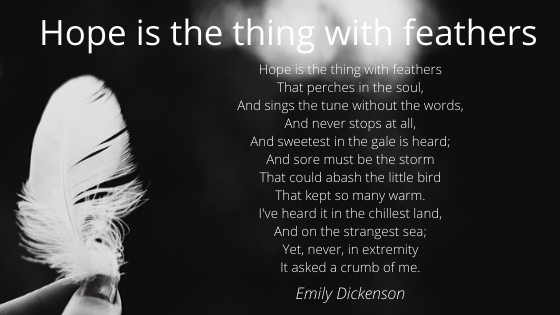
And here’s another one, by Emily Dickenson, that I’ve shared before, but it’s so appropriate, and a great one to memorize and meditate on, that I’m sharing again.
I hope you find these encouraging and inspiring. Stop by poets.org to find more Shelter in Poems. Poem in Your Pocket Day will be April 30 this year. Start looking for a short, sweet poem to share!
Where do you find solace and courage these days? Do you have any poems you can recommend?
I’ve been really frustrated this week. Thanks to COVID-19 and our need to stay home, there are no appointments to run to, no activities for my kids to attend. I should have more time to get things done…
But I’m not. And I have been extremely cranky about it. Ask the children.
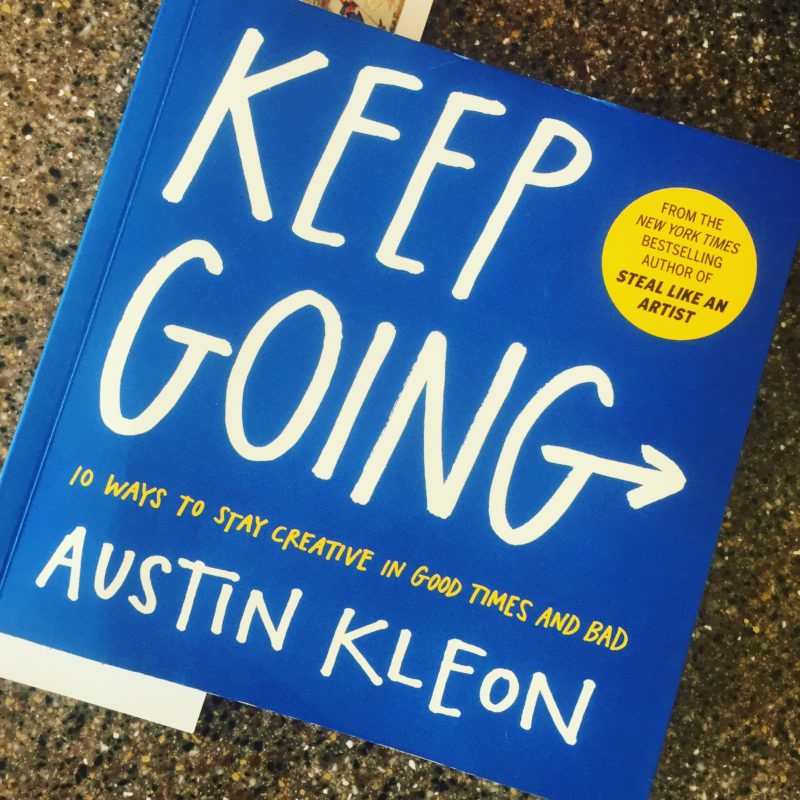
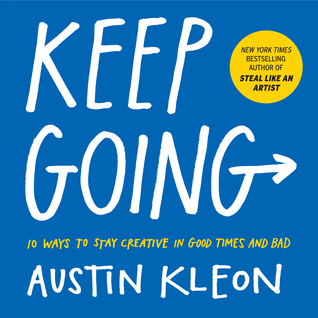
Thank goodness this was also the week I decided to finish Austin Kleon’s book Keep Going: 10 Ways to Stay Creative in Good Times and Bad. It’s a fun little book, literally, with lots of pictures and drawings, plenty of inspirational quotes, and, most importantly, concise advice about how to stay creative, no matter what is going on in life. Lately on social media, Kleon has been touting his book as the perfect manual for working from home, and he’s not wrong.
Keep Going is a bold font, five by five inch book I plan on keeping handy for reference and reminders- an easy, quick read to pick up when I find myself slipping down a slide of self-doubt and negative thinking. Keep Going shares ten tips for keeping our minds and souls open to the creative process. Kleon doesn’t just say what to do; he explains why it’s important and how to do it. My two favorites: “Forget the noun, do the verb”, and “Demons hate fresh air”. Want to know what those mean? Read the book!
The best message Kleon shared with me through the pages of Keep Going: I need to stop worrying about being productive, and focus instead on doing good things with my time. Things like turning off my phone, taking walks, observing nature, looking for interesting juxtapositions, and allowing myself to falter and change. I realize none of this sounds like earth shattering revelation, yet Kleon’s style is so fresh and succinct, he makes it easy to not just read, but also to actually live his very important message.
Practing photography is play, and it’s good for me, according to Kleon.
Here’s how Kleon closes his book, with words I need to memorize and repeat to myself daily!
Worry less about getting things done. Worry more about things worth doing. Worry less about being a great artist. Worry more about being a good human being who makes art. Worry less about making a mark. Worry more about leaving things better than you found them.
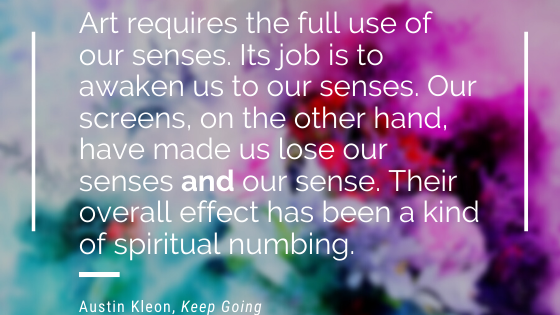
Austin Kleon, Keep Going
Keep Going doesn’t just tell me how to be more creative, it gives me permission to indulge my creativity, now and always, because it will help me be a better person. 😉
Keep Going is the perfect read for this time of quarantine. Its also a great gift. If you want to sample more of Kleon’s work, visit his website and check out his weekly newsletter. In it, he shares quick thoughts and links to cool things that inspire the senses. Through it I’ve discovered some interesting Spotify playlists and inspiring articles to read.
Are you familiar with Kleon’s work? What books and people inspire you to be creative in good times and bad?
More time at home means more time with my kids, which, I confess, I’m thankful for. The other day, I watched a video presentation my son made that I would never have seen if he was at college. So, that’s a plus during these crazy days.
More time with my kids (all teens and young adults) means more time for us to debate the hows and whys of doing things – the best way clean up the kitchen, the best way to manage screen time, and, this Word Nerd’s personal favorite, the best way to use grammar.
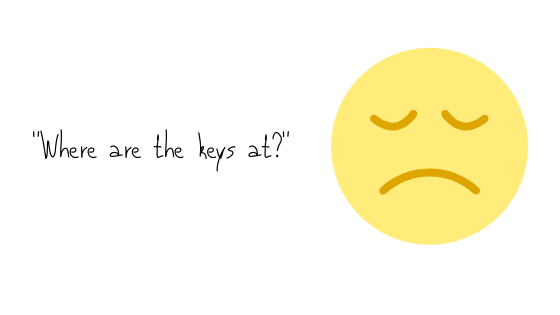
One of my children has taken to adding “at” on the end of phrases and questions. Like, “Where are the keys at?” It’s a common colloquialism here in southwest Virginia, and like “I might could do that“, it makes me cringe. Every time. Which is probably why he says it. But I still correct him, every time.
According to Merriam-Webster, the rule to not end sentences with a preposition started with the English poet and essayist John Dryden. In 1672, Dryden wrote an essay criticizing Shakespeare for using the “terminal preposition”. Dryden probably felt this way because Latin does not allow terminal prepositions, and at the time, many believed English should be structured more like Latin. This idea made it into grammar rule books and has been taught for centuries.
However, the folks at Merriam-Webster suggest that sometimes, ending a sentence with a preposition makes more sense than trying to avoid it. For example, “What did you step on?” is less clunky than “On what did you step?”. Or “I wish I knew where the cat came from” sounds smoother than “I wish I knew from where the cat came.”
If a preposition is unnecessary to convey the meaning of the sentence, leave it out. For example, in “Where are the keys at?”, the “at” is unnecessary. The question makes sense without it. Same for prepositions that appear in the middle of sentences. “The dog jumped off of the couch” can be more simply stated as “The dog jumped off the couch.” The of is redundant.
Prepositions that are part of phrasal verbs (verbs made from multiple words, including prepositions, like cheer up or log in) are appropriate at ends of sentences.
If the sentence is less clunky when putting a preposition at the end, go ahead and do that.
In formal writing, like a cover letter for a job application, stick to conservative rules so as not to offend a potential employer with what could be perceived as “bad grammar”.
So, according to Grammar Girl, there’s good reason for me to cringe when son says “Where’s it at?” It’s redundant, and that is what I will lovingly explain to him the next time he says it. 😉
What are some grammar habits that cause you to cringe? Let’s take a closer look at them!
More time at home means more time to read. But during these days of social distancing and sobering news about COVID19 from Italy and New York, I don’t really want to hunker down with sad historical fiction about WWII or a memoir about grief.
Fun and fantastical are definitely the way to go in these uncertain times, so I’ve compiled a list of fun and/or easy reads to keep your spirits up while you #stayathome. Click on the links to read my full reviews. I would LOVE IT if you would share similar titles in the comments. We can all use a smile, right? 🙂
Fun
The Rosie Project by Graeme Simsion. College Professor Don Tillman likes order, structure, schedule. Enter Rosie, who treasures none of these things. A fun read. (A blog reader said #2 in the series isn’t great, but #3 is.)
Where’d You Go, Bernadette, by Maria Semple. A hilarious and thoughtful story of an intelligent, talented woman who gets lost in motherhood and marriage- and how she finds herself again.
Yes, Please by Amy Poehler. Funny and insightful memoir from a successful comedienne. (The fam has been watching A LOT of Parks and Rec these days; I love, and often relate to, Leslie Knope’s slightly hysterical enthusiasm and compulsions.)
Year of Yes by Shonda Rhimes. Six little words from her older sister challenge Shonda to do the things that scare her. The result? A much happier Shonda.
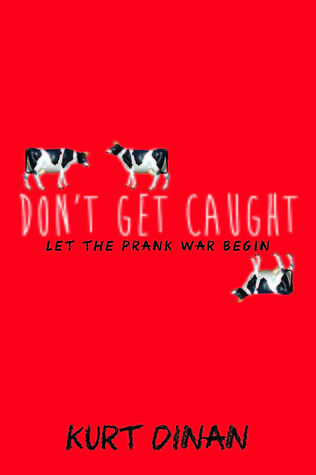
Don’t Get Caught by Kurt Dinan. “10:00 tonight at the water tower. Tell no one. -Chaos Club” When “just Max” – no social life, GPA 2.5 – gets this invitation, he knows he must be suspicious. He also knows he has to go. A fun YA prank book.
Artemis Fowl, by Eoin Colfer. A 12 year old (slightly) evil genius plots to steal gold from fairies. Very fun, and over the course of the serious, Artemis gets a conscience! (very witty kid lit)
Graceling by Kristin Cashore (from Goodreads: With elegant, evocative prose and a cast of unforgettable characters, debut author Kristin Cashore creates a mesmerizing world, a death-defying adventure, and a heart-racing romance that will consume you, hold you captive, and leave you wanting more.) YA Fantasy
Inspiring
“A handbook for working from home”
Becoming by Michelle Obama. An inspiring memoir about Michelle’s rise from a low income neighborhood in Chicago to Princeton and the White House. Empowering and optimistic. A must read for all young women.
The Audacity of Hope by Barak Obama. The former president wrote this memoir while serving as an Illinois senator. Explores the joys and challenges of public service, always with a pervasive attitude of hope.
Keep Going by Austin Kleon Artist/ writer Austin Kleon shares his formula for persisting with creative work. He has recently dubbed his book a “handbook for working from home.” Short, lots of quotes and drawings. 😉
What fun and uplifting books can you recommend? Please share in the comments!
During these upturned and uncertain days, let me suggest a fabulous Word Nerd Word: resilience. The news, especially reports from Italy, sometimes scares me, but as I tell my children, including the 19 year old college student who didn’t expect to be living at home this semester, this isn’t the first time our society has faced overwhelming challenges, and we must practice creativity and flexibility to survive this crisis too.
We must practice resilience.
My grandmother was born in 1914, and although she’s been gone for many years, I still remember her scolding me for wasting food or buying an unnecessary trinket at Winkie’s Variety Store. “I was a child of the Depression”, she would frequently chant, “and I learned not to be so wasteful!” She told me stories of how when she was a young mother with three children during WWII, she traded ration coupons with her unmarried sisters to get enough sugar and shoes to feed and clothe my mother and her siblings. To this day, even with all the toilet paper cleared from Walmart shelves, I have a hard time imaging rationing.
But, she did it.
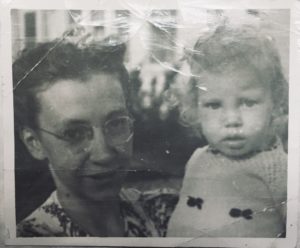
My grandmother and mother, circa 1945.
While reading great pieces of historical fiction, like The Alice Network, The Island of Sea Women, All the Light We Cannot See, I am awe struck by the horrific situations and enormous sacrifices that generations before us made in the face of adversity. Quite frankly, I’ve often thought our society has gone soft, that we would never be able to endure what our grandparents and great grandparents did.
Well, now we can prove ourselves.
Resilience comes from the Latin verb resilire, meaning “to jump back” or “to recoil.” In physics, resilience describes the ability of a strained body to recover its size and shape after deformation caused by physical stress. In everyday life, resilience means the ability to recover from or adjust easily to misfortune or change. I’m determined to be resilient in this crisis, to rise above the worry over lost opportunities and conveniences, to not be overwhelmed by nagging fears of lives shattered by illness and lost income.
Here’s how I’m embracing resilience:
I’m staying “informed” without becoming “obsessed”. I check
a few reliable news sources each day to learn the latest COVID developments. I
ask my husband for updates from the world of health care. And then I stop. I
could listen to podcasts for hours; I choose not to. When the shadow of fear
creeps into my thoughts, I unplug.
I’m focusing on the positives of this crazy situation. I have my all of my kids at home again. Yes, that means going through four gallons of milk and five bags of chips each week; it also means quality time playing games and taking hikes. And, all of those household projects I’ve been putting off because we were too busy running around? Well, let’s just say some weeding and window washing are in our future. And while I always use technology with a cautious hand, I am thankful that my iPhone makes it easy to check on my dad and see proof of life for friends and loved ones. I’m hopeful that maybe, the need for us all to pull together for the greater good will finally overwhelm the hostility and division that has dominated our culture for too long.
I’m thinking of my grandmother and what would make her, “a child
of the depression” proud. Hint: whining wouldn’t do it. Seeking ways to help
the people around me would.
Finally, I’m contemplating the words of C.S. Lewis, author
of The Chronicles of Narnia and Mere Christianity. In 1948, Lewis
published Present Concerns: Journalistic
Essays, which included the piece “On Living in an Atomic Age”. This essay was
written a few years after atomic bombs had been dropped on Japan and the world
faced a new conflict: The Cold War, but I think Lewis’s advice applies today. Just
sub in “corona virus” for “atomic bomb”:
In one way we think a great deal too much of the atomic bomb. “How are we to live in an atomic age?” I am tempted to reply: “Why, as you would have lived in the sixteenth century when the plague visited London almost every year, … or indeed, as you are already living in an age of cancer, an age of syphilis, an age of paralysis, an age of air raids, an age of railway accidents, an age of motor accidents.”
…In other words, do not let us begin by exaggerating the novelty of our situation. Believe me, dear sir or madam, you and all whom you love were already sentenced to death before the atomic bomb was invented…
…the first action to be taken is to pull ourselves together. If we are all going to be destroyed by an atomic bomb, let that bomb when it comes find us doing sensible and human things—praying, working, teaching, reading, listening to music, bathing the children, playing tennis, chatting to our friends over a pint and a game of darts—not huddled together like frightened sheep and thinking about bombs. They may break our bodies (a microbe can do that) but they need not dominate our minds.
After a week of sobering news including university closings and the cancellation of the NCAA tournament, this Word Nerd decided a post on “the story behind trench coat” just wasn’t appropriate. (Although my 13 year old is still curious about it and so am I. Maybe I’ll hit that later.)
Instead, I feel compelled to explore some phrases we are hearing all too often these days: pandemic and social distancing.
Earlier this week, the World Health Organization declared the corona virus a pandemic and urged countries to take more aggressive action against the spread of the disease. To help explain the significance of this, let’s talk pandemic.
Pandemic comes from Latin pandemus, from Greek pandēmos of all the people, from pan (all) + dēmos (people). It describes an outbreak of disease that occurs over a wide geographic area and affects an exceptionally large number of people. (Merriam-Webster). It happens when a new virus or bacterium makes people sick, or when a virus or bacterium spreads rapidly, or both. Notable pandemics of the past include:
The Black Death, which killed approximately 75 million people (30-60% of Europe’s population) in the 14th century
The Spanish flu, (H1N1) which killed 100 million people worldwide from 1918-1920
The Avian flu (H1N1) 2009
While an epidemic is usually limited to a specific country or region, a pandemic crosses international borders. Experts believe increased travel and mobility and antibiotic resistance could cause more pandemics in the future.
In an attempt to subdue the spread of the disease, the CDC is recommending several precautions including “social distancing“, or “remaining out of congregate settings, avoiding mass gatherings and maintaining distance (approximately 6 feet) from others when possible.”
I must admit, a week ago, I was suspicious that social media and confusing messages from news sources and the federal government were causing unnecessary panic. After spending the past two days listening to podcasts and reading articles from reputable sources, I am now prepared to do my part to help stop the spread of this virus. I’ve stocked up on groceries, and my family plans to “lay low” for a while by avoiding places where it is easy to give and receive germs (the gym, restaurants, shopping). We expect schools to announce they will be closing soon; my 19 year old son is already home for an indefinitely extended spring break.
If you have questions or concerns about this new pandemic, I highly recommend the following (they are sources for this post):