
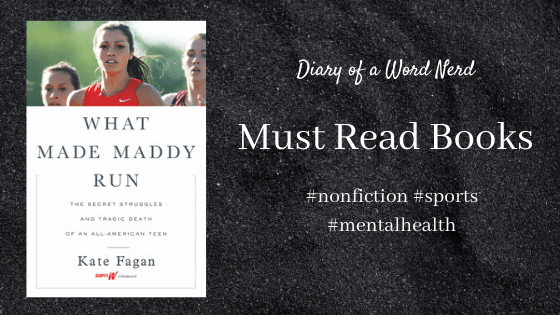
What Made Maddy Run is a challenging book to read in this time of pandemic and quarantine. But it’s important.
Madison “Maddy” Holleran was a superstar athlete and student from an affluent town in New Jersey. She had straight A’s, a beautiful smile, a reputation for winning, and an Instagram profile that documented her fabulous life. She was recruited to the University of Pennsylvania to run college track and cross country and started at U Penn in August, 2013, thrilled to be attending the Ivy League school of her dreams.
In January, 2014, after struggling for months with disappointment and depression, Maddy committed suicide.
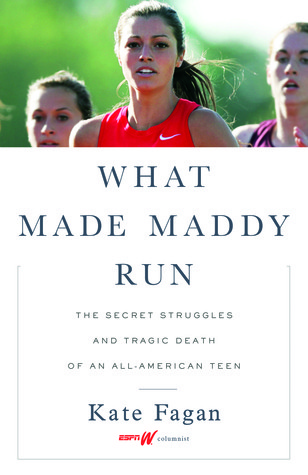
In What Made Maddie Run, sports writer Kate Fagan explores the forces, including depression, anxiety, and the pressure to perform in a social media driven world, that might have contributed to Maddy’s struggles. It is an informative and insightful look into college athletics, mental illness, and the challenges young adults face. Fagan uses interviews with Maddy’s friends and family, as well as information from Maddy’s interactions via text and email, to assemble clues about what Maddy was thinking and why she decided to take her life.
What I liked

I’ve long been concerned about the negative effects of social media and the excess of omnipresent, but shallow, connections it encourages. In What Made Maddy Run, Fagan explores the influence of social media on all of us, but especially teens and young adults. She says, “Comparing your every day existence to someone else’s highlight reel is dangerous for both of you”, and points out that while its easier to “stay in touch” via text, “efficient communication does not mean effective communication” and cites evidence that texting and interacting via Instagram and Snapchat do little to help people when they are in distress.
Here is a quote that spoke to me:
Very little of what we say in text is a literal representation of how we feel, what we’re doing, how we’re behaving. It’s an animated, easy to digest version, an exaggeration or a simplification, but not a reflection. And that would be fine, if it weren’t the main way we now communicate with one another.
Kate Fagan, What Made Maddy Run
Fagan also looks at the shift from high school to college and how the transition can contribute to stress, anxiety, and depression, especially for athletes. In high school, the steps to “success” are easy to see: get good grades, excel at sports, do well on the SAT, participate in volunteer and leadership activities. It’s exhausting, but not confusing. High achievers just keep reaching for the next rung on the ladder. But once students get to college, the ladder morphs into a tree with many, many branches. Choices are more plentiful, and progress is harder to track. It left a girl like Maddy Holleran, used to straight A’s and first place medals, overwhelmed and confused about who she was and where she fit in. Important things for me, the mother of a daughter transitioning to college this fall, to consider.
Finally, What Made Maddy Run looks at how our society has come to measure success in very narrow terms, and how that can negatively affect the physical and mental health of our children.
What I didn’t like
I listened to the audio book of What Made Maddie Run, which Fagan reads herself. While I could at times hear the emotion in her voice and could tell how invested she was in telling Maddy’s story sensitively, often her reading was stilted. Also, sometimes, Fagan digresses into comparisons into her own life, which included playing basketball for the University of Colorado, and while I suspect she intended to add dimension and legitimacy with these side stories, (she struggled as a college athlete too), I mostly wanted to hear about Maddy’s story.
Recommendation
What Made Maddy Run is a great book to read if you are a young adult who struggles with anxiety or depression or pressure to perform, or if you are the friend or parent of someone who does. It does not sensationalize Maddy’s suicide, but instead offers important things to consider and is a much needed conversation starter about the difficult, but very real, issue of mental illness and the influence of social media on our society. It is of course sad, (no surprise, I cried), so if you are feeling down during the quarantine, perhaps you should wait.
Have you heard of Maddy Holleran? Can you recommend other books that address mental illness, pressure to perform, or the influence of social media?
Thanks for getting thoughtful with me today.