Breaking news this morning: President Trump and his wife have tested positive for COVID and are currently in isolation at the White House.
White House Chief of Staff Mark Meadows confirms President Trump is experiencing mild Covid-19 symptoms, and affirms more health updates will come later in the day. https://t.co/nMEkOTKhPEpic.twitter.com/HUtj1NqumT
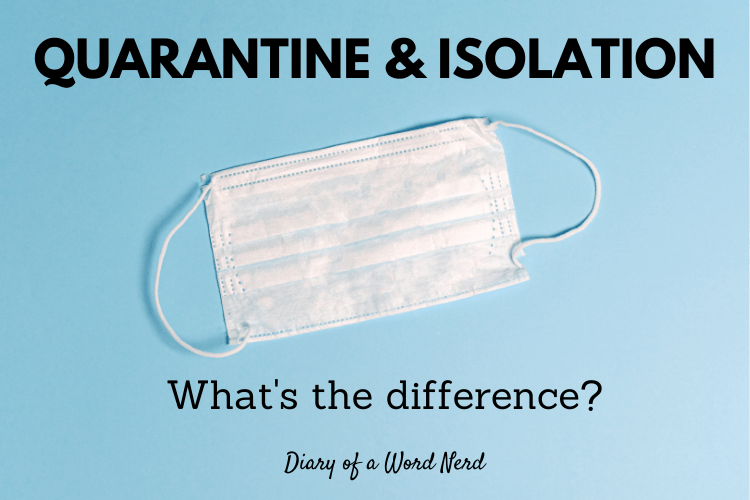
I don’t know about you, but for the past few weeks I’ve been muddling over the terms “quarantine” and “isolation”, which are so often used in the same sentence. This morning’s news prompted me to finally settle the issue.
Both quarantine and isolation are used to describe situations in which people separate themselves from other people to prevent the spread of illness. The difference in the terms has to do with the purpose and length of the situation, not so much with what each situation looks like. They both amount to the same thing: separation from others.
Isolation separates sick people with a contagious disease from people who are not sick.
Quarantine separates and restricts the movement of people who were exposed to a contagious disease to see if they become sick.
People go into isolation when they know for sure they are sick. They must stay away from other people for ten days from the day their symptoms developed OR from the day of their positive test result, AND fever has not occurred for 24 hours, AND other symptoms have resolved.
People go into quarantine after they have close contact with someone who is confirmed sickand are waiting to see if they develop illness. This usually involves waiting for test results and symptoms. It’s very important for people who have had exposure to COVID to quarantine for the full 14 days, even if they feel healthy, because the illness can take up to two weeks to show up, and because they can still spread the virus to other people even if they feel fine.
So, do you get the difference now? I hope so! What are some other terms floating around in the news these days that confuse you? I’d be happy to try and clarify.
The earliest I remember thinking about race was in high school. I had a close friend, who was white, and her parents told her she could never, ever date a black guy. So, she was only interested in dating black guys. I remember feeling that somehow her parents’ blanket disapproval of all black boys was wrong, but I don’t know if I labeled it racist. I should have.
Later, when I started college at UVA in 1989, racism became a more obvious issue. A pair of black girls from Philly lived across the hall from me, and I remember two things vividly: “Pump Up the Jam” blasting in their room, and the fact that one of them refused to speak to any of the white girls on the hall. She announced at a hall meeting early in the year that the white man had planted AIDS in Africa to kill the black man, and she had no desire to get to know any of us.
I was shocked. I never thought of myself as racist, yet this girl was calling me just that. How could she accuse me of racism and refuse to speak to me before knowing me at all? Her words and actions were hard to take, and yet they forced me to think about my race and the implications of racism more than I ever had before.
Her roommate, by contrast, entered into dialogue with all the girls on the hall. She explained how it felt to be the only black person in a room full of white people. She even offered to take us to a black party, so we could experience how it felt to be in the minority, if only briefly. None of us took her up on it. This girl was thoughtful and articulate, and yet I never took the time to get to know her. That was a waste.
Now, in the chaos of 2020, the topic of racism has captured my full attention. In the past thirty years, I’ve been concerned about racism – during the Rodney King trial, during Barack Obama’s campaign and presidency, while reading the novel Small Great Things, while following news about Colin Kapernick’s actions- but I’m embarrassed that I’ve never thought deeply about it and its implications until now. The Ahmaud Arbery case tipped me over the edge, perhaps because I love to run. I was horrified that an unarmed man out for a neighborhood run could be shot dead. As I watched the video of Arbery grabbing the shotgun pointed at his chest, I wondered what had happened to make him act so boldly. I wanted to learn more. The months that followed have only reaffirmed that reaction.
These days, I struggle with what to do, both as an individual and as a member of society, about racism. I marched for Black Lives Matter in June and personally thanked the 18 year old girl who organized the protest, but that hardly is enough. How can I meaningfully examine and act on this incredibly complicated issue? I can start by educating myself. That means consuming content from multiple and varied sources that overtly and subtly address the topic of racism.
Here’s what I’ve read/ listened to so far:
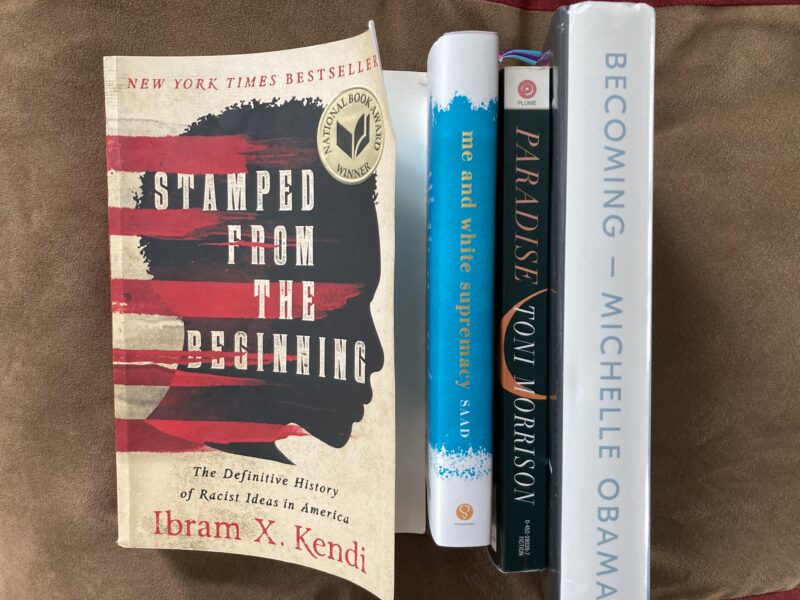
Becoming, by Michelle Obama. Memoir. Obama describes her rise from humble beginnings to Princeton, a job with a large legal firm, and a “swerve” to public service. Explores family, career, the balance between the two, and the desire to serve and have a positive impact on the world.
The Audacity of Hope by Barack Obama. Memoir. Written before he was president, the book describes Obama’s experiences as a senator and the challenges of creating meaningful change in a politically polarized environment.
White Fragility by Beverly DiAngelo. Adult non-fiction. Explores the social structures and attitudes that contribute to racism in America. Examines the reasons why white people have a hard time talking about racism.
Such a Fun Age by Kiley Reid. Adult fiction. Tells the story of a young black woman named Emira and how race complicates her romantic and work relationships.
Ghost by Jason Reynolds. Middle grade fiction. Castle Crenshaw, AKA Ghost, is excited to be recruited to a city track team, but he must figure out if he’s running for fun, or running from himself.
A Long Way Down by Jason Reynolds. Young adult. A novel in verse exploring a neighborhood shooting and how it affects the people involved, especially a young man on a mission to retaliate.
Paradise by Toni Morrison. Adult fiction. Morrison tackles complicated issues: the interactions between black and white, woman and man, outcast and chosen. It’s not an easy read, but it is a worthwhile one, especially these days. “So the venom is manageable now. Shooting the first woman (the white one) has clarified it like butter: the pure oil of hatred on top, its hardness stabilized below.”
Code Switch Podcast, NPR. Explores the impact of race on all parts of society: politics, pop culture, sports, health. It’s where I heard about Such a Fun Age and learned what “a Karen” is.
Next up for me:
Stamped by Ibram Kendi, and I got the Stamped: Racism, Anti-Racism, and You, a Stamped remix by Jason Reynolds and Ibram Kendi for my kids
Me and White Supremacy by Layla F. Saad
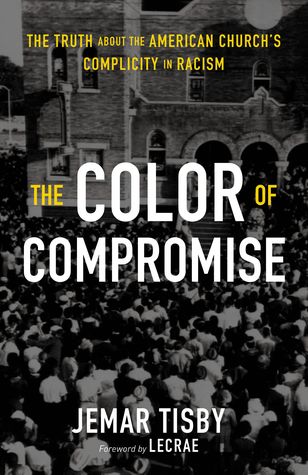
The Color of Compromise by Jemar Tisby
How are you responding to the national reckoning on racism? What have you read lately that has informed your opinions and understanding? Please share helpful and relevant titles below.
sedition /se·di·tion/ comes from the Latin sedition-, seditio, literally, separation, from sed-, se- apart + ition-, itio act of going, from ire to go. It means incitement of resistance to or insurrection against lawful authority.
So, basicially, Mr. Caputo suggested that scientists, specifically some working at The Centers for Disease Control and Prevention, are actively working against President Trump and undermining his authority. Mr. Caputo has since apologized for the accusations.
Regardless of how you feel about Mr. Caputo’s accusation of sedition, (I happen to think that scientists are being undermined in the current political climate and not the other way around…), at least now you can discuss any possible sedition with a word nerd’s knowledge. 😉
What words from current events have left you feeling confused? Please share… I’m happy to do some Word Nerd research!
A few weeks ago, I wrote about our need to preserve humanity in this difficult time of COVID. This morning, after getting a message from a friend who teaches and is frustrated with the judgement and complaining she’s hearing only three days into our unprecedented school year, I started thinking about the lack of patience and grace in our current society. Thanks to technology and Tik Tok, we have developed short attention spans and short tempers. We are good at offering criticism and bad at offering praise.
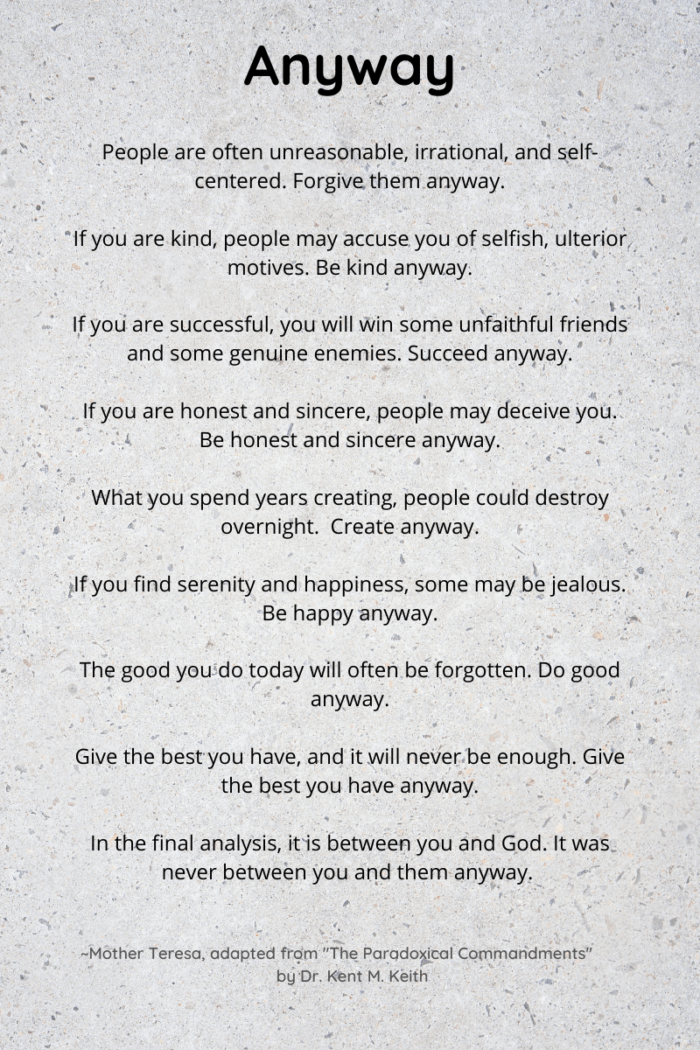
So, for all of the people who are working extremely hard in this crazy time to improve the lives of people who might not appreciate your efforts, I share these words. I always attributed them to Mother Teresa. After doing research, I learned “The Paradoxical Commandments” were written by Kent M. Keith in 1968 as part of a booklet for student leaders. A version of them was written on a wall in Mother Teresa’s home for children in Calcutta, and that’s the version I share here:
Thank you to everyone working hard, and do not despair. Your efforts are appreciated!
What words of encouragement can you offer to teachers, healthcare workers, essential workers, public servants, and leaders in these difficult time? Thanks for sharing!
It’s a little crazy around here this weekend. My youngest child is turning 14 (HOW did that happen?). My daughter is FINALLY packing to move in to her college dorm tomorrow. And I’ve got just a few things to do. So I will keep today’s post brief, with a valuable piece of advice from New York Times opinion writer Liz Bruenig: log off.
Bruenig recently appeared on the podcast The Argument to discuss the intersection of religion and politics in America, and at the end of the show, she offered a recommendation. She pointed out that while we need to be wary of untrue, misleading information on the Internet, we also need to be aware of the negative effects of too much truthful, and discouraging, information. She said,
“I don’t think we’re actually particularly well-designed to cope with getting news of the entire world updated every 10 minutes on a live stream… It used to be the sole province of God to know a full accounting of all the human evil that was happening at any given time. Now it’s the province of any Twitter user, and it’s a heavy burden. So log off.”
Elizabeth Bruenig
Excellent advice, right? How do you handle the onslaught of information we are exposed to each day, especially in the challenging time of corona? Share your thoughts… and then log off and enjoy your weekend!
On our weekly walks, my friend Leslie and I discuss everything from protests and the pandemic to the best way to keep floors clean when you have four children and several pets.
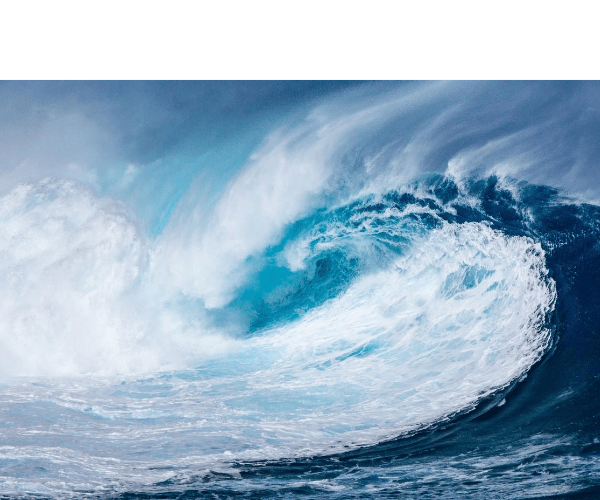
This past Wednesday we pondered Hurricane Laura. Leslie updated me on the seriousness of the storm, mentioning that weather forecasters predicted an “unsurvivable storm surge”. Which prompted each of us to wonder, what exactly is a storm surge? If you don’t know either, the Word Nerd is here to set you straight!
Storm surge should not be confused with storm tide, which is the total observed seawater level during a storm. Storm tide = storm surge + astronomical tide.
Many experts believe that in coastal communities, storm surge is a bigger threat than wind to individuals and their property. Usually, almost half of the deaths during hurricanes are caused by storm surge. This is because storm surge makes flooding worse. The rivers and other waterways that usually drain to larger bodies of water will flow backwards, or inland, with storm surge. And the water that comes in with the storm as rain or as storm surge has no where to go – so it stays, flooding the land and destroying whatever is in its path.
Several factors affect the size of a storm surge, including the geography of the land where a hurricane hits, the bathymetry of the area, the tide cycle, the track of the storm, and the strength, speed and size of the storm. For example, if a hurricane hits low lying land, like that in Louisiana, water from a storm surge will travel farther inland. And if a storm hits at high tide, there will be more water to push inland because the water level is already high. Bathymetry (another new Word Nerd Word!) describes the depths and shapes of underwater terrain. So, for example, in a place with a shallow continental shelf (again, Louisiana) the storm surge could be more severe than in a place with a steep continental shelf, like Miami, Florida.
Scientists also believe that climate change has contributed to the severity of storm surges. With the global rise in sea level, storm surges have gotten worse.
If you’d like to learn more about storm surge, or see more helpful graphics, visit these sites:
Are there any other storm/ ocean / meteorology terms you’d like to learn more about? Got something interesting about storms to share? Please add to the comments!