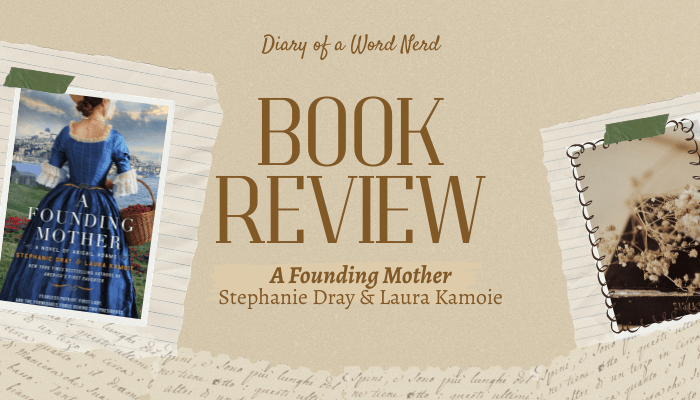
I’m a huge fan of Stephanie Dray. I’ve enjoyed several of her historical fiction books. Dray has a knack for digging up details about interesting women in history and making their stories relevant to modern readers. As a child of Virginia, I know a lot about Thomas Jefferson and George Washington. I attended Mr. Jefferson’s University and worked at Washington’s Mount Vernon as a high school student! Dray’s upcoming release A Founding Mother: A Novel of Abigail Adams gave me the opportunity to learn more about how this notable founding mother from Massachusetts shaped our country at its birth.
The Premise
A Founding Mother takes readers to the revolutionary setting of Boston in the 1770s. While Abigail Adams birthed and raised four children amid riots and calls for revolution, her husband John rose from country lawyer to one of the men trying to birth a new nation. Abigail demonstrated strength and wisdom during a harrowing time, and I enjoyed reading about her.
What I like
Dray and her co-author Laura Kamoie present Abigail’s story with engaging prose and just enough detail to hold reader interest without weighing down the narrative. I could relate to the woes and joys Abigail experienced as a mother. Physical and mental illness plagued her children, and yet she remained strong. Throughout the novel, Dray and Kamoie highlight the importance of quiet work performed in the background.
But without mothers, not one sprout would grow — whether the fruit be a child or a nation. It is mothers who nourish and guide each shoot toward the light without knowing what may blossom and what may wither on the vine. Without knowing which children will live or die.
I also admired Abigail’s fortitude as a wife of an important statesman. Her character states:
Party factions were tearing our young nation apart and it fell to my husband to hold this union together, alone if must be. Well, I resolved he wouldn’t be alone. He’d have me. I didn’t know how much I could help by charming ladies in the parlor or smiling at Hypocrites like Jefferson. But for John and for the country, I was willing to do this and much more.
After reading about Founding Fathers like Alexander Hamilton and Benjamin Franklin, who had strained family relationships and inappropriate connections with women, it was encouraging to learn about the faithful lifelong partnership shared by John and Abigail Adams. John relied on his wife for advice and trusted her with managing their family and property, especially when we was gone for lengthy trips to Europe for his country.
Finally, I enjoy learning about history because it deepens my perspective. Present perils and conflicts feel less scary when I view them with a wider lens. Conflict has always been a part of our country. Early in the novel, John Adams says, “Had I to snap my fingers and make things right, I would. But America is a great, unwieldy body. Its progress must be slow.” That statement rang true in the revolution and still does today.
What I didn’t like
A Founding Mother covers most of Abigail’s adult life, and therefore is long. Towards the end, after John Adam’s term as president, it started to drag for me. Reading about the tragic lives of three of Abigail’s children also wore on me as the novel wrapped up.
Recommendation
The publish date of May 5, 2026 times nicely with the celebration of America’s 250th birthday (see Word Nerd Word semi quincentennial) as well as Mother’s Day. A Founding Mother would be a great gift for moms or history buffs and fans of strong women.
Have you read this book or any others by Dray and Kamoie? What did you think? Share your thoughts in the comments.
Thanks for getting nerdy with me!






I don’t think I’ve read any books by Stephanie Dray! I’ll definitely be checking these out. I think Nana would love these too.