decimate \’de-sə-māt\ verb, from Latin decimus, tenth; to reduce drastically, especially in number; to cause great destruction or harm. For example,
German bombers decimated London during WWII.
Now, I realize a lot of you may know the meaning of decimate, but do you wonder how we got from the Latin root meaning “ten” to a word meaning “great destruction”?
According to Merriam-Webster, in ancient Rome, if a group of soldiers didn’t perform well, one tenth of their number would be executed to teach the rest a lesson. In fact, another definition of decimate is “To select by lot and kill every tenth man of.”
Pretty interesting, huh? I shared this tidbit with my seventh grader on the way to school, and later that day, his teacher saw me at a school event and said, “your son taught me something today!” She went on to explain the origins of decimate.
Have you ever read the final lines of a book and had the uncomfortable feeling that you missed something? Big?
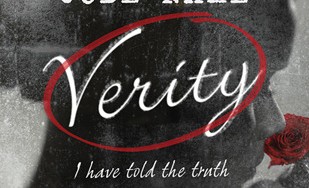
That’s how I felt when I finished Code Name Verity, by Elizabeth Wein. Agents and other writers have recommended it, and it receives fabulous reviews on Goodreads, but I almost gave up on it.
The Premise
Code Name Verity tells the story of two young women, who would never have been friends under “normal” circumstances,” brought together by the horrific events of World War II. They both contribute to the war effort for Great Britain, one as a pilot and the other as a spy. Unfortunately, both end up stranded in occupied France while carrying out a secret mission.
The book opens from the point of view of one of the girls; she uses many different names in the book, but let’s just call her “Verity.” She’s in a Nazi prison, writing her confession. But her rambling narration often left me frustrated and confused. I told the book club girls I was giving up.
“No,” they all said. “It gets better by page 200.”
Two hundred? That’s pretty far in. But I plugged on.
At page 200, the point of view shifts to Maddie, and she’s much easier to relate to. As she tells her side of the story, Verity’s confession makes more sense. Plot twists and surprises come to light.
Recommendations
Code Name Verity is definitely worth reading. Most of the reviewers on Goodreads are fearful to say too much about the book, worrying about spoilers, but I think these tips are helpful and not too revealing.
It’s great for anyone who enjoys historical fiction, strong female leads, or airplanes and flying (I don’t really care about airplanes or flying, which was another reason why the first half dragged for me.)
Despite Verity’s wandering narrative, remember that she’s a very bright, strong-willed character. And that she specializes in CODE. She has important things to share, even when it doesn’t seem like she is.
The book is set during WWII, and involves Nazi interrogation, so expect to be repulsed and sad at times.
It’s a powerful story of the sacrifices made by many people during WWII, sacrifices that many of us today have never had to consider.
As I mentioned earlier, I feel like I missed some important pieces to Code Name Verity; in particular, I had a hard time relating to Verity. I plan on rereading the first part, just to get everything I can out of the book.
Have you read Code Name Verity? Did you enjoy it? How did having two narrators hurt or help the story?
Welcome to Wondrous Words Wednesday, an awesome meme for word nerds hosted by Kathy at Bermudaonion.net.
I’m slow out of the blocks this week- the last few days of school have me running around frantic. Can you relate? Whew!
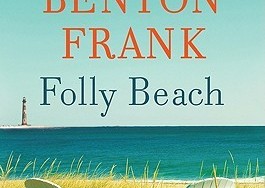
My word comes from the novel Folly Beach by Dorothea Benton Frank. It’s an easy summer read about a woman, Cate Cooper, who is reeling from her husband’s suicide. His “financial and emotional perfidy” leaves her broke, homeless, and looking for answers, so she returns to her childhood home, Folly Beach, South Carolina, to figure things out.
Note: perfidy was a WWW word a few weeks ago! Anyone remember it? Hint: treachery. Read: her husband was a jerk.
As Cate plans to return home,
“…I spoke to Russ [her son], who was perfectly sanguine as most men are about a parent coming to town.”
sanguine \’san-gwən\ adj. from French sanguin-, sanguis; consisting of or relating to blood, or marked by sturdiness, high color, and cheerfulness
From my experience with wound care as a physical therapist (NOT the part I miss), I knew sanguine meant bloody. But I didn’t understand how it worked in the sentence quoted above until I looked it up. I guess Cate meant that her son was cheerful about her plans to visit him.
Hope my sons will be sanguine about my visits in 20 years!
Word Nerd Workout
Think of a sanguine character from fiction or movies and tell us about him or her.
I just watched The Great Gatsby, so I’ll say that Jay Gatsby was the most sanguine character of that story; too bad his optimism was somewhat delusional.
Only five more days of school. Woo hoo! But I know that before our second day of summer vacation has passed, my kids will say, “There’s nothing to do.” Or worse, “I’m bored.”
I have the solution, and it doesn’t involve electronic devices. Instead it requires a trip to the library.
But what to get?
Last week was Children’s Book Week, sponsored by the Children’s Book Council and Every Child A Reader. Each year during book week, the CBC announces the winners of the Children’s Choice Book Awards, the only national book award program in which kids and teens pick the winners. Over one million voted this year!
To help you create an interesting stack of summer reading titles, let me share the winners from each category:
The finalists included The Duckling Gets a Cookie!? by Mo Willems, which is my personal favorite in this category for the year. You just can’t beat Mo’s humor and his strong-willed characters.
Looks like lots of dystopian and paranormal. The Mortal Instruments: City of Bones movie comes out in August. Guess I’d better start reading and get ready for the hype. Ooh. Love that red hair!
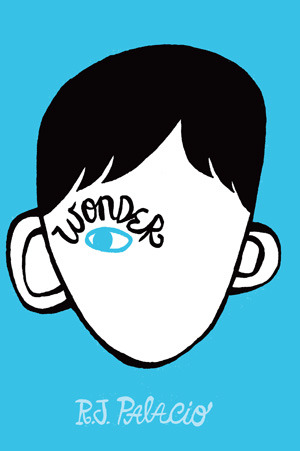
Other finalists included John Green, (my hero), Veronica Roth, and newcomer R. J. Palacio for Wonder. A fellow book nerd tells me it’s similar in theme to The Fault in Our Stars. A boy with a facial deformity must learn how to fit in at a new school. My two oldest read it and said it’s hilarious. I’m hoping to enjoy it soon via audible.
I hope this gives you some ideas for summer reading. Go to Goodreads and add them! To see the complete list of winners and finalists, visit www.bookweekonline.
Can you comment on any of these books? What have been some of your favorite books published over the past year? We all need suggestions, so please share.
Welcome to Wondrous Words Wednesday, a meme hosted by Kathy of bermudaonion.net. It’s a great way to learn new words!
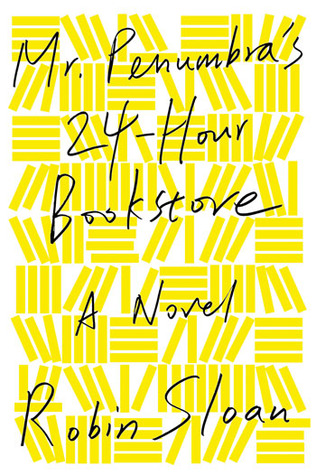
Today I’m sharing my last word from Mr. Penumbra. I could guess the meaning, but I wanted to know the etymology.
Cobwebs and dust coated the shelves of thederelictbookstore.
derelict \’der-ə-likt\ adj from Latin de- + relinquereto leave; abandoned, especially by the owner or occupant; lacking a sense of duty
Derelict can also be used as a noun: something voluntarily abandoned, or a person no longer able to support himself.
Word Nerd Workout
I’m including a review of last week’s word, erstwhile, since a lot of you were surprised by the meaning of that one! I’m so glad we can learn together.
Complete the analogy:
erstwhile : former :: derelict : _______________
Leave your suggestions in the comments, and go use some awesome words today!
Last week I mentioned my rapidly expanding TBR list. And I bet a lot of you are like me: you’ve got lots of things to read, and not enough time to read them.
Until now.
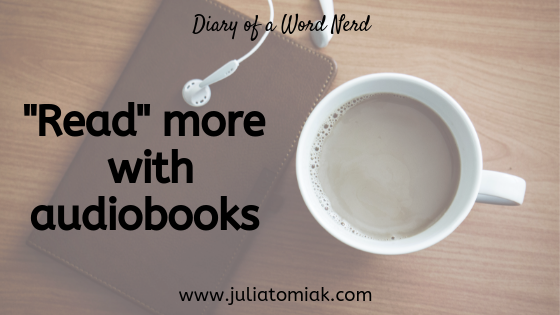
I have the solution to your reading dilemma. (Drum roll here): Audio books!
Benefits and Drawbacks
With an audio book, you can “read” a new book while you are doing something else- like driving, cleaning, running, etc. In the past year, I’ve started shuttling my kids to sports practice in another town. That translates to four-five hours of car time, at least, each week. I could listen to music, or I could listen to books! (I love it when I can accomplish two things at once!)
However, you are at the mercy of the reader. Most of the performances I’ve heard are excellent (everyone always raves about the Harry Potter audio books), but sometimes a reader can throw you off. I did NOT like Maximum Ride when I listened to it; my kids swear it’s the narrator. (I still think it’s the story, more action than characterization. Sorry James Patterson.)
Also, with an audio book, it’s hard to go back and “reread” key passages. I wish you could somehow make voice notes, like how you make notes on a Kindle.
Audio Options
Where can you find audio books? Here are some options:
The Library. (The cheapest option). I first started on the audio kick when I found Artemis Fowl on CD at our public library. Unfortunately, that was on the only book in the series that my library owns on CD; in general, our branch doesn’t have a huge selection of audio books.
Overdrive (Another cheap option). This system is linked to our public library and allows patrons to borrow e-books and audio books. However, it doesn’t support all listening devices (you can use an iPod touch but not a Nano, which I have), and, again, it has limited titles. If your library doesn’t use Overdrive, it probably uses a similar system. Ask at the circulation desk.
iTunes This worked because I own an iPod Nano, and I have lots of iTunes gift cards. However, for some reason, iTunes doesn’t have Artemis Fowl: The Opal Deception available in audio book, so I had to look elsewhere.
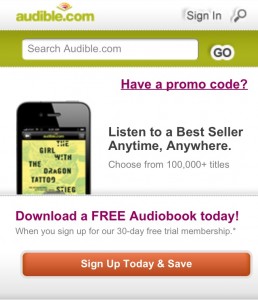
Audible.com This site, owned by Amazon (what isn’t anymore?), has the biggest selection of audio books I could find, as well as reasonable prices. They offer various membership plans. See below.
Audible Basics
If you want to start listening through that TBR list by using audible.com, there are three simple steps to follow:
Choose a plan.They offer a variety membership options, based on how many books you think you’ll listen to over a month or year. First time users can benefit from discounts, like the first month free. I tried Audible in the fall, thought I wouldn’t use it enough, and cancelled my plan without hassle. Now that I’m back, I’ve signed up for the Gold Annual membership. That’s twelve credits (one credit = one book) over one year, at about $12 per book. Most recently published audio books cost $20 or more, so that’s a pretty good deal.
Download the software. It just takes a few minutes to get the necessary software. Choose your preferences. Once you buy and download a book, you have it forever.
Start listening!
I recommend the Artemis Fowl series. Nathaniel Parker reads the story with style, using Irish, British, Scottish, and American accents to distinguish the characters. It’s also safe for all the ears in my car. I’ve also enjoyed The Giver and Mr. Penumbra’s 24-Hour Bookstore.
My friend Leslie wants to try to listen to The Lord of the Rings; I advised that it might put her to sleep. Don’t get me wrong, I love Tolkien, but it’s dense stuff. Next on my list: Wonder!
Honestly, Audible is not paying me to publish this post. I just want to help my fellow word nerds find ways to enjoy great books.
Have you ever used audio books or audible.com? Can you recommend any similar services or any other great books to listen to?

 Welcome to Wondrous Words Wednesday, the great weekly meme hosted by Kathy of Bermudaonion.net.