

Why You Should Keep a List of Books You’ve Read

reading log
The library summer reading log

When my kids turned in their summer reading logs at the library, the girl helping us asked, “Do you want to keep your reading logs?”

I shrugged.  Frankly, I find reading logs cumbersome.  I make my kids fill them out every summer because I know it helps the library get funding.

But then the librarian said, “I have a list of every book I’ve read since the beginning of high school.  It’s a long list.”

Maybe it was the competitive side of me that perked up.  Or that controlling girl who likes to keep up with details.  But suddenly, a book list sounded appealing.

We kept the reading logs.

Three reasons why you should keep a list of the books you read

  1. Pride  Let’s be honest, if you love books and pride yourself on your ability to consume them, it’s nice to have a comprehensive list of every volume you’ve read.  You’d have a record of all the classics and “must reads” you’ve devoured.  For this mama who spends a lot of time doing things that have no material proof (parenting, laundry, dishes), a concrete list of accomplishments sounds lovely.
  2. Accountability  Having a list allows you to analyse your reading habits.  Maybe you read more science fiction than you realized.  Perhaps you’ve read fewer classics than you thought.  A record can help you fill in some voids (yes, that includes some non-fiction or biographies) or not – but at least you’d have a clear picture of your reading choices.
  3. Recommendations  If you’re a book nerd and other people know it, chances are they will ask you for reading suggestions.  If you keep a list and add a few notes for each entry or use a rating system, you’ll be better equipped to help people find good stuff to read.

Have I convinced you yet?  Hope so!  But now…

goodreads home scan circledHow should a reader set up a list of books read?

For the technology savvy, I recommend a Goodreads account.  Using the site, or the Goodreads mobile app, you can set up a “Books Read” shelf and enter your books by:

  • using your mobile device to scan the ISBN number on the back of printed books
  • downloading your Amazon purchases
  • using the Goodreads search function
  • adding books manually

Goodreads prompts users to rate and review every book entered.  This helps users to remember details about books.  Unfortunately, with Goodreads, as well as most social media sites, you don’t own your content. So if Goodreads ever shut down, your list would disappear.

Another option is a file on your computer.  You would always have it, especially if you save it in a cloud like Dropbox or a program like Evernote.  My friend Rachel has kept a running list of our book club reads for years.  Thank you, Rachel!  However, sometimes digital devices and files aren’t handy.

That leaves good old pen and paper.  You could buy a pretty notebook at Barnes and Noble and record your books.  You’d always have a hard copy with space for notes and ratings. However, if your friend asks you for a mystery recommendation at lunch, and your notebook is sitting at home on your nightstand, you’re outta luck.

I haven’t mentioned a color coding system… Oh, the possibilities!

How do you keep track of books you’ve read?  What is the benefit of doing so?

Thanks for sharing your ideas!

Julia

Tweetable: 3 reasons why you should keep a list of #books you’ve read via word nerd @juliatomiak  #amreading

Vocab from The Book Thief: Vociferous

wondrous memeWelcome to Wondrous Words Wednesday, the meme for book nerds who want to improve their vocabulary.  Visit Kathy at Bermuda Onion for links to more challenging words.

This summer, Marcus Zusak has dominated my reading.  First, I enjoyed I Am the Messenger, a book many teens I know claim as “the best book I’ve ever read.”  Stay tuned for a review.

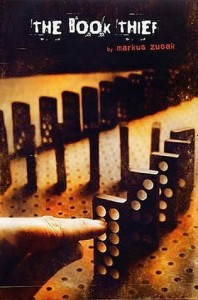
Now I’m reading The Book Thief,a novel about a girl who loves books but unfortunately lives in Germany in 1941 when the Nazis burned many volumes.  Zusak creates a unique spin on this World War II story with his poetic style and an unusual narrator (Death).

The Book Thief actually made my daughter cry.  She rarely gets emotional about books.  A wardrobe dilemma, maybe, but not books.

The Book ThiefSo I read with trepidation, because I frequently cry over books.  (Especially The Fault in Our Stars and The Time Traveler’s Wife).  I tried The Book Thief once before, in the dead of winter while I was postpartum.  I couldn’t finish it.  Too sad.  But now, I’ve promised my daughter I’ll read it so we can watch the movie together.

I’ve got tissues ready.

Besides giving me great imagery, Zusak also uses some fantastic vocab.  Here’s a sample:

He smiled loudest when the ring announcer listed his many achievements, which were all vociferously applauded by the adoring crowd.

Vociferous \vō-‘si-fə-rəs\ adj; from Latin vociferates, from voc/vox – voice + ferre to bear; marked by vehement, insistent outcry

Word Nerd Workout

Use vociferous in a sentence.  My example:

The teacher struggled to elevate her voice over the vociferous complaints of her students about the bathroom pass policy.

Thanks for getting nerdy with me!

Julia

Spread the word on Twitter: Word nerd word from The Book Thief: vociferous = marked by insistent outcry via @juliatomiak 

Vocabulary from Sherlock: Ostensible

wondrous memeWelcome to Wondrous Words Wednesday!  Do you ever come across words that you think you should know but don’t?  Wondrous words is the meme for you.  Visit meme hostess Kathy at Bermuda Onion to find links to tons of interesting vocabulary.

My entry this week comes from the T.V. show Sherlock.  My husband and I have recently discovered this series; it’s smart, fast paced, and the characters exchange brilliant quips. However, sometimes I have to pause and talk out the plot to make sure I’m following everything…

I can’t remember the exact quote from the show, but it was something like:

Hospitality is the ostensible reason for your visit, but I don’t buy it.

SherlockOstensible is one of those words I should know back from high school and the SATs.

ostensible \ä-‘sten-sə-bəl\ adj from Latin ostendere  meaning “in front of”, from ob- to show + tendere to stretch; intended for display; being such in appearance; plausible rather than demonstrably true

Aha!  I should have thought about the word ostentatious, which means showy.  Ostensible is all about appearances, not necessarily the truth.  (A perfect word for Sherlock.)

Word Nerd Workout

It’s back to school week here at our house; let’s get into academic mode.  Here’s an analogy for you to complete, which reviews a previous WWW word:

inchoate:imperfectly formed :: ostensible: ____________

Thanks for getting nerdy with me!

Julia

Spread the word on Twitter:

Tweet: Word Nerd Word: ostensible = intended for display. More at http://ctt.ec/Ze8v3+ #amreading #words

Vocab from Ann Voskamp: Carapace

wondrous memeWelcome to Wondrous Words Wednesday, a meme for sharing new words learned while reading or just some old favorites.  Visit Kathy at Bermuda Onion for more vocabulary boosters!

I’ve been slowly savoring Ann Voskamp’s One Thousand Gifts this summer.  Voskamp’s poetic and profound writing continues to amaze me, and I must absorb it in small doses.  Here’s a great example:

Do I believe in a God who rouses Himself just now and then to spill a bit of benevolence on hemorrhaging humanity?  A God who breaks through the carapace of this orb only now and then…

carapace \’ker-ə-pās\ noun; from the Spanish carapacho; a bony case or shield covering the back of an animal (like a turtle or crab); a protective, decorative or disguising shell (a carapace of silence around herself)

I’m guessing Mrs. Voskamp was using the second meaning.

1000 giftsWord Nerd Workout

Can you think of a synonym for carapace?  Everything that comes to my mind isn’t nearly as poetic, e.g. “shield”.

Thanks for getting nerdy with me today!

Julia 

Tweetable: Word nerd word from @Ann Voskamp & #OneThousandGifts : carapace = a protective shell. 


What Is a Split Infinitive, Anyway?

Photo credit:  pancit tinola; https://www.flickr.com/people/kwein_01 CC-BY
Photo credit: pancit tinola, 2009, https://www.flickr.com/people/kwein_01 |CC-BY| via Wylio

A good friend of mine got chastised for using a split infinitive in one of his comments at a board meeting.

I admit to silently correcting grammar, but I would NEVER rebuke someone in a public setting! How tacky.  It’s stuff like this that gives the grammar conscious a bad rep.

Besides being appalled at my friend’s predicament, I also was curious.  What is a split infinitive anyway?   I figured a word nerd should know this.

For the answer, I turned to one of my favorite podcasts, Grammar Girl, hosted by Mignon Fogart as well as my desktop reference, Grammatically Correct.

First you must know what an infinitive is.  If you’ve tried to learn Spanish, I bet you know this. The infinitive is the unchanged form of a verb, and in English there are two forms:

  • Bare infinitives, like
    •  eat
    • sleep
    • fly
  • Full infinitives, like
    • to write
    • to read
    • to illustrate

When a writer or speaker puts another word, often an adverb, between the two parts of the full infinitive, he splits the infinitive.  An often cited example comes from Star Trek: 

To boldly go where no man has gone before

See how the boldly jumps in between “to” and “go”?  There’s the split infinitive.  Here are some more examples:

  • It’s in our best interest to avidly pursue this financial goal.
  • Sara opted to blindly follow her heart and not the warnings of her conscience.

Since the Victorian Age language experts have advised against splitting infinitives: one can’t split infinitives in Latin, so one shouldn’t split them in English.  (Note: one can’t split an infinitive in Latin because it’s usually ONE WORD.)  The rule against split infinitives is a classic example of an old rule that sticks “just because” it always has.

glassesCheck out Grammar Girl’s post and the comments that follow, and you’ll see that even in the 21st century, people have passionate opinions about the placement of verbs and adverbs.  (Have you ever heard that an adverb should always come after a verb?)

Both Grammatically Correct and Grammar Girl advise against splitting infinitives in formal writing if you’re concerned about offending an editor or other important figure.  However, for modern writers and speakers, the most important consideration should be flow.  If rewriting a sentence to avoid a split infinitive makes the phrasing awkward and clunky, then split away!

Word Nerd Workout

First, find the split infinitive I’ve used in this blog post.  Second, write your own sentence with a split infinitive, and then a rewrite without it.  Which sounds better?

My example:

  • It’s in our best interest to avidly pursue this financial goal.
  • It’s in our best interest to pursue avidly this financial goal.  (Yuck!)
  • It’s in our best interest to pursue this financial goal avidly.  (Maybe?)

I still like the first option the best.

If you like to dive deep into grammar discussions, check out the Grammar Girl podcast.  I thought I knew grammar until I started listening.  Each information packed episode lasts about ten minutes.

Julia

Tweetable: Do split infinitives trouble you? Find out what they are & if they’re acceptable with @juliatomiak, Word Nerd


What Does Debrief Mean?

wondrous memeWelcome to Wondrous Words Wednesday!  If you like to learn new words, you’re in the right place.  Visit Kathy at Bermuda Onion for links to more noteworthy vocabulary.

We had a word nerd debate in our house last week.  My son said that he “debriefed” his friend about a party.

I know – what 14-year-old boy uses the word “debrief”?  Mine, thank you.  And I’m proud.

But, I told him I didn’t think he was using the word correctly.  “Couldn’t you just say you ‘briefed’ her about what happened, as in a briefing? Debrief sounds like the opposite of a ‘briefing’.

He insisted, in Tomiak style, that he was right.  His father joined him.

I pulled out the Merriam Webster app.

Two minutes later, I had to admit they were right, sort of.

Debrief \dē-‘brēf\ verb; first used in 1945

  1. to interrogate someone upon return (as from a mission) in order to obtain useful information
  2. to carefully review upon completion (debrief the flight)

My son was telling his friend about something he’d done; he wasn’t asking her questions.  But he argued that his use fit under the “to carefully review” definition.

I still say it’s not quite the right use, but no one is listening any more.

Did you note the year this word first started being used?  This is definitely a term of military origin.

Word Nerd Workout

Can you use debrief correctly in a sentence?  Better yet, let me know if you have word nerd debates in your house and which words inspire them.

Thanks for getting nerdy with me!

Julia

Spread the word on Twitter: Word nerd word: debrief = to interrogate someone upon return from a mission; more at http://wp.me/p2SvHJ-sQ via @juliatomiak