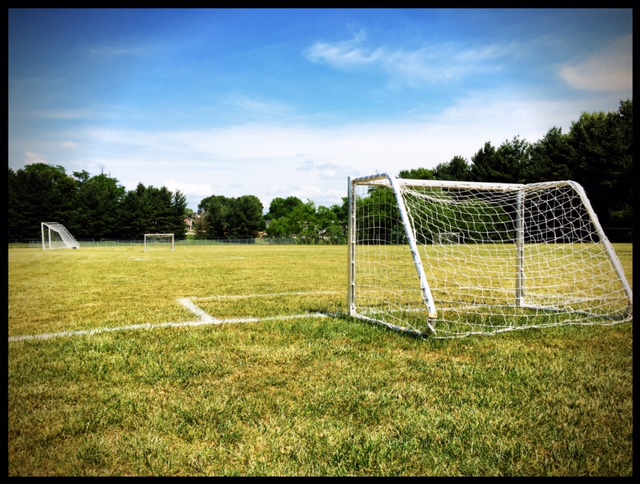


Look at that U8 energy! Photo Credit: Nancy Anderson 2014
The Word Nerd Word of the week comes from my energetic U8 soccer players. At practice Monday someone asked, “Where does the word ‘soccer’ come from?”
I couldn’t let that one go unanswered.
To read about more interesting words, visit Kathy and her friends at Bermuda Onion. You’ll find links to Wondrous Words Wednesday posts, and you can also contribute one of your own.
The term soccer has interesting history. According to an article in The Atlantic, historians can trace the basic game of soccer back to the middle ages. But official rules weren’t set until the late 1800s, when the sport gained popularity with aristocratic boys in England. In 1863, club leaders met in a pub to agree on official rules and form the “Football Association”.
Later, the term “Association Football” got shortened to “soccer”. The theory is folks at Oxford and Cambridge liked to put “-er” on the ends of words, but Associationer didn’t sound good, so they used “soccer” instead.
The term gained favor in the U.S. in the early 1900s to distinguish it from American football. British fans embraced the name “soccer” after WWII, when the influence of American culture was high. However, in the 1980s, the Brits started to reject the American term and use “football” instead.
The Atlantic story has more details and a cool map that shows what countries around the world call the sport we know as soccer.
Word Nerd Workout
Do you know the origin of the name of your favorite sport? Look it up and share!
Someday, when my persistence and hours of editing have paid off, I hope to tell you about the author event where Igot to answer questions and sign books.
I’m a total book nerd, but I’ve never been to a book signing. Not many entertainment celebrities visit Southwest Virginia. Kiera Cass is a graduate of Radford University and lives in the Christiansburg, VA area, so that’s how a best-selling author ended up at our local Barnes and Noble. And I got to see her!
The night of Kiera’s appearance, I picked up my daughter and a few friends from swim practice and rushed to B & N fifteen minutes before the event started. “It shouldn’t be too crowded,” I told the girls. We weren’t in New York City, after all.
When several young ladies wearing formal dresses passed us in the parking lot, I knew I’d underestimated the significance of the affair.
Selection fans dressed for the part
The staff inside Barnes and Noble seemed as befuddled as I felt. I bought The Heir, Cass’s newest release, and received a raffle ticket to hold my place in line for the book signing. Then I crammed into the children’s section with the rest of the fans. Tulle and sparkle collected in the main aisle, along with a few brave males. The guy in line in front of me carried a pink sequined bag, I’m assuming for one of his female companions. That’s a dedicated boyfriend.
My daughter and her swim buddies, sporting wet hair and t-shirts, abandoned me for the cafe. Daughter has read the series and finds it “girly and ridiculous”. She spent her time searching for Jane Austen novels. My sons, aged 11 and 8, avoided the glittery anticipation by playing with Nooks on display.
Promptly at six, a publicist introduced Kiera Cass. Those of us in the back stood on toes and strained to hear. Kiera is no taller than me and had to stand up on a chair to interact with her audience. Eventually, her husband/boyfriend jumped in to help with the Q & A. (Ha! My husband, King of the Introverts, would NEVER volunteer to take questions and make jokes for the crowd.)
Can you see her up there?
Kiera was friendly and fun, and it’s too bad the space wasn’t set up better for her to chat with her fans. Her favorite books are The Little Prince, The Book Thief and just about “any YA.” For Selection fans, she shared these tidbits:
There will be a fifth book
A studio has purchased the rights to make the books into movies, but nothing is definite
She has a project in mind to work on after she finishes the Selection series, but she wouldn’t give details. It will probably be a stand alone book.
More important to me, she gave the following advice to aspiring writers:
Read, read, read, even stuff you don’t like
Master grammar – your editor will love you
Make time to day dream – she said “Seriously, mark it on your calendar and allow for time to let your mind wander.”
When the Q & A ended, we organized ourselves into a winding line among the shelves. B&N staff gave away raffle prizes and handed out post-it notes for us to write our inscription requests on. It took over two hours for Kiera to sign all the books. Hello, hand cramps. Sadly, I had to leave at 7 and never met Kiera. (You know, four kids, hectic schedule, etc.) Fate placed me in line behind a woman I knew, and she graciously got the book signed for me. Yay for bookish mamas.
Here’s what the Word Nerd learned at her first live author event:
Get there early, even if you live in a small town
Plan to spend several hours
If you’re an author doing an event, bring a vivacious friend to work the crowd (Paula Hearne, this means you.)
Bring a portable speaker system and a safe platform on which to stand.
If you write kid lit, tip-off the librarians at the local schools about your appearance.
Have you ever attended an author event, either as a fan or an author? What did you learn? What was the funniest thing you’ve seen? What helps these things run smoothly?
National Poetry Month has ended, but I’m still reading a Poem-A-Day thanks to poets.org. Last week, the intriguing poem “Doha Thing Long Thought and Kind” by Alice Fulton appeared in my inbox. That piece, and the commentary that followed, sent me to my Merriam-Webster app for at least three words.
To find more interesting vocabulary, visit Kathy and her friends for Wondrous Words Wednesday at Bermuda Onion. Write your own post to share, and/or read everyone else’s.
First, let’s tackle the question that’s probably bothering you: what is a Doha? According to the poet, Alice Fulton, a Doha is a traditional Indian form featuring aphoristic couplets offering spiritual wisdom—sometimes in a dialogic, call and response pattern.
If you’re like me, you’re wondering – okay, and aphoristic means…? Aphoristic is an adjective describing a concise statement of principle or wisdom. (e.g., My grandmother often made the aphoristic observation: “It’s a great life if you don’t weaken.”)
Finally, dialogic means, as you can probably guess, relating to dialogue.
Would you believe I haven’t even covered the Word Nerd Word yet? Whew, this Alice Fulton lady has amazing vocabulary. That’s because she’s a poet!
Prodrome \’prō-drōm\ noun, from the Greek prodromospro- (before) + dromos (act of running)
A premonitory symptom of disease
So, in the poem, roses were a sign of something bad to come.
Word Nerd Workout
Can you use prodrome in a sentence? Here’s my try:
Only later did Lillian realize the unreturned phone calls were a prodrome for the demise of her marriage.
Follow up: My husband, a physician, used prodrome in casual conversation days after I published this post. We were talking about my son, who was suffering from the stomach bug. He’d felt nauseous for almost a day before he actually starting getting ill; my husband called that “a long prodrome”.
You know what I’d like for Mother’s Day? A week-long vacation to a secluded beach house. There, someone would prepare healthy meals and leave me alone to write, read, and exercise. I’m thinking yoga, hiking, and paddle boarding. After three days of solitude and relaxation, I might let my hubby join me.
Unfortunately, I won’t get that this year. Nor do I expect many of you can give it. But I do have some practical ideas for Mother’s Day gifts with a Word Nerd bent.
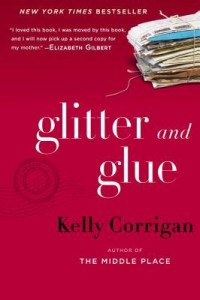
Glitter and Glue, a memoir by Kelly Corrigan
In 1992, Kelly Corrigan set off to see the world. A new college grad, she believed that “things happen when you leave the house.” After a few months, Kelly landed in Australia, broke and a little disheartened better “things” hadn’t happened. She took a job as a nanny for two young children who had lost their mother to cancer. The experience changed her dramatically.
For many years, Corrigan’s relationship with her mother was “adversarial but functional.” She says,
“When I was growing up, my mom was guided by the strong belief that to befriend me was to deny me the one thing a kid really needed to survive childhood: a mother… She looked at motherhood less as a joy to be relished than as a job to be done, serious work with serious repercussions.”
Corrigan’s experiences as a psuedo-mom caused her to rethink her attitude about her own mother. Her memoir uses crisp writing and fresh descriptions to share profound insights on the complicated job of motherhood.
I loved Glitter and Glue. It got me thinking about family relationships from multiple perspectives.
as a mother- am I too hard on my kids? Too practical, too distant, too blunt (like Corrigan’s mom)
as a daughter – My mom and I had plenty of arguments and miscommunications. Just when I was old enough to appreciate her (age 25), she died from a neurological disease. I wish I had as much time as Corrigan to learn to love and accept her mom while she was still living.
as a mother – will my daughter (age 13) ever appreciate me? Will she call me as an adult when she has questions? She currently shares a fair amount with me – thank God- but sometimes, our conversations sound like this:
Her: Nevermind
Me: How will I ever understand if you don’t explain?
Her: You just don’t get it
Me: (smiling ruefully, because I was 13 once, and I do get it) Hopefully someday you will get it.
Her: looks at me like I have three noses
When my daughter is old enough, I will give her this book. 🙂
I highly recommend Glitter and Glue for all mothers and for adult children.
Spiral Sudoku
My mother in law loves working Sudoku puzzles to keep her brain sharp. She recently pointed out that spiral bound puzzles are easier for her to handle. It made perfect sense- spiral books are easier to keep open to a page and to write on. A great suggestion from a smart lady. Here’s a spiral Sudoku at Amazon.
Don’t Sweat the Small Stuff for Moms, by Kristine Carlson
Years ago, in the child-bearing haze of my 30s, someone gave me Don’t Sweat the Small Stuff for Moms by Christine Karlson. It has short, inspiring chapters for moms with children of any age. Sadly, Don’t Sweat got buried in the “diaper days”, and I only recently rediscovered its treasures. I read a great piece the other night in which Karlson insisted that parents need to keep expectations and boundaries firm and clear for toddlers as well as teens. Talk about validation! The snippets offer the perfect soul food for the exhausted mother.
Can you suggest any other Word Nerdy gifts for moms this year?
Please add to the list! And for all you moms, Happy Mother’s Day. And for all of you who have lost their moms, you will have a special place in my thoughts May 10.
Last week’s post on the origin of “Hat Trick” prompted great discussion on Facebook, as well as the mention of another curious soccer term, the “nutmeg” or “meg” for short. If you think of nutmeg as merely a spice, I’ve got a revelation for you!
Sometimes when we’re playing soccer in the back yard, my eldest son sends the ball between my legs as I defend him. He shouts “Nutmeg!”,collects the ball, and shoots on goal. He’s not talking about cooking. The term is used when a player passes the ball between an opponent’s legs and maintains possession.
I hate getting nutmegged! When I defend, I try to keep my legs bent and staggered instead of wide open. But sometimes I forget. And get humiliated.
My dear friend Valerie thought the term might reference a hit to the “no zone” … you know, with the mention of nuts and all.
I’m here to clear up the confusion.
The Meaning of Nutmeg
There are several theories about the origin of the term “nutmeg”. Wikipedia says it comes from “tunnel,” (like a tunnel through the legs) and offers several words used for the trick in foreign languages, including
“Caño” or “túnel” in Hispanic America
“Panna” in European, Latin, and African countries (panna is a Surinamese word)
“Tunnel” or “Beinschuss” (leg shot) in Germany
“Petit Pont” (little bridge) in French
“Salad” in Jamaican English
Uh oh, that boy is about to get nutmegged!
The Guardian has a juicy story, thanks to the book Football Talk – The Language And Folklore Of The World’s Greatest Game by Peter Seddon. Seddon links the term to sneaky practices in the nutmeg trade in the 1870’s. Back then, nutmeg was such a precious commodity that traders would mix wooden replicas into sacks of nutmeg shipped to England. The term “nutmegged” came to mean being deceived and made to look foolish by a clever adversary.
The Guardian also shared some other suggestions, including the fact that “meg” rhymed with cockney slang for leg. Or the notion that “nuts” (another term for nutmeg in Northern England) references the nuts (testicles) of the player tricked by the move. So, Valerie, you might be right!
I like the trading story, myself.
Word Nerd Workout
Can you share another term from sports that has an interesting background?
A few weeks ago, I saw this sticker at my local library:
I’m already a self-proclaimed Word Nerd. Could I be a geek too?
My young friend Annika tells me that a geek is someone who obsesses about things like comic books, anime, or Sherlock. A nerd is someone with academic or intellectual interests and/or abilities. In other words, someone like me, who likes learning new things via the TED Radio Hour and Grammar Girl podcasts.
So, it seems possible that I can be a geek AND a nerd. I just don’t want to be a dork.
I was curious about this Geek stuff, so I checked out geekthelibrary.org. According to them, “to geek” is:
To love, to enjoy, to celebrate, to have an intense passion for.
To express interest in.
To possess a large amount of knowledge in.
To promote
Geek the Library is a non-profit promoting public libraries and encouraging funding for them. Their slogan “Geek the Library” reminds us that public libraries support all geeks, as well as normal people.
Public libraries play a critical role in our society by offering things like:
free public access to computers and the Internet
assistance with online job applications
help with homework or tutoring
special programing such as art classes, gardening tips, and music.
reading programs to encourage reluctant readers
resources and information on hundreds of topics
entertainment via books and DVDs
Many people are struggling because of the poor economy. Public libraries can fill in the gaps by creating a sense of community and providing valuable assistance.
They can’t do all this without funding.
Here’s where you come in.
Use your library to help you with what you geek.
Tell other people about available programs and resources at your local library.
Find out how your local library gets funding, and do what you can to help.
For example, I know my library gets money based on participation in the winter and summer reading programs, so I always sign up my family.
Get cool t-shirts and stickers from geekthelibrary.org that proclaim what you geek. (I’d like an “I geek books” shirt, myself.)
Share what you geek at the geekthelibrary site.
I proudly geek my local library, as well as books, soccer, grammar, and Tolkien.
What do you geek? What do you do to support your local library?