Vocab from Orphan Train: Pusillanimous

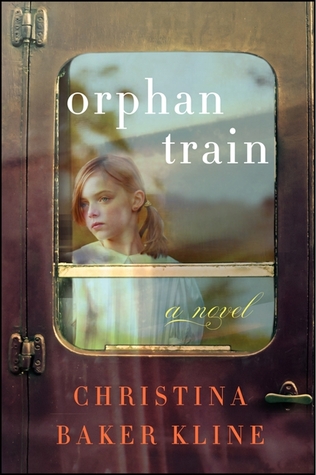
My book club is reading Orphan Train this month, and it’s a great novel for discussion. It also has a few words I had to look up, including pusillanimous. Whew, that’s a mouth full, isn’t it? I’ll include a pronunciation guide. 😉

wondrous memeIf you like learning new words, join the Wondrous Words Wednesday meme, where bloggers share interesting words or new words they’ve learned from their reading.

Here’s the quote from Orphan Train:

Ralph hovers, uncertain. As always. She knows he’s caught between her and Dina, and utterly unequipped to handle either one of them. She almost feels sorry for him, the pusillanimous wretch.

Pusillanimous \pyü-sǝ-lǝ-’la-nə-məs\ adjective from Latin pusillus very small (diminutive of pusus boy) + animus spirit

  • lacking courage and resolution : marked by contemptible timidity

from Merriam-Webster

Word Nerd Workout

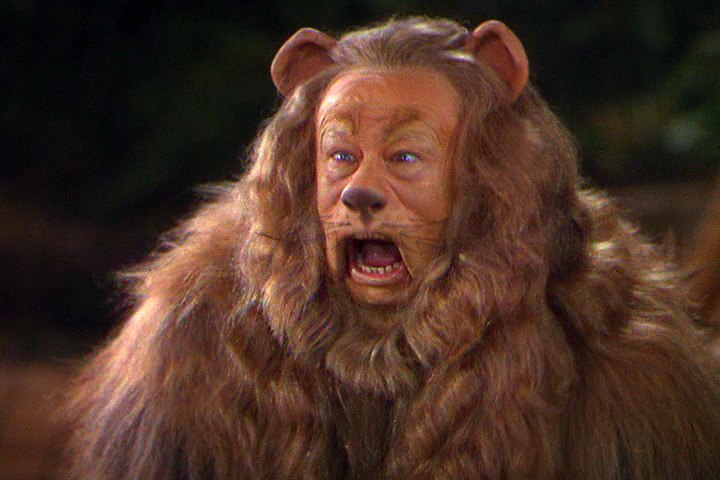
Can you think a synonym for pusillanimous or share a pusillanimous character from movies or fiction? I suggest the Cowardly Lion from The Wizard of Oz.

Photo credit: Insomnia Cured Here via Flickr CC-BY-SA

Thanks for getting nerdy with me today!

Julia


When to Use Italics for Titles

Daughter had her writing SOL last week – for those of you who don’t live in Virginia, “SOL” stands for Standards of Learning, standardized tests used to assess student competence at the end of a course.  SOLs have dramatically affected the state of education in our Commonwealth, forcing teachers to link all of their instruction to SOLs and to sweat every spring in fear that their students won’t do well on the exams and, consequently, jobs might be in jeopardy.  The current environment emphasizes spoon-feeding over exploration and regurgitation over problem solving.

Whoops, I got carried away.  Let me step down off my box and continue with the topic of this post…  Ahem.

Daughter didn’t know when to use italics and when to use quotes when using titles in an essay.  My Word Nerd gut told her this: For big items, like books, movies, plays, use italics.  For smaller things, like magazine articles or song titles, use quotes.  I wasn’t sure about poems.

Here’s what my trusty resource, Grammatically Correct by Anne Stilman, has to say on the matter:

Italicize the following:

  • names of ships and space vehicles
  • book titles
  • newspapers
  • magazines
  • films
  • plays
  • operas
  • CDs/ albums

Use quotation marks to show:

  • titles of short stories
  • poems
  • book chapters
  • magazine or journal articles
  • songs

Word Nerd Note:  These are conventions, not absolutes, and it is acceptable to use italics or quotes or nothing to set off the items listed above.  For bibliographies, you can use a style guide (usually your teacher or publisher suggests one) to determine what rule to follow, and if you have no specifications, just be consistent with your formatting.

Word Nerd Workout

Which of these need italics and which need quotations, according to the convention above?

  1. The Great Gatsby (a novel)
  2. She Walks in Beauty, Like the Night (poem)
  3. The Masque of the Red Death (short story)
  4. The Fantasy (a cruise ship… one I’ll be riding on in May!)
  5. Fix You (a song)
  6. Vogue (magazine)
  7. The Martian (film or book, take your pick!)

Thanks for getting nerdy with me!

Julia


What Is a Nimbus?

I’m currently reading Orphan Train, by Christina Baker Kline, a lovely novel that alternates between the present and the early 20th century and combines interesting historical fiction with the theme of searching for a sense of family.  It came highly recommended, and I’m glad I’m reading it.

My wondrous word for today comes from this quote from Orphan Train:

I follow her down the hall and through the door into a parlor, where a plump, bosomy woman with a nimbus of downy gray hair is sitting on a rose velvet sofa next to a glowing fire.

I always thought a nimbus was someone foolish, like a nincompoop.  I think I got that from a cartoon of my childhood.  Clearly, that doesn’t work here.

If you like to explore the meanings of new words, visit the Wondrous Words Wednesday meme, hosted by Kathy of Bermuda Onion.

Here’s what you need to know about nimbus:

nimbus \ˈnim-bəs\ noun, from the Latin for rainstorm or cloud; probably akin to Latin nebula cloud

  1. a : a luminous vapor, cloud, or atmosphere about a god or goddess when on earth
    b : a cloud or atmosphere (as of romance) about a person or thing
  2. an indication (as a circle) of radiant light or glory about the head of a drawn or sculptured divinity, saint, or sovereign
  3. a : a rain cloud
    b : thunderhead; also : cumulus

From Merriam-Webster

Here’s a picture of a painting of Jesus with a nimbus around his head to signify his divinity:

Photo Credit: Tamara Aguilar via Flickr CC-BY

Word Nerd Workout

First, have any of you heard of my definition of nimbus (someone silly or foolish?)  Second, can you use nimbus in a sentence?  Here’s my try:

After the phone call from Trevor, Katrina spent the evening walking around in a nimbus of bliss and was oblivious to her brother’s taunts.

Good luck, and thanks for getting nerdy with me.

Julia


Is Alot a Word?

A discussion with hubby prompted this question:  Is alot a word?  He swears he’s seen it in published pieces.

Here’s the short answer: no.  If you try to look up “alot” in the dictionary, you’ll get nothing. The proper way to say that a large bunch of something exists is to say “a lot.”  So, starting now, strike it out of your blog posts and school papers.  “Alot” doesn’t exist.

Along the same lines, alright isn’t necessarily proper either.  According to Merriam-Webster, alright means all right, and but “some critics have insisted that all right is all wrong”.  🙂  It’s used more often in informal writing and fiction.  So, use at your own risk.

A whilevs.awhileAnd finally, awhile is another “a-word” surrounded by confusion and controversy.  As I related in my post on awhile, there are three things to consider when using awhile vs a while:

  1.  A while is a noun (hint: it’s got the article “a” in front of it); it suggests a specific period of time.  If you can replace “awhile” with “a week”, then you should use “a while”.  Example: It’s been a while since I’ve had a good burger. 
  2. Awhile means “for a time”, and it’s an adverb.  You should be able to replace “awhile” with another adverb, like “quickly”.  Example: She ran awhile.
  3. If a while is used in a prepositional phrase, as in, “She ran for a while,” you use “a while” because the object of a preposition must be a noun, not an adverb (“awhile”).

Are there any other “a-words” that give you trouble?  How about other words that have been contracted but perhaps shouldn’t be?  I’d love some fodder for future posts.

Thanks for getting nerdy with me!

Julia


Who I Am: Running is My Valium

This is my third post for the Who I Am project, a year-long writing adventure focusing on all the little things that make me, me.  This month’s prompt: habits.    

I’m gonna admit something embarrassing: I was a pudgy kid.

I liked to play outside, but I also liked to eat.  And watch re-runs of Happy Days and Welcome Back, Kotter every day after school.  Eventually, those habits left a mark around my middle, and Mom had to order “pretty plus” sizes for me from the Sears catalog.

Fortunately, before my teenage years hit, I learned to balance these indulgent habits with some healthier ones.  Several influences conspired to create this shift:

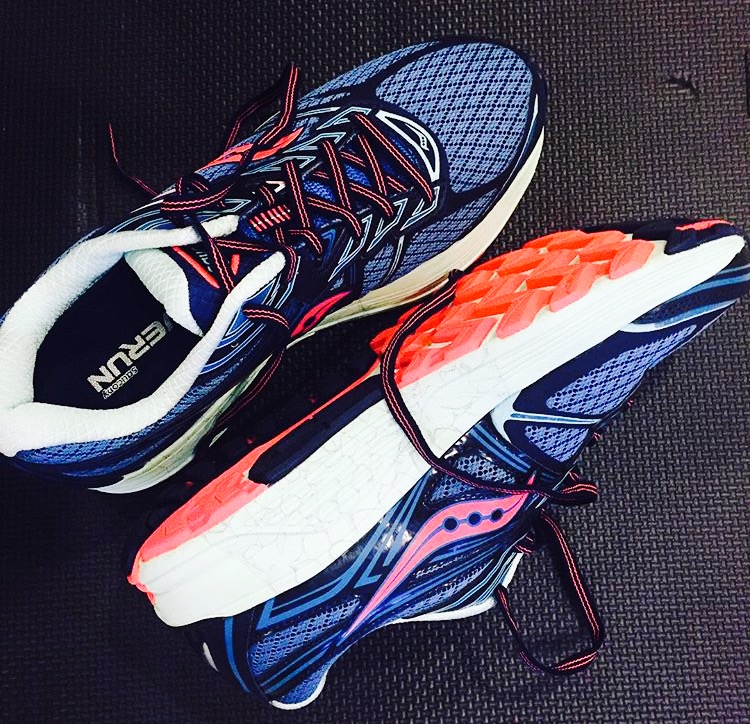
  • running shoesFirst, in sixth grade I started playing soccer and realized I liked running, sports, and competition.  One of my few good memories from middle school comes from Presidential Physical Fitness testing in seventh grade, when we had to run the 600 (the 1980’s version of the mile).  I was in third place on the final stretch and closing in on the boy in second.  He glanced back at me and said, “Yikes!  It’s a girl!”  The fear in his eyes was exhilarating.  My love of running began.
  • Second, I developed an interest in boys, which prompted an interest in my appearance, which prompted a not entirely healthy obsession with calories consumed and calories burned.  By eighth grade, I’d shed my “pretty plus pounds”.  I’m determined to never get them back.
  • Third, I discovered the power of endorphins.  Here’s what they do: make you feel awesome!  My mom had a chronic illness which brought a fair amount of tension into our family life.  I learned that I could escape the stressful atmosphere when I went outside to run or bike, and that the “feel-goodness” of my activity lasted for a few hours.

And so a habit was born.

Thirty years later, I still  exercise to manage my weight and my stress.  Yes, I have four children, and running is my Valium.  The kids and hubby know: when Mom is cranky, send her out for a run.  I don’t need a race to motivate me, although they are fun.  I don’t need a running partner to keep me accountable, although a long run is so much more therapeutic when swapping rants with a good friend.  Unfortunately, every friend I’ve ever run with has moved away or started to work full-time, so I’m currently hesitant to enlist running companionship.  But, I know someone training for her first 5K, and, my runner’s enthusiasm is kicking in…

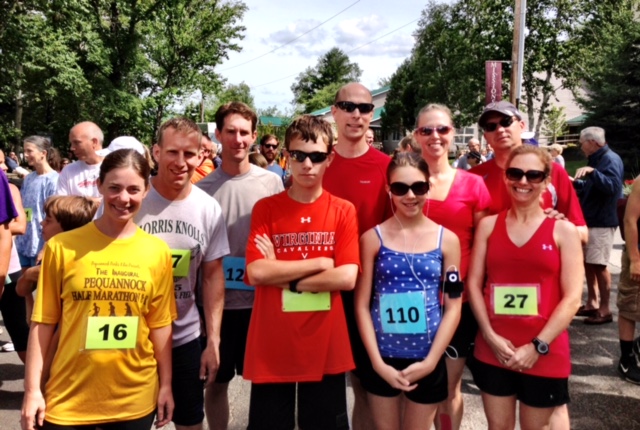
See? Don't all those runners look happy?
See? Don’t all those runners look happy?

My habit has a positive focus, fitness and health, but I can’t deny that two negative emotions also drive me: the fear of gaining weight and the fear of poor health.  Although I’ve got 45 years of wisdom to my name, I still have issues with body image.  When I tell my daughter, “Your body is strong and beautiful and you can do awesome things with it, so enjoy it!” I’m speaking to both of us.  Also, I spent my formative years watching my mother’s body deteriorate, and it scared me.  I exercise to stay strong and functional for as long as I can.  Aging is inevitable, poor health doesn’t have to be.  (Not that Mom could do anything to prevent her illness, but it doesn’t hurt to try…)

As my Oma (grandmother) always said, “It’s a great life, if you don’t weaken.”

What is a habit defines you, and when did you start practicing it?  I’d love to know more about who you are…

See what others have to say about quirks and habits via the Who I Am project, hosted by Dana and Bev.

Who-I-am-button

Thanks for stopping by!

Julia


Why You Should Read Fangirl

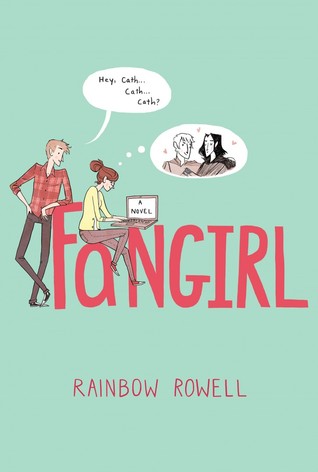
I just finished listening to Fangirl by Rainbow Rowell, and I liked it even better than Eleanor and Park, which I raved about in my review.  Fangirl could be considered Young Adult or New Adult fiction since its main character is a college freshman struggling to overcome her social ineptness in her first year at the University of Nebraska.

Premise

Cath is an introvert who retreats into the fandom of Simon Snow (a fictional equivalent of Harry Potter) when her real life gets too difficult. She and her identical twin sister Wren grew up reading, and loving, the Simon Snow books and writing fan fiction that earns them some online popularity. But when the girls go to college, Wren wants to start a new life, unattached to her twin, and Cath finds herself floundering outside of her comfort zone. She’s pretty sure her roommate hates her. She can’t believe how much her roommate’s boyfriend smiles. And, there’s this cute guy in her fiction writing class who likes collaborating with her, but never offers to walk her home after their late night writing sessions in the stacks.

This is a great novel about facing fears and shattering self-imposed boundaries.
fangirlWhat I liked

I could relate to so many of Cath’s issues: feeling socially awkward, wondering how to deal with grown up guys, facing deep-seated family conflict. I especially enjoyed Cath’s description of her writing process and all the joys and frustrations that come with trying to get the right words to tell a story.

Rainbow Rowell has particular skill in writing fresh, vivid descriptions of people and emotions. One of the reasons Cath likes Levi, her roommate’s boyfriend, is that he has “10,000 different smiles.” And on a day when Levi is uncharacteristically unfriendly, she says he’s “thirty degrees lower than normal Levi.”

The characters often exchange funny quips, but the humor is balanced with thoughtful treatment of serious issues like abandonment and mental illness.

The chapters of Cath’s story are interspersed with snippets from either the “real” Simon Snow books or from Cath’s Fan Fic, and I had fun trying to figure out what Ms. Rowell wanted to accomplish with those interludes.

What I didn’t like

Not much.
eleanor and parkRecommendation

This is a great book for older teens who like realistic fiction or for adults who don’t mind a good college story. Rebecca Lowman, who read Eleanor’s chapters in Eleanor and Park,  narrates this audio book as well.  She does a great job in both.  I highly recommend the audio version.

Notes on content

Characters consume alcohol, but they also suffer the effects of excessive drinking. (Cath’s sister ends up in the hospital with alcohol poisoning.) There are a few “kissy” scenes, and the characters discuss having sex.  In Cath’s Fan Fic, the main characters, and arch enemies, of the Simon Snow series have a homosexual relationship.  But in the Fan Fic and the main story, nothing explicit ever happens between characters.  Some language.

Have you read this or any of Rainbow Rowell’s books? What did you think?
Thanks for stopping by!

Julia