
The Hate U Give by Angie Thomas is a young adult novel that vividly addresses issues from the headlines: racism and police violence. It’s a thoughtful, well written book relevant for today.
Premise
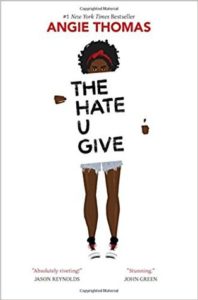 Sixteen year old Starr Carter lives in a poor, black urban neighborhood, but she attends a fancy, mostly white, private high school in the suburbs. Starr struggles to balance her two distinct worlds and the roles she believes she must play in each of them. When Starr witnesses, at close range, the shooting of a childhood friend, her worlds collide and her assumptions about justice are challenged. Starr must learn to claim an identity, and a voice, that will serve her in all places and with all kinds of people.
What I like
In The Hate U Give, Thomas planted me firmly in an unfamiliar culture. (Isn’t that one of the greatest things about books?) Thomas describes Starr’s world using language and dialogue (”Boy, it’s good to see where the Lord done brought you), sounds (gun shots in the night), and images (gang symbols and colors). She forces readers to consider how it feels to be on the receiving end of racist comments, or to be scared simply because a cop pulls up next to you at a stoplight.
There are so many differences between my world and Starr’s, yet Thomas does a good job of showing the similarities too. Starr’s father glares at her boyfriend, and her mother fusses about how to treat other people. Despite our differences, I can still relate to Starr and that’s an important message of The Hate U Give – we can, and should, find ways to connect despite social, cultural, and economic differences.
Another thing I like is the relevance of this book to current events. With disturbing regularity, we hear about police shooting black people in controversial situations. Clearly, there is an issue in our country that needs addressing. Thomas’s book prompts discussion about this issue.
Finally, the ending of The Hate U Give is not tied up and happy, just like racism is far from resolved in the real world. However, Starr emerges wiser and stronger from her experiences.
There are several powerful lines in The Hate U Give, including:
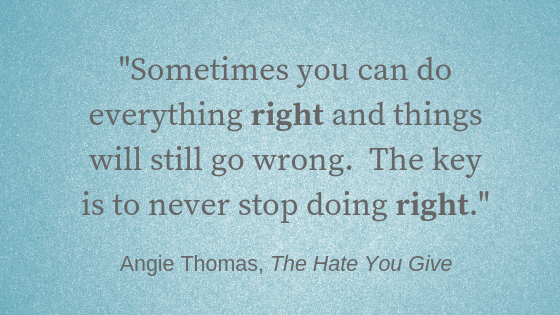
When Starr realizes she’s allowed one of her white friends to get by with racist comments, she says, “That’s the problem. We let people say stuff, and they say it so much that it becomes okay to them and normal for us. What’s the point of having a voice if you’re gonna be silent in those moments you shouldn’t be?” Pow!
And finally, Thomas closes her acknowledgments in the back of the book with this:
“And to every kid in Georgetown and in all ‘the Gardens’ of the world: your voices matter, your dreams matter, your lives matter. Be roses that grow in the concrete.”
Thomas’s story is powerful, but those two sentences of hers are my favorites.
Recommendation
Although this is a young adult novel, I think readers of all ages, above about 12, should read The Hate U Give. Hopefully, it will prompt thoughtful discussion about racism and its consequences.
The movie adaptation of The Hate You Give comes out October 19. Read the book quickly, before you see the movie. Here’s the trailer:
Notes on content
The Hate U Give includes violence and profanity that may not be appropriate for younger readers.
Can you share some reading suggestions that tackle the subject of racism? I really enjoyed Small Great Things by Jodi Picoult.
Happy reading!

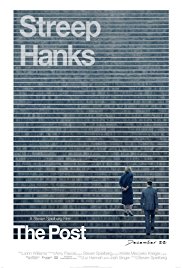 The Post stars Meryl Streep as Katherine Graham, newly appointed publisher of The Washington Post, and Tom Hanks as her tenacious editor, Ben Bradlee. The year is 1971, and President Nixon has prohibited The New York Times from publishing The Pentagon Papers, documents that demonstrated that the U.S. government lied to the American public about The Vietnam War for decades. Nixon claims he’s protecting national security; journalists across the country believe he is attempting legalized censorship.