
How to Survive the College Drop Off

moving

The big day is quickly approaching.  The one when I pack up a van with bedding, towels, and clothes.  Drive three hours away.  Drop off my son to live on his own at college.  There are so many good things about this change.

  • He’s ready.
  • He’s excited.
  • All the fun things to do at college!
  • He will learn how to use the gifts he’s been given to make this world a better place.
  • He’s going to my alma mater, one of my favorite places on the planet.

But.

I’m amazed by the number of emotions I feel at one time:  joy, excitement, pride, nostalgia, worry, sadness.  I’m excited he has this opportunity, and yet, he is the child who rubs my back when he knows I’m stressed.  I love his smile, his sense of humor, his driven nature.

I will miss him.

I will miss not just his physical presence in my days, but also his childhood.  Now he is becoming a man, and our relationship will change.  I remind myself that change isn’t bad.  It’s natural, it’s normal, it often leads to good.  (Like, the transition from Pull Ups to underpants was a great thing, right?)

A wise friend told me to start praying about this day years ago, so that when the time came, I’d be ready. And I am, mostly, although I plan to keep a pair of sunglasses handy for that final goodbye.  I don’t want to embarrass the boy with my tears.
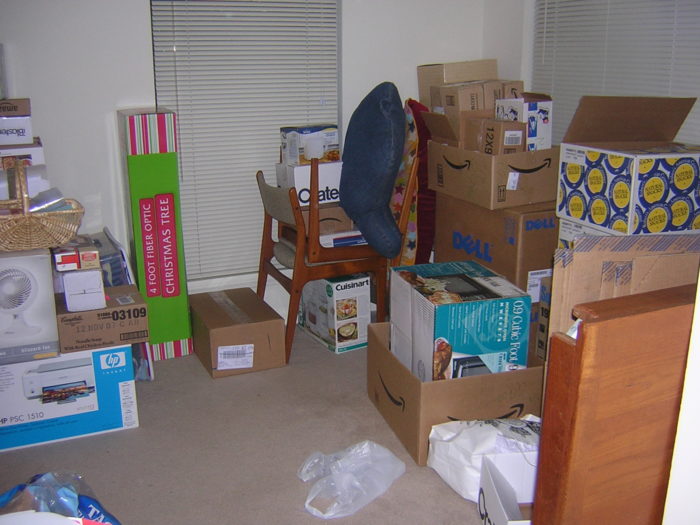
Photo credit: Maggie via Flickr CC-BY

To help me, and anyone else who needs this, prepare for the BIG DAY, I asked some experienced writer friends to share tips for the college drop off. Dana and Amy both took their oldest children to school last fall, and they have some excellent ideas for making the day go smoothly.

Dana, at Kiss My List, says:

Planning is the key to a smooth college drop-off. You can’t control the emotional weight of the day, but you can control other factors, and this will help you get through the process with less angst.
 
  1. Do your homework ahead of time. Find out the wheres and whens of drop-off, unloading and parking. Decide who is staying with the car until it’s empty, who is moving stuff in, who will park the car, etc.
  2. Let your student decide where everything goes in the room. It’s his space, not yours. You don’t want him texting you to ask where you put his underwear, do you?
  3. Amazon has everything your student may need once you leave. Everyone else will be hitting Target or Walmart that day, and those stores are more crowded than they are on Black Friday. Last minute shopping will just add to the stress; there is nothing he needs that desperately.
  4. Before drop-off day, write a note to your student. I tucked mine under my daughter’s pillow for her to find that evening. Two years later, she still has it in her desk.
  5.  Avoid prolonged goodbyes. A hug, an “I love you,” and a swift exit is best for everyone. You can cry in the car. This is an exciting time for your student, but even good change is stressful. He doesn’t need the additional stress of seeing his mom or dad lose it.
  6. Make plans for when you get home – dinner with friends, a movie (comedy, please!), or anything else that brings you joy. You’ll have something to look forward to, and the activity will be a good distraction.
  7. Be kind to yourself. It’s a big adjustment, but you’ll be okay. And so will your baby.

Amy Makechnie, published author and mother of four, had to take her daughter across the country to start college. Amy offers this advice:

  1. Pack lightly. Dorm rooms are small. You really don’t need 100 books, old journals, scrapbooks, or photo albums – there’s too much fun to be had to be reliving the past!
  2. DO bring a framed picture of your family. Amazing how much more you love each other when you’re not living with one another.
  3. Take your child to college, if you can. I’m so glad I did. At 18, my husband flew across the country by himself – I still think that’s such a sad scene!
  4. Put a note under your child’s pillow or hidden somewhere. He/she will find it at just the right time. Maybe a $20 bill, as well.
  5. Say good-bye quickly. Cry later. This isn’t about YOU. This is a VERY exciting time for your child.
  6. Let them go. It’s time to fly.
  7. Keep their room at home for them. At least for the first year! Nothing says, “welcome back” like a sibling completely usurping your room and every possession in it!  I always want my children to feel that they have a place and a room to come home to, no matter where they go. You don’t need a shrine(!) but that first year, when everything is changing so much, I think it’s important for your child to know that home stays the same (and hopefully that “same” is a good one!)

Did you notice how the note thing appeared twice?  That’s a must.  I’ve got a draft already.

Do you have any other suggestions for surviving the college drop off?  

Thanks for getting sentimental with me,

Five Fun Things To Do in San Diego

If you haven’t been to San Diego, you must visit. It’s warm and sunny almost every day, and there are fabulous things to do, like petting a rhinoceros at the Safari Park or traveling over two miles through the clouds up Mt. San Jacinto. Sound thrilling? It was! Here are five things I highly recommend if you are ever near San Diego.

Kayaking on Mission Bay

We rented kayaks from Mission Bay Aquatics Center and spent the morning paddling around Mission Bay. The staff at MBAC was extremely helpful and friendly, and there were free lockers to store small items. Mission Bay is great for kayaking- it’s self-contained and fairly calm, there are small beaches to explore, and there is little motor traffic. While paddling, we saw two amphibious boats used for seal watching— basically big blue buses floating on the surface of the water! Rentals were inexpensive: $21/single/2.5 hours and $26/double/2.5 hours. You can also rent sailboats and paddle boards. The only negative was parking- the lot at MBAC was full, and we had to find pay/ street parking. When you venture out on the water, be prepared to navigate around large groups of novice sailors and paddle boarders close to the MBAC.

Torrey Pines State Preserve

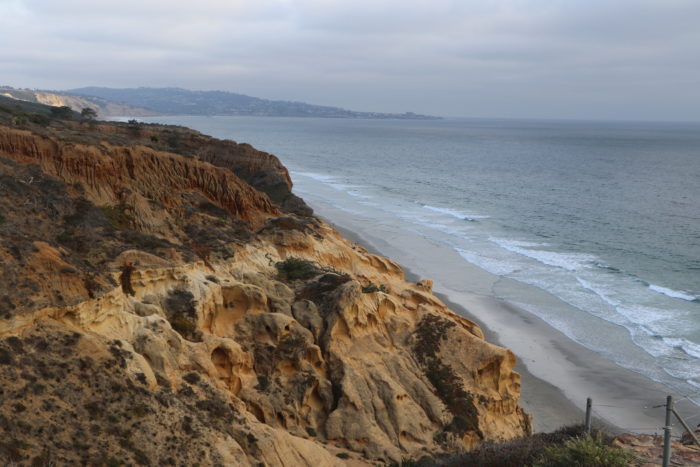
At Torrey Pines State Preserve you will find beach access, hiking trails, and one of the few places where Torrey Pines still grow. They are beautiful trees with twisting trunks and branches that reminded my son of something from a Dr. Seuss book. We took the Guy Flemming Trail and were treated to gorgeous, panoramic views of the coast. Access fees range from $12-20, depending on the day and season (fees are higher on weekends and during high season, spring-Sept).

The view of the Pacific Coast from the Guy Flemming trail.

The San Diego Zoo Safari Park

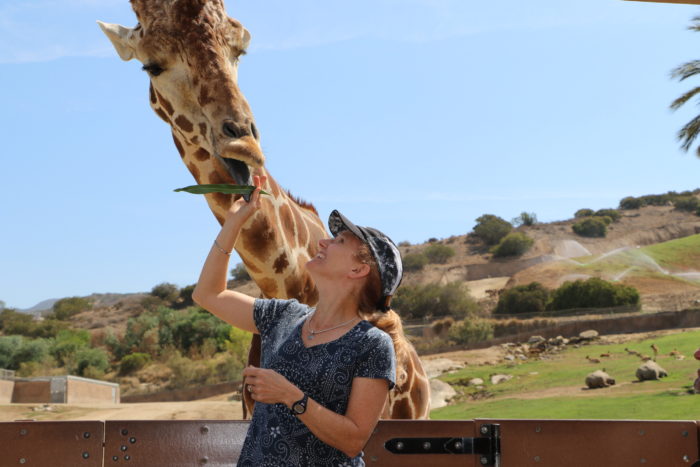
The Safari Park promotes education about animal conservation and does much research to keep fragile species alive. Some of us did the Caravan Safari and rode a truck into a huge animal enclosure. We got to feed a giraffe: note, giraffe saliva is the same consistency as hair gel. Another note: giraffes have huge, beautiful eyelashes.

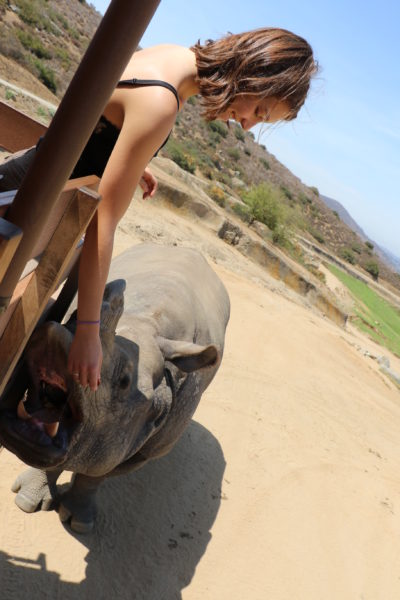
We were also lucky enough to feed and pet a rhino mom and her “baby” (who weighed 500 pounds). We just leaned over and dropped apple slices into their waiting mouths (which happened to have very large teeth.) The other half of our crew rode a zip line across the enclosure in a Flightline Safari.

Please note the teeth!

In the new Walkabout Australia section, we walked through an area with loose kangaroos and wallabies playing nearby. A kangaroo literally jumped right in front of me across the path.

We spent the entire day there, and it’s well worth the entry fee ($54 for 12+). If you plan on going to the San Diego Zoo also, get a 2 day pass and save yourself some $$. (2 day pass is $86.40 for 12+)

The San Diego Zoo

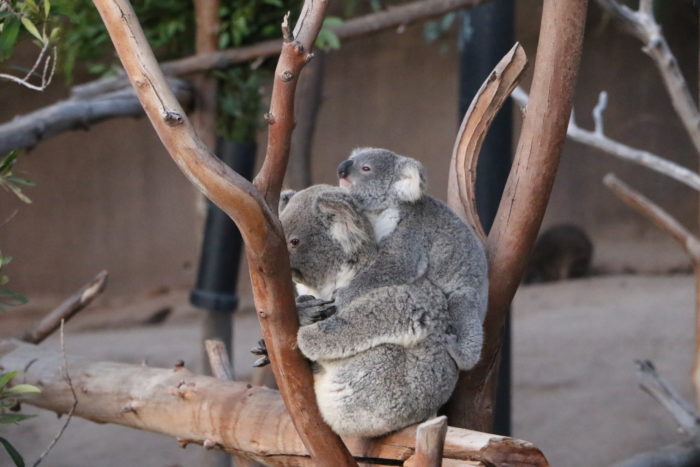
The world-renowned San Diego Zoo did not disappoint, even though we had already spent a day at the Safari Park. It’s clean, with lots of trees to provide shade from the San Diego sun. We saw a mama hippo napping with her head on her baby’s back, as well as a Giant Panda enjoying a mid day snack. Again, education and conservation were the focus. My family loved it, especially the snuggling koalas and the mama leopard with her two cubs.

San Diego Zoo
I mean, how adorable!

At both the Zoo and the Safari Park, we found the best time to visit the animals was early morning or evening; they tend to sleep during the hot, midday hours. Food inside both parks was pricey, but we felt better knowing the money was going toward animal conservation. Tickets same price as for the Safari Park.

Palm Springs Tramway

We drove over two hours to Palm Springs, but the day long excursion was worth it. We parked at the base of Mt. San Jacinto in the desert, then rode the Palm Springs Tramway two and a half miles up the mountain to access hiking trails at 9000 feet. The tram ride is “amazing and terrifying”, as my daughter described it. The floor of the circular tram car slowly rotated during the ten minute ride, giving visitors views in all directions.

The tram ran on cables supported by five towers, and at every tower, the tram swung, prompting stomach lurches and contemplation of the meaning of life (’cause it felt like it was about to end.)  Comments from my husband regarding the likelihood of our tram falling did not help my anxiety during the trip, but I squeezed his hand tight (perhaps cutting off blood flow), and survived unscathed.

There were lots of hiking trails available from the mountain station, and we opted to hike to the “saddle” of the mountain, a six mile adventure round trip. The trail was steep at times, and the altitude change slowed the adults down. The teens did just fine and enjoyed scaling giant boulders along the trail while the old people caught up. (Excuse me, oldER). The views at our destination were well worth the thigh-burning climb.

Mt. San Jacinto
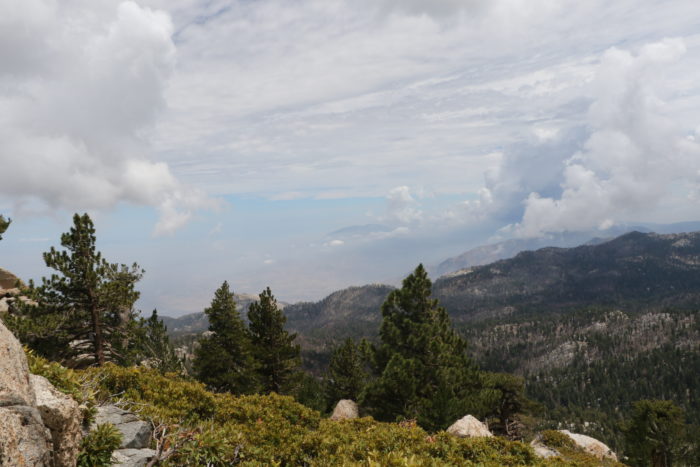
The view from Mt. San Jacinto

Fees for the tram are $25.95 for adults (aged 10+). Hiking is free, but you must obtain a permit if you go beyond the ranger station.
Word Nerd note: The Palm Springs Tramway is an engineering feat from the 1960s. Helicopters flew 23,000 missions over 24 months of construction to build the towers for the tramway.

Have you ever visited any of these or other noteworthy sights in San Diego? Please share. We stayed with friends, but if you have any tips about lodging, please share those as well.

Thanks for “traveling” with me!


What is Glamping?

In my latest read, Sophie Kinsella’s My (not so) Perfect Life, protagonist Katie Brenner gets fired from her marketing job in London and must return home to her father’s farm.  While she secretly hunts for another job in the city, she helps her father set up a glamping destination.

Yes, that’s right, I said glamping.  Think bed and breakfast in a yurt.  Don’t know what a yurt is either?  Let me explain.

According to the website Glamping.com, glamping (glamour + camping) is “travel that transforms you”.  It’s for people who want a more “authentic experience” than a stay in a hotel with standardized fixtures.  Glamping provides travelers with the opportunity to immerse themselves in nature and culture without sacrificing comfort.  Some glamping destinations include a tree house in the forest canopy, a yurt on a mountainside, or an eco-lodge with gorgeous views.

When Katie Brenner tries to describe glamping to her dad, she says,

They want nice soap, but they want to use it looking at the sky, listening to cows.  They want to feel rural, but not actually be rural.

She suggests outdoor showers with wooden pails that drench glampers, high count thread sheets, and yurts.

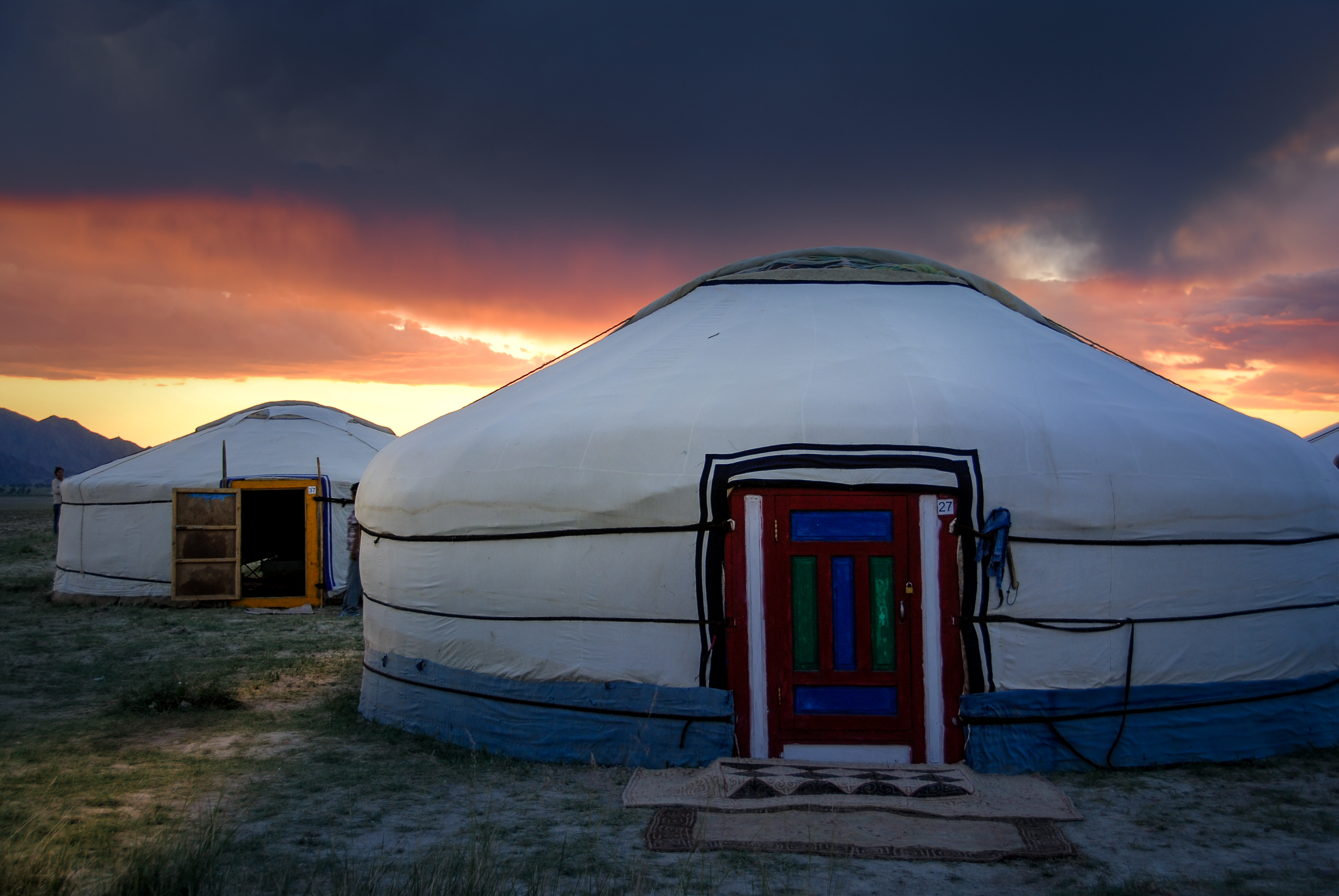
Which reminds me.  This is a yurt:

Photo credit Bernd Thaller via Flickr CC-BY

According to Greenfuture.io, yurts are circular tent-like structures originally used by nomads on the grassy plains of central Asia.  They were solid enough to provide a good home, but were easy to pack up and move when necessary.  The Mongolian people used them, and in the Mongolian language they are called “ger”.

Yurts are no longer just for nomads or society averse hippies.  They are gaining popularity for several reasons

  • it’s more affordable to construct a yurt than a typical home ($10,000 to $50,000)
  • modern yurts have more comfort features, including electricity, windows, and plumbing
  • yurts are eco-friendly; they are usually energy-efficient and have little environmental impact

Don’t forget to visit Kathy at Bermuda Onion for the WWW meme!

Have I inspired a desire for a new traveling experience for you?  Hopefully I’ve at least taught you something new.  If you like to learn new words, visit Kathy at Bermuda Onion, where bloggers share new words or ones they love.

Have you ever heard of glamping or yurts?  Better yet, have you ever experienced either first hand?  Please share!

Thanks for getting nerdy with me, and happy summer travels, no matter your style or destination.


Where to Find “Must Read Books”

A friend and avid reader who likes to keep up with all things literary asked me if I knew of a definitive list of the top 100 books of all time.  Somewhere in my house I have a faded, creased paper with titles my high school AP English teacher gave me as recommended reading, but it has been years, and many children, since I’ve seen it.

A quick search on the web turned up several lists of “Must Read Books”, each with a different focus.  Common titles included books you’d expect:

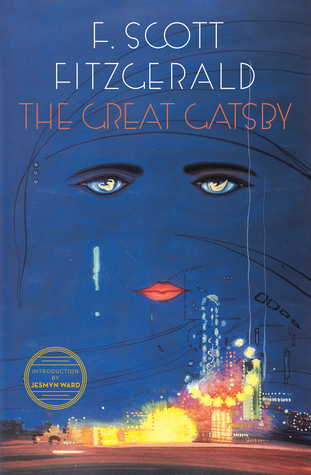
  • The Great Gatsby
  • Great Expectations
  • The Catcher in the Rye
  • Rebecca
  • The Grapes of Wrath
  • The Hitchhiker’s Guide to the Galaxy
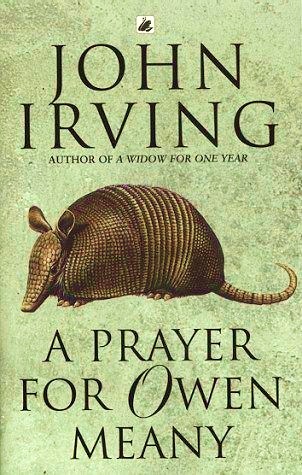
  • A Prayer for Owen Meany
  • Lord of the Flies
  • Atonement
  • Lolita
  • Madame Bovary
  • On the Road
  • Of Mice and Men
  • Midnight’s Children
  • Les Miserables
  • A Clockwork Orange
  • The Three Muskateers
  • The Handmaid’s Tale

I couldn’t find one list that seemed most “legit”.  However, looking through the different lists gave me lots of new reading ideas.  Here are a few that I found, and I hope they inspire you too! (Click on the link to see the full list.)

Must Read Book Lists

Book Bub’s 100 Books to Read Before You Die  This is a well rounded list, and my favorite of all the ones I explored.  It is a blend of classics, modern fiction, and non-fiction.  Let’s be honest, too many classics in a row can become drudgery.  If you work your way through this list, you can sample a nice variety of books to stimulate your brain and grow your literary awareness.  This list includes a description of each book, a very helpful feature the others lack.

Goodreads 100 Books to Read Before You Die Shelf  Goodreads users can organize books they want to read or have read into virtual shelves.  This shelf contains books that Goodreads users consider “top 100”.  Note: there are over 1000 titles on this shelf.  This list could keep you busy for a loooong time.

BBC’s Top 100 Books You Need to Read Before You Die  This list is described as “an esteemed list of 100 books every person should read before they die — a literary bucket list, if you will”.  It’s heavy with classics.

The Modern Library’s 100 Best Novels  The Modern Library was established in the early 20th century by Boni and Liveright, one of the most important American publishing houses of the early 1920s.  The goal was to publish inexpensive modernist European and contemporary American titles for readers.  The Modern Library established itself as the source for the “World’s Best Books”, and although titles in the Modern Library have changed based on popularity and availability, the goal remains to provide readers with books of literary and historical merit.  I didn’t recognize several titles on this list.

Amazon’s 100 Books Everyone Should Read Before They Die  This list is given in alphabetical order and includes a nice blend of classics and modern/ popular fiction, including kid lit.  I was surprised, but happy, to see Where the Sidewalk Ends and Where the Wild Things Are on this list.

I’m not sure why these lists have an obsession with death (why can’t they just be called “Must Read Books”?), but I did find them helpful and inspiring.  I’m curious about A Prayer for Owen Meany… any one ever read that?
Do you know of a “Must Read Book List” you can share?  Have you used any of these lists?

Thanks for getting nerdy with me!


Why You Should Read Tell Me More

Tell Me More Kelly Corrigan

Looking for a thoughtful read peppered with humor and humility? Try Tell Me More by Kelly Corrigan.

Premise

Tell Me More is a memoir of sorts, focused on a specific purpose. Corrigan says in her book dedication, “This book is about things we say to people we love (including ourselves) that make things better.” Each chapter is about one thing Corrigan is learning to say, such as, “It’s Like This”, “Tell Me More”, “I Don’t Know”, and “No”.

What I liked

Corrigan writes easy to read prose full of original, thought-provoking descriptions. For example, here’s how she presents one of her daughters:

Speaking of menstruation, lack of perspective, and fits of irrationality, I have two teenage daughters. Georgia is sixteen, with Vidal Sassoon hair, almond-brown eyes, flat feet, and a killer dimple. She likes lacrosse and Snapchat and prefers precalculus and chemistry to the humanities, where there are too many possible answers. Her interest in me hinges on allowance and rides; offering anything more, like an opinion, visibly chafes her.

I love the rhythm of her words, the accuracy of her observations, and the specificity of her images.

Corrigan ponders deep questions and truths inside the framework of the mundane. She blends serious, sometimes sad reflections with humor and wit to create a wonderful balance of heavy and light. I could understand so many of her struggles. And the ones that were new to me, like the death of a dear friend, hit me harder because of her ability to communicate emotions so powerfully.

The chapter called “Tell Me More” made me reconsider my whole approach to communicating with my kids. Corrigan shares a conversation she had with her college roommate on the way to a reunion. She talks about her daughters, saying, “When they tell me about a problem,— which is rare and getting rarer— I can think of five things they should do before they finish their first sentence.” Her friend responds with, “Right. But then there’s that whole weird thing where half the time, it’s not even about what they say it’s about. So your advice is totally wrong because you don’t even understand what the real problem is or what they’re asking for.” Her friend goes on to suggest that instead of trying to solve our kids’ problems, we should listen and encourage them to talk with phrases like, “Tell me more,”, “What else?, and “How do you feel about that?”

Whoops. I’ve never been good at this. I want to fix the problem (”Have you tried x, y or z?”) or, even worse, minimize the problem (“It’s not that bad”), or suggest, and this is a most horrible offense, that maybe they are making the problem worse. Giant mother fail. One of my sons tried to give me feedback on this a few years ago.

It was during his middle school years, when he liked to give me a recap of his day during the car ride home from school. He summed up the events of each class into a sentence or two, giving me a verbal image of what happened. Usually, it was just a narrative, but sometimes, he would include issues that reared up, like harsh words about a test grade, or a conflict during a group project on the Civil War. Once, I tried to “fix” the problem, throwing out suggestions, feeling very experienced and helpful in the driver’s seat of the van. My son stopped me. “Mom, I just want you to listen. I don’t want you to tell me what to do.”

Ouch.

That alerted me to my problem, but it would take a few more years, and Corrigan’s book, to spark a communication strategy overhaul. I only hope it’s not too late.

What I didn’t like

There was nothing I didn’t like, but I will warn at this point that the book isn’t always easy, and is often quite sad, as Corrigan wrote it while processing the deaths of her father and a dear friend.

Recommendation

If you enjoy memoir and books about motherhood/parenthood, you would definitely enjoy Tell Me More. I listened to the audiobook, read by Corrigan, and it was great car ride/ folding laundry entertainment.

What memoirs have you enjoyed? I also loved and reviewed Glitter and Glue by Kelly Corrigan.

Happy reading!

Julia

The Word Nerd Complies with GDPR Standards

This morning I’ve spent over two hours (that I would have preferred to spend  writing) making sure that Diary of a Word Nerd is compliant with GDPR requirements.  I’ve added a privacy policy and updated some features so that you know that this site uses cookies and you give permission for this site to use and store your personal information.  Since I’m not selling anything (yet!  Hopefully books someday), the only thing I keep is your name and email, and I use those to contact you about new posts if you subscribe.  I may also use your email to respond to a comment you leave.  That’s it!

If you have a blog or website too and are curious about GDPR requirements, I highly recommend two things:

  • Do your research.  I found the following articles very helpful.  And yes, even if you don’t sell anything, if you collect emails or use cookies to save information to make commenting easier, you collect personal information and you need to take GDPR seriously.
  • Look around on your blog settings and tools  Since GDPR was enacted, the platform I use, Word Press, and the theme I use, Graphy, have added several features to make it easier to comply with GDPR, including a comment privacy checkbox and a widget with a cookie notification.  I spent a lot of time looking at plug ins before I realized some features were already built into my blog and I just needed to activate them!  Do yourself a favor and poke around.

Also, I did some general housekeeping, deleted bag plug ins, etc, on the blog, and as a result, you may have lost your subscription.  Please use the subscription box in the right sidebar to make sure you will always be notified when I post something new.

If you have other suggestions for updating blogs and websites to be GDPR compliant, please share them below!  I am not a coder or a software developer, so plain English is appreciated.

Thanks for stopping by!