

Why You Should Read Train Smart, Run Forever

I’ve been raving about Train Smart, Run Forever to friends “in real life”, so I thought I’d better share on the blog. I heard about it via the Runner’s World podcast (when it was still live), and I started applying its training concepts this January. As an aging athlete (I’m knocking on 50), I’ve struggled with nagging injuries over the past six years. But Train Smart, Run Forever has helped me prepare for a 10 mile race later this month, and the best news… no back or hip pain!

Why I picked up this book

I’ve been running since I was 11. At that early age, I learned that going for a run made my problems smaller. Not only did it help me manage my weight; it also helped me manage my mood. But I’ve always been a 30 minute, three mile kind of a runner. Especially once I had kids, I only had half an hour a day to get my fix.

Now that my kids and I are older, I want something besides the 30 minute run, but I have to choose a realistic goal. I’m not getting any speedier, so a faster 5K is not the answer. I coach high school cross country, and running with state ranked teens really shows you how fast you never were and how slow you really are. A few years ago, I spent nine months recovering from a pulled hamstring I acquired trying to beat my 13 year old daughter in 400 repeats.

So, faster times are not my goal.

However, more distance seemed achievable. Unfortunately, every time I ran more than five miles, I got back and hip pain, or more pulled muscles. I’ve turned to PTs and chiropractors for help, and I’ve also spent a lot of time walking.

Enter Train Smart, Run Forever.

What this book offers
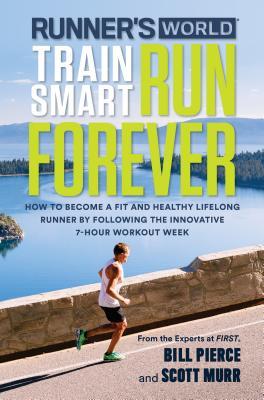
Train Smart, Run Forever

In Train Smart, Run Forever Bill Pierce and Scott Murr share training tips from their own running experience as well as data collected from thousands of runners who have used the Furman Institute of Running and Scientific Training (FIRST). Since the early 2000s, FIRST has conducted running retreats and running clinics, and in the process, it has gathered a lot of helpful information.

The book opens with a description of FIRST and the data collected through the program. Then it explores issues relevant to the aging runner, with chapters like “Is Long Distance Running Healthy?”, “Why Do I Get Injured?” and “Don’t Forget Why You Are Doing This”. The last third of the book describes Pierce and Murr’s seven hour per week training plan, with detailed explanations of workouts and the reasoning behind them.

What I like

The Train Smart, Run Forever training program is all about balance and cross training, with an emphasis on variety, strengthening, and stretching. According to the plan, I only run three days a week. The rest of the days I cross train or strength train. The program compliments what I learned in P.T., and the variety and balance has worked well. A few weeks ago, I ran 10 miles without hurting myself, something I never thought I’d be able to do.

The Train Smart, Run Forever program isn’t time intensive. The workouts require one hour each day, with the exception of one long workout session on the weekend. I think an hour a day is a reasonable amount of time to spend on your health.

The authors of Train Smart, Run Forever spend a lot of time talking about elite runners, but the training principles apply to all levels of runners. The pacing guides are based on a wide range of 5K times, from 16 minutes to 40 minutes.

Finally, the training guide is thorough and specific. It has daily workouts with options built in for cross training, strength work, and stretching. The running workouts each have a purpose (no more “junk miles”), with Tuesdays focusing on speed intervals, Thursdays focusing on tempo runs (sustained effort over time), and weekends focusing on distance. There are even pacing guides and a perceived exertion scale to let you know how hard you should work and for how long.

What I don’t like

The first part of the book sounds like a long ad for the FIRST program. My husband actually stopped reading because of it. I just skimmed through a lot of that stuff, knowing that I would never travel to Furman to do a stress test in the FIRST lab. The training principles that come after all that are what I wanted to know about.

Recommendation

If you love to run, but you are getting older or have been sidelined by annoying injuries, you should pick up Train Smart, Run Forever. I promise, Runner’s World isn’t paying me to endorse the book. I just want more people to know about this helpful training guide.

Have you heard of this book or the FIRST program? What other exercise books can you recommend?

Thanks for getting nerdy with me!

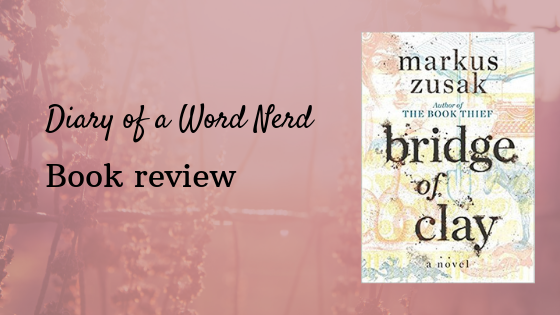
Why You Must Read Bridge of Clay

The Dunbar Boys: five brothers, young teens and young men, living on their own with only a mule named Achilles to watch over them. How did they get there and where are their parents? That’s the story Markus Zusak tells in his latest novel, Bridge of Clay. There’s a murderer, a piano, a mattress in the grass, and a sweet. sad story about love, loss, and the ties that bind families together.

I listened to the audiobook, which Zusak reads himself, as if he were talking about his own brothers. Bridge of Clay is a long book, but it’s worth the effort.

Premise

Bridge of Clay opens with Matthew, the oldest brother, digging up his grandmother’s typewriter (the “old TW”) so that he can record his family’s stories. He skips around a bit, but eventually we learn about the history of each of his parents, the quirks of each of his brothers, and how his brother Clay holds the key to all of the stories.

What I Liked

Zusak writes with a beautiful, poetic style, short sentences that build a rhythm and play with words. Sometimes I swear I heard rhyming couplets! When describing how Penny Dunbar, mother to all the boys, responded to cancer treatment, Zusak writes:

She tried to reassemble herself; she tried to resemble herself.

Here’s another great example of his style:


“He, as much as anyone, knows who and why and what we are:
A family of ramshackle tragedy.
A comic book kapow of boys and blood and beasts.”

Zusak’s descriptions are vivid brush strokes, sometimes brief, always fresh, painting a picture and often leaving just enough out so that the reader can fill in the rest.


“He was a wasteland in a suit; he was bent-postured, he was broken.” 

I love how Zusak delineates each member of the family clearly – their struggles, their desires, their loves. Even though there are five boys, Zusak makes each one distinct in his speech and actions. I felt like I was sitting among them and laughing at their jokes. They are a compelling lot, and I loved hearing about them.

The story has plenty of sadness; I teared up more than once while listening to it. But it also has humor (there are five boys and a mule, after all), and love and joy and triumph.

Finally, I liked how Zusak kept a sense of mystery throughout the book. It’s a character driven story, but Zusak keeps the reader interested by withholding key parts of the family story. Matthew always refers to his father as “the murderer”, and Clay always keeps a laundry pin in the pocket of his jeans, but we don’t find out why until the very last chapter.

I’m so glad I listened to the audiobook of Bridge of Clay. Zusak emphasizes the rhythm of his prose, and sometimes, during very touching scenes, his voice breaks, as I imagine Matthew’s or Clay’s would if they were telling me the story.

What I Didn’t Like

Not much. Bridge of Clay is a little long and meandering, told in snippets. Zusak jumps around between past and present, and initially it was challenging to follow the story line, but once I figured out the style of the book, I didn’t have any trouble.

Recommendation

If you like family sagas, or books that champion a love of stories, or Zusak’s other novels The Book Thief and I Am the Messenger, I highly recommend Bridge of Clay. It has unique voice, and again, Zusak’s writing is gorgeous.


“There are hundreds of thoughts per every word spoken, and that’s if they’re spoken at all.” 

Notes on content

This story is about five brothers, ranging in age from about 13 to 25. Expect swearing, drinking, and some references to sex. But it’s pretty mild and fits the story line.

Have you read Bridge of Clay or any of Zusak’s other books? What did you think?

Thanks for getting nerdy with me!
Why February is Spelled Funny

February is my birthday month (also my daughter’s), so it’s special to me, even though it’s dark and cold, and I’m usually ready for it to end way before the 28th. It’s a curious month, unusually short and unusually spelled (what is that extra “r” doing in there?), and this year I’ve decided to get to the bottom of why February is so unique.

Get ready for a little ancient Roman history…

Even though English started as a Germanic language in western Europe, the invasions and mingling that went on over the centuries introduced Latin based vocabulary and spelling, as well as Latin/ Roman customs. Our “February” comes from the Roman month Februarious, named for the festival of februum, a Roman purification ritual held on February 15. The “r” after the “b” in februum made its way into our modern spelling, although most people today do not pronounce the extra “r”.

Why is February so short? (Like me? ;)) Originally, the ancient Romans used a 10 month calendar that went from March to December. The winter months didn’t mean much in a society based on agriculture, so they didn’t bother keeping track of the days in winter, after December. Finally, in 713 BCE, King Numa Pompilius decided to line up the calendar with the 12 lunar cycles of the year (about 355 days), and he added January and February to the end of the calendar.

But there was still a problem. The ancient Romans, a superstitious lot, thought even numbers were bad luck. So King Pompilius made all of the months an odd number of days long. But 12 months of odd days added up to an even number of days for the year, and he couldn’t have that. So, he decided to make the last month of the year, February, the “unlucky” month of even days, and therefore he kept it short.

That calendar worked for awhile, but the months and seasons fell out of sync, and an adjustment “leap month” had to be added every now and again. People in power abused this flexible calendar by adding days to extend the political terms of friends and subtracting days to foil their enemies.

When Julius Caesar came to power in 46 B.C., he made more adjustments to the calendar, basing it on the sun, not the moon, and adding a few days to months so one year = 365 days. February moved to the beginning of the year, but retained its short length (except on leap years, when one day is added to February). Caesar’s changes stuck, and the calendar we use today is based on a modified Julian calendar. In 1582, Pope Gregory added leap years to keep the number of days in one year more in line with the length of a solar year, so technically, we use a “Gregorian calendar”.

If you want to learn more about February, visit:

Wondrous Words Wednesday

If you like learning about words, visit Kathy at Bermuda Onion for her Wondrous Words Wednesday meme. Bloggers share favorites or new words they’ve learned.

What’s another unusual calendar term that you’d like to know more about? Like, what’s going on with that “n” in Wednesday?

Thanks for getting nerdy with me!
Agape: A New Word for Valentine’s Day

Valentine’s Day has been around since the middle ages.  The British Library in England has a valentine greeting from 1415: a poem that Charles, Duke of Orleans, wrote for his wife while he was imprisoned in the Tower of London.  An ancient valentine! 

While the holiday currently celebrates romance, its origin is a bit mysterious.  Some legends say that Valentine was the name of a priest serving under Claudius II in third century Rome.  When Claudius decided that young men couldn’t marry (bachelors made better soldiers), Valentine married lovers in secret—and was put to death when Claudius discovered his illegal activities.

Another legend claims that Valentine was a man who helped Christians persecuted by the Roman Empire.  When Valentine was imprisoned for his deeds, he wrote a letter to a young woman he loved and signed it, “from your Valentine,” a sentiment still used today.

Yet another legend claims that the church decided to celebrate St. Valentine on February 14 so that it would overshadow the pagan fertility festival of Lupercalia, held on February 15.  (For more fun facts about Valentine’s Day, visit History.com.)

Whatever the reason, people now celebrate Valentine’s Day in the U.S., Canada, Mexico, the U.K., France, and Australia.  In fact, Valentine’s Day is second only to Christmas in greeting card rank.  According to the Greeting Card Association, we send about 1 billion Valentine cards each year!  That’s a lot of pink and red envelopes.  But with all of the hostility and angry words floating around in our world today, I think we need something more than roses and lace this Valentine’s Day.  We need more heart.

This February 14th, instead of celebrating love in the just romantic way, let’s also celebrate love the “agape” way.  Agape is a Greek word, the one most frequently used for love in the New Testament.  In this Biblical context it describes an unconditional, self-sacrificing love, one that is shown to both friends and enemies.  It is often used to describe God’s unending love for humanity. 

Wouldn’t it be nice if it described us too?

Even if you don’t believe in a God, or aren’t familiar with the New Testament, I hope you recognize that our world would be infinitely better if we all tried harder to love selflessly.  If we acknowledged the flaws within ourselves before harshly judging the flaws in others. If we embodied the practice of treating others the way we want to be treated.  If we considered our words carefully before speaking or posting to social media.  

This Valentine’s Day, we need more than cupids and chocolate.  We need to show love the agape way, selflessly showing respect and concern for those we like and for those we don’t like so much. 

Thanks for getting “agape” with me!

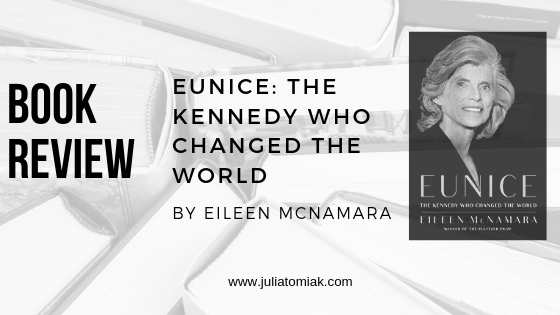
Why You Should Read Eunice

Eunice Kennedy Shriver wasn’t perfect, but she was smart, tenacious, and persistent. She never held public office, but she had huge influence on her brothers Jack, Bobby, and Ted, and through them brought about important research and legislation on mental retardation, special education, women and children’s health, and abortion.

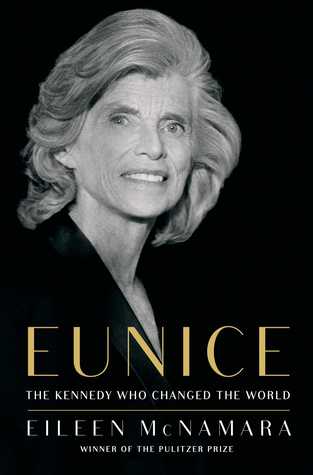
If you care anything at all about women’s issues or 20th century history and politics, you should read Eunice’s biography, Eunice: The Kennedy Who Changed the World by Eileen McNamara.

What I liked

Eunice was a fascinating woman, abrupt and terrifically demanding, but also strong willed and undaunted by challenges. She was the privileged daughter of Joe Kennedy, the millionaire, and sister to JFK, RFK, and Edward Kennedy, who each held public office, including president of the United States. Luckily for women and children across this country, Eunice used her power and influence for good.

Her contributions to society include, but are not limited to, the establishment of the Special Olympics program, as well as the overhaul of services provided for children with mental retardation and other disabilities. She also led committees and research teams on issues concerning special education, women’s health, and abortion.

I enjoyed learning about the Kennedy family. They have been highly influential in our country, and yet I knew little about them. Some interesting tid bits I discovered while reading Eunice:

  • Joe Kennedy was a self-made millionaire, earning his fortune in the stock market via insider information (which was, at the time, a legal practice)
  • Joe and Rose Kennedy had NINE children: the well known brothers listed above, as well as a son who died in WWII and five daughters, one of whom had mental retardation and lived most of her life in various institutions
  • John F. Kennedy (“JFK”) had many serious health problems, as did Eunice. I always thought he was a dynamic, energetic, healthy young man!

I enjoyed learning about 20th century America, although some of the things I discovered shocked and horrified me. For example, I wasn’t surprised that people with mental and intellectual disabilities were shuttled away to institutions. However, I was shocked to discover that many people, including CLERGY, regarded people with disabilities as less than human:

In 1968 Joseph Francis Fletcher, an ordained Episcopal priest who taught Christian ethics at Harvard Divinity School, wrote in Atlantic Monthly that there was ‘no reason to feel guilty about putting a Down Syndrome baby away, whether it’s “put away” in the sense of hidden in a sanatorium or in a more responsible lethal sense. … True guilt arises only from an offense against a person, and a Down’s is not a person.” (emphasis added by me)

Fletcher wrote this after it was made public that a baby born with Down’s Syndrome died at Johns Hopkins Hospital after its parents, who were unwilling to raise a child with Down’s Syndrome, opted refused simple surgical treatment of a life-threatening, but easily corrected, obstruction between the child’s stomach and small intestine. The baby was put in a corner and left to die. It took fifteen days.

Whoa. That happened three years before I was born.

Wait, there’s more. Until 1984 it was LEGAL to withhold lifesaving medical treatment from a child born with a disability. That was in my life time. Horrifying. I’m happy to see that we have progressed as a society, although I’m acutely aware that we still have work to do. We still need people like Eunice.

(Humorous side bar of comic relief: After WWII, there was a rise in juvenile delinquency, and politicians, police, and social scientists blamed the disruption of family life caused by the war, as well as comic books and pinball machines for their corrosive influence on youth. Ha! I wonder what those same social scientists would say about iPhones now! )

Eunice is a complex female role model to study. She was confident and unwavering, yet she always deferred to her father, her brothers, and her husband. Upon receiving an honorary doctorate from Santa Clara University, she said,

All of my life I have been taught that men are the dominant sex, that it is men who go to the best colleges, that it is men who make the memorable speeches and run for public office. I therefore congratulate the president and faculty of Santa Clara for striking this new blow for freedom and for equality.

In all her work on public policy regarding women’s health and all the hours she spent helping women who had served time in jail find jobs and security, she kept herself minimalized, marginalized by her woman hood.

Or did she? Perhaps with Eunice’s example, we see that a title isn’t what you need to change the world. It’s spirit.

McNamara makes it clear that Eunice was a driven but scattered woman who needed help to run her household and raise her children. She was often away from home and oblivious to the needs of her children, which is another great example that women cannot do everything for everyone at once. Something has to give. In Eunice’s case, she did great work for society, but she needed assistance with her family. Which is okay. It’s reality. We are human.

What I didn’t like

Eunice rambles. The chapters do not have form or focus. The book is a long winded chronological recap of Eunice’s life, and McNamara jumps from topic to topic (from personal life to public policy) in the tiny space between paragraphs. There are also a LOT of names… politicians, doctors, people I will never remember. I could have done with fewer details and more organization. Some details are very poignant and relevant, ( e.g., the incident with the baby with Down’s Sydrome) but others have little relevance and weigh the book down.

Recommendation

Eunice: The Kennedy Who Changed the World is good reading for people who are interested in history, the Kennedys, or issues surrounding women’s and children’s health. Just be prepared to skim every now and then (and don’t feel guilty about it!)

Have you read Eunice? What did you think? Can you recommend another interesting biography?

Thanks for getting nerdy with me!

What Does Prescient Mean?

prescient

I usually struggle with non-fiction. These days, I mostly read at night, for 15 minutes before fatigue takes over, and when I’m tired and sleepy, I don’t want facts and information. I want a good story!

But lately, I’m warming to non-fiction, especially biography and memoir. Perhaps I’ve stumbled upon some well written books. I also like how I learn new things from non-fiction. For example, my latest read, Eunice: The Kennedy Who Changed the World, has taught me much about 20th century history, the changing role of women, and the Kennedy family. (Did you know that JFK had EIGHT brothers and sisters? I didn’t- until now!)

It’s also taught me new vocabulary. According to Eileen McNamara, author of Eunice, Joe Kennedy (JFK’s father and the family patriarch) earned his fortune in the 1920s as a Wall Street speculator “with the help of insider information, not then illegal”. Kennedy “saw the crash coming and sold off his holdings in time. He got richer still by shorting stocks as prices fell and by buying up real estate at discounted prices in the aftermath of the crash. He had also been prescient about the movie industry.”

I didn’t know what prescient means, and I had to look it up.

prescient: \ ˈpre-sh(ē-)ən(t)\ from the Latin verb praescire, “to know beforehand”; having or showing awareness of and preparation for the future

Turns out, prescience is related to “science” (based on the Latin word for “to know”), and words like “omniscient” and “conscience”. Thank you, Merriam Webster.

Word Nerd Workout

Can you think of another word related to “science”? Or a synonym for prescience?

Wondrous Words Wednesday
Don’t forget to visit Kathy at Bermuda Onion for the WWW meme!

If you like learning new words, or learning about the meaning and history of words, join the Wondrous Words Wednesday meme at Bermuda Onion. Every Wednesday on Kathy’s blog, readers share new words they’ve learned or enjoy.

Thanks for getting nerdy with me!