Hi everyone! This week I will be busy cleaning, cooking, and practicing deep breathing to NOT wind myself into a knot as I prepare to welcome family into our home for Thanksgiving. I’m looking forward to seeing everyone. However, I am NOT looking forward to prepping food for 18 people for several meals. Luckily, everyone likes to pitch in. (And the teenagers may not like to pitch in, but they will when prompted.)
I’m not gonna lie- I purchased three bottles of wine for the celebration. 🙂
This weekend during a long drive, I listened to a FANTASTIC podcast episode from Kelly Corrigan Wonders. In it, Kelly and her guest Anna Quinlan, both of them best selling authors, share pieces they have written in honor of Thanksgiving. The episode is funny, thruthful, and full of great advice for preparing your heart and mind for Thanksgiving. I strongly recommend you listen… like while you are baking pies or scrubbing toilets or packing. 🙂
Like Kelly and Anna, I encourage you to have an attitude of gratitude and forgiveness (for yourself and your family) this Thanksgiving.
Book burning is something that happened long ago, in Nazi Germany before WWII, so that Hitler could control what German people read and thought. Nothing like that would ever happen in America in the 21st century, right?
We’ll see.
Last week, in my home state of Virginia, two elected officials, members of the Sponsylvania County School Board, suggested that two books they found offensive should not just be removed from school libraries. They wanted them burned.
According to the Free Lance Star, board member Rabih Abuismail said, ““I think we should throw those books in a fire,” and board member Kirk Twigg, said he wants to “see the books before we burn them so we can identify within our community that we are eradicating this bad stuff.”
In the end, the board voted 6-0 to remove books with “sexually explicit” material from library shelves and discussed reviewing how books are chosen for school libraries. No burning has taken place – yet.
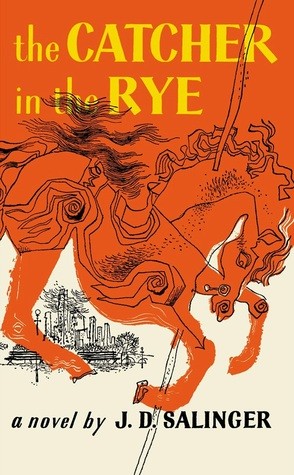
When I heard this story, a chill passed through me. Burning books? That’s what we are devolving to now? I understand that parents may have concerns about the content of books, and I respect that some people might be offended by the content of Toni Morrison’s Beloved or Salinger’s Catcher in the Rye. I’m all for transparency about book content and the freedom to choose alternatives. However, the recent rise in calls for book removal, and this specific instance of calling for book burning, have me very concerned about where we are heading in this country, and how politics is seeping into the once mundane and, dare I say, boring world of school board meetings.
Some history on book burning
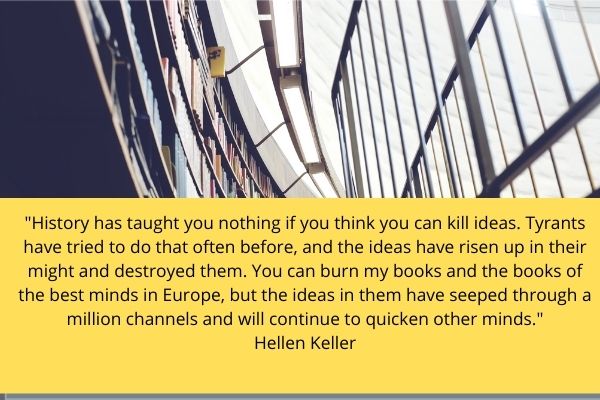
In 1933, university students in towns across Germany burned over 25,000 books by Jewish and/or blacklisted authors: Sigmund Freud, Albert Einstein, Hellen Keller, Ernest Hemingway. At the time, the German minister of Public Enlightenment and Propaganda, Joseph Goebbels, told thousands of Germans that “the era of extreme Jewish intellectualism is now at an end. … The future German man will not just be a man of books, but a man of character. It is to this end that we want to educate you. … And thus you do well in this midnight hour to commit to the flames the evil spirit of the past.”
The American media expressed some shock, but one journalist, New York Herald Tribune columnist Walter Lippmann, took the book burnings as an ominous predictor of what was to come. He said, “”These acts symbolize the moral and intellectual character of the Nazi regime, for these bonfires are not the work of schoolboys or mobs but of the present German Government … The ominous symbolism of [this act and] these bonfires is that there is a government in Germany which means to teach its people that their salvation lies in violence.”
And so it did.
The Catcher in the Rye has had many challenges over the years
Books have been challenged and banned for a long time. Visit the American Library Association’s website to see books that have been frequently challenged and why. (I was shocked to learn from this page that as recently as 2001, books by J.R.R. Tolkein were burned in New Mexico because they were deemed “satanic”!) What’s new is the coordinated effort behind the removal of materials. We’re hearing stories about challenges across the country in places like Texas and Kansas. There were even calls for removal of materials at the last school board meeting in my own little old Wythe County.
According to Nora Pelizzari, a spokeswoman at the National Coalition Against Censorship, “What has taken us aback this year is the intensity with which school libraries are under attack.” She added that the apparent coordination of the effort sets it apart: “Particularly when taken in concert with the legislative attempts to control school curricula, this feels like a more overarching attempt to purge schools of materials that people disagree with. It feels different than what we’ve seen in recent years.” (From The Washington Post)
What concerns me
The world is very different now compared to 1933. Books are ubiquitous and come in many forms – paperback, e-book, audiobook. Posts about books fill Instagram and Twitter. Tik Tok videos promote books via Book-Tok. I’m not worried that we won’t have access to books. I’m worried about the mindset behind the desire to limit access.
Choosing to review, and perhaps even restrict books. for sexually explicit content is one thing. Although, I must point out there is more sex, as well as violence, profanity, and nudity, on the Internet than in any book. Also, books usually present edgy content in context – showing how characters are influenced and affected by it. You often don’t get context on social media. But, you can’t take down You Tube, much less burn it. So people are targeting something tangible – books.
Unfortunately, I doubt this line will end with “sexually explicit” books. In October, a lawmaker in Texas started an investigation into books that “contain material that might make students feel discomfort, guilt, anguish, or any other form of psychological distress because of their race or sex or convey that a student, by virtue of their race or sex, is inherently racist, sexist, or oppressive, whether consciously or unconsciously.” That’s getting into very gray, and very political, water.
On Saturday, when I ran into Walmart to pick up some socks, a man in a VFW hat greeted me at the entrance. “Hello there,” said the Veteran of Foreign Wars. I was in a hurry, but something about his age, the pins on his hat, and the way he smiled reminded me of my Dad. I stopped.
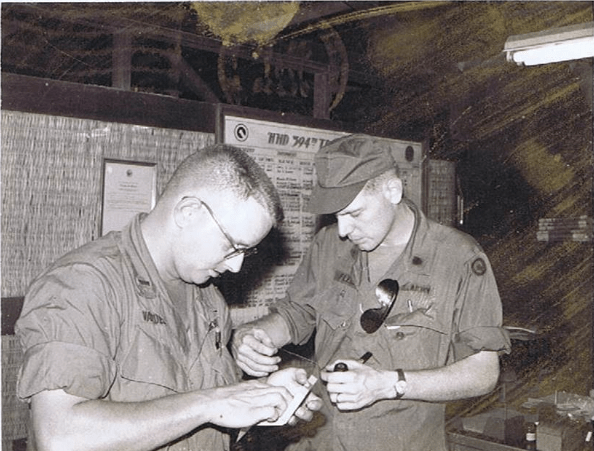
My dad passed away in April. He was a veteran of the Vietnam War and a proud wearer of baseball hats with pins that memorialized the things he loved: Civil War battle sites, the University of Virginia, and being an army vet.
I pulled out my wallet and put a bill in the VFW collection basket. The volunteer offered me a plastic red poppy, but I declined. I didn’t need a token reminder. My donation honored my dad, and giving it gave me a smile, and I won’t lie, and a few tears.
At church the next day, Terry, the pastor’s wife, spoke to the children about Veteran’s Day. She told them about the history of Veteran’s Day and why we celebrate it. Then she offered each of them a tiny green soldier to take home to remind them to pray. I almost took a soldier, but I have enough things of Dad’s in my house these days to remind me of him and to pray for vets.
What I didn’t have enough of was knowledge about the history of Veteran’s Day. Thank you, Terry, for the inspiration. And you too, Dad. Sorry I didn’t do this sooner.
My dad, on the left, in Vietnam, with his friend who sent me this picture. His friend apologized for the photo quality, saying, “we only had film cameras and had to send the film from Vietnam to California to get developed, so you didn’t throw any pictures away.” I think it’s a treasure!
The history of Veteran’s Day
According to History.com, Veteran’s Day started as Armistice Day on November 11, 1919, one year after the end of WWI. (For you Word Nerds, armistice comes from the Latin arma meaning weapons + the Latin sistere to come to a stand.) The name Armistice Day referred to the agreement between the Allied Powers and Germany to end the fighting of the first World War on the eleventh hour of the eleventh day of the eleventh month. In 1926, Congress passed a resolution to make it a yearly observance, and in 1938, it became a national holiday. In 1956, the name officially changed to Veteran’s Day.
On Veteran’s Day, we celebrate all veterans, living or dead, but especially living vets who served our country. Interestingly, Great Britain, France, Australia, and Canada also commemorate Veterans of WWI and II near November 11. In some countries, it’s called “Remembrance Day.”
According to History.com , there were 19 million living veterans in April of 2021. And Virginia, my home state, is one of the top three states with the highest percentage of veterans. Considering how many vets live near the national capital and in the Hampton Roads area, I’m not surprised.
Thank a vet!
My father in law is also a vet who served in the Vietnam War. His stories are so different from what you typically hear about Vietnam. He was a civil engineer in the navy, and he went into Vietnam later in the war to supervise the rebuilding of areas for the native people. He talks about what a beautiful country it is and how much the people appreciated what he and his men were doing. Perhaps I should ask for more stories this Thanksgiving. And thank him for his service.
Thank you to all veterans. It is no small job you’ve done for us, and you don’t get enough credit.
Do you know a veteran? Ask them for a story and thank them for their service this week.
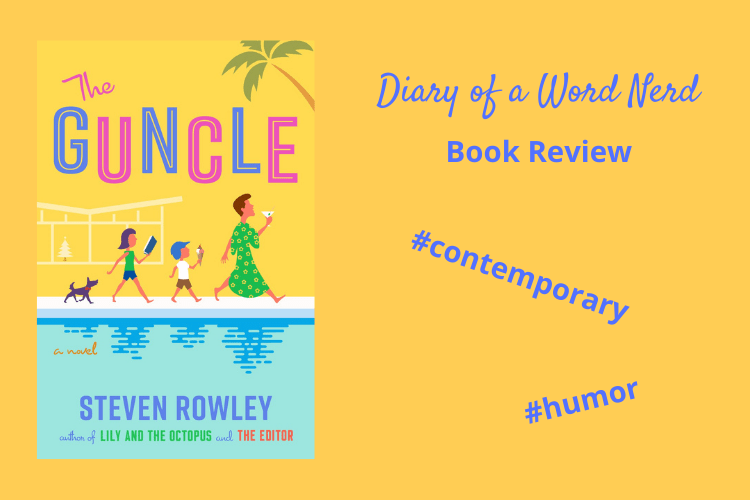
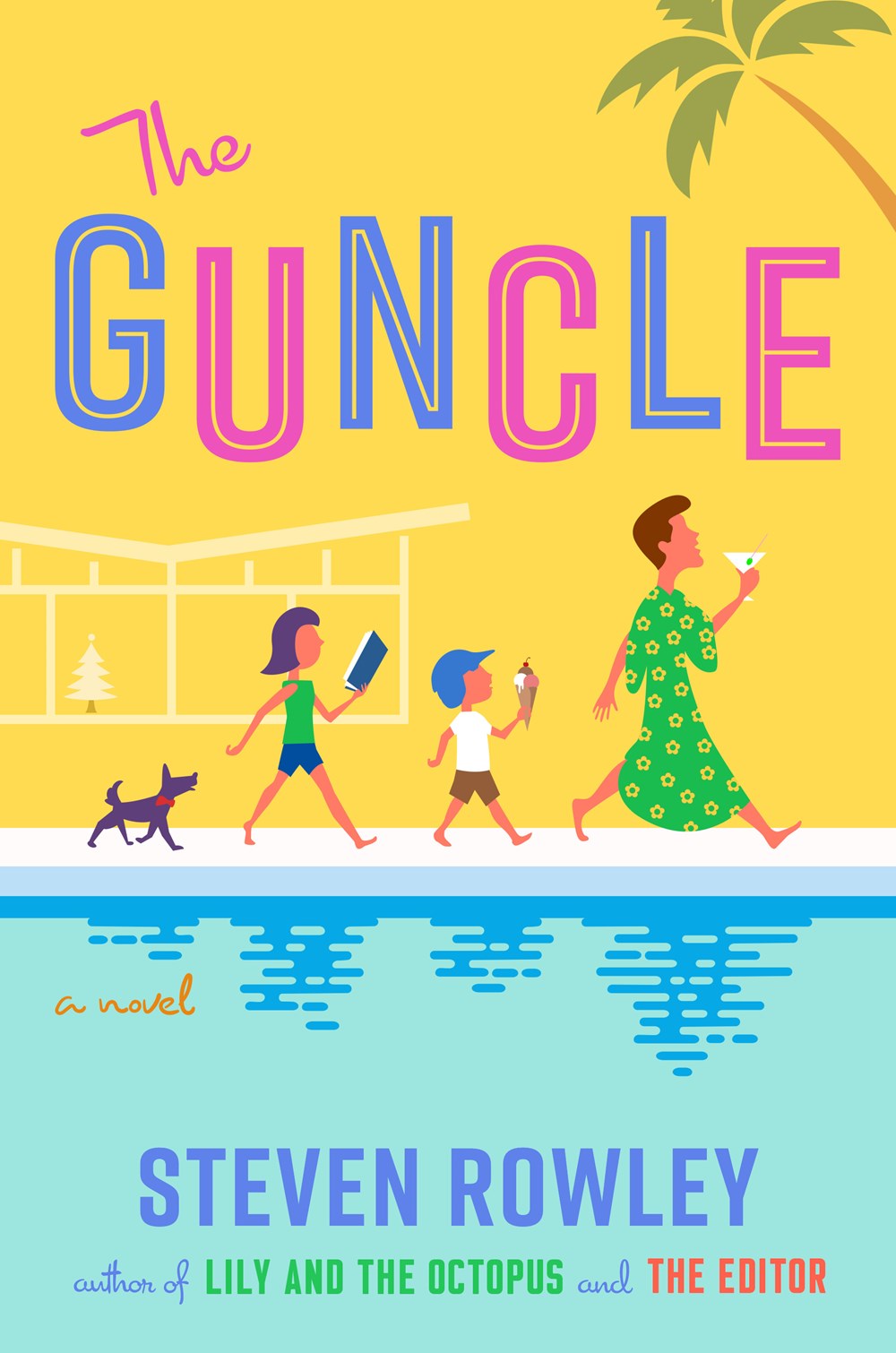
If you, like me, are tired of depressing headlines in your news feed and are dreading the stress of the holidays, let me introduce you to a warm, funny, and thoughtful gem of a book that might be the perfect distraction right now. The Guncle, by Steven Rowley, tells the story of Patrick, a once famous sitcom star who is forced out of his self imposed solitude when tragedy strikes his family.
The Premise
After his TV show was cancelled, and his long time partner Joe died in a tragic car accident, Patrick retreated to the quiet and sunshine of Palm Springs. When crisis strikes his family, he finds himself the sole caregiver of his niece and nephew. Patrick has plenty of money and lots of opinions about fashion, healthy eating, and society’s obsession with social media. However, he has a lot to learn about taking care of two children under ten and helping them navigate the murky waters of grief and loss.
What I Liked
Patrick is hilarious. His humor is witty, his commentary on social norms insightful. I love it when he says that everyone taking, posting, and re-watching videos of themselves is “masturbatory”. His references to pop culture suggest he’s about my age, a child of the 80s, and many of his quips made me smile. His approach to parenting is often unorthodox, but it’s obvious that he cares about his niece and nephew and wants to help them. His unusual approach to guiding his charges gently calls into question what we accept and do not accept as “okay” in parenting today.
When his niece Maisy doesn’t want to wear a girl’s bathing suit, Patrick definitively states, “There is no one right way or wrong way to dress.” When he “tag teams” disciplining his young guests while his sister is visiting, he observes, “wow, this really is easier with a partner.”
Patrick must help his niece and nephew as they grieve the loss of their mother, and in the process, Patrick navigates his own grief and ends up healthier for it.
Even though The Guncle deals with some tough issues, such as grief, death, cancer, and loss, it balances the heavy with genuine humor. I am currently grieving my father, and the book helped me to process my own loss without making me feel sad.
What I didn’t like
The Guncle or GUP are nick names for Patrick that focus solely on his sexual orientation – he is gay. I found this, and many stereotypes about gay people peppered throughout the novel, a little off putting. For example, Patrick’s neighbors are “a thruple” – three gay men living together. They like to swim naked and have statues of gay men with large penises scattered throughout their house. It seemed a little too “The Bird Cage” for me. However, the author, Steven Rowley, is gay, so I guess his sensitivities and understanding of this issue are better than mine.
Greenwashing is just what you might expect: companies trying to brainwash us into believing their products or actions are “green.” According to Merriam-Webster, greenwashing is “expressions of environmentalist concerns especially as a cover for products, policies, or activities.” To further illustrate the term, Merriam shares a quote from Fortune magazine:
As money pours in, critics warn that greenwashing is becoming endemic, as companies spin their behavior to attract ESG investors’ dollars. —
Katherine Dunn, Fortune, 11 Oct. 2021
Here’s another explanation of greenwashing from the Corporate Finance Institute. Greenwashing happens when “companies spend time and money advertising and marketing that their goods or services are environmentally friendly when, in fact, they are not. In other words, greenwashing is the act of making false or misleading claims about the environmental benefits of a product, service, technology, etc.”
Kinds of greenwashing to watch out for
Not only does the Corporate Finance Institute explain greenwashing, it also outlines practices companies use to convince consumers they are acting in environmentally ways.
Hidden Trade Off- A company might emphasize an environmental benefit over another problematic issue
No proof- claims are not backed by data or third party certification
Vague claims- companies make vague claims that lack specific details, e.g. a label of “all natural” or “recyclable” (just because it is recyclable doesn’t mean your community will accept it for recycling)
False labels – companies will create false labels or certification to make a product look like it has been approved by a green screening process
Irrelevant information- unrelated environmental issues are emphasized
Lesser of two evils- claiming environmental benefit for a product or service when there isn’t one to begin with, e.g. organic cigarettes
Fibbing – making claims that are false
What you can do to avoid being “greenwashed”
In a time when disinformation and misinformation run rampant, we must ask more questions. As with everything else, we need to seek reliable data and information about environmentally friendly claims. We also need to hold companies, individuals, and agencies accountable for their practices. Treehugger.com suggests looking for data, hard numbers, and comparisons to other products when considering a purchase. Consumers should also check if a brand is making sustainability a foundation of its business model. Most companies truly interested in the environment will make information readily available to the public via a website.
I must admit, in my desire to pursue more sustainable living habits, I have definitely been greenwashed. Now, when I see something is “recyclable” or that it has been “green certified”, I will look for more information about what that really means.
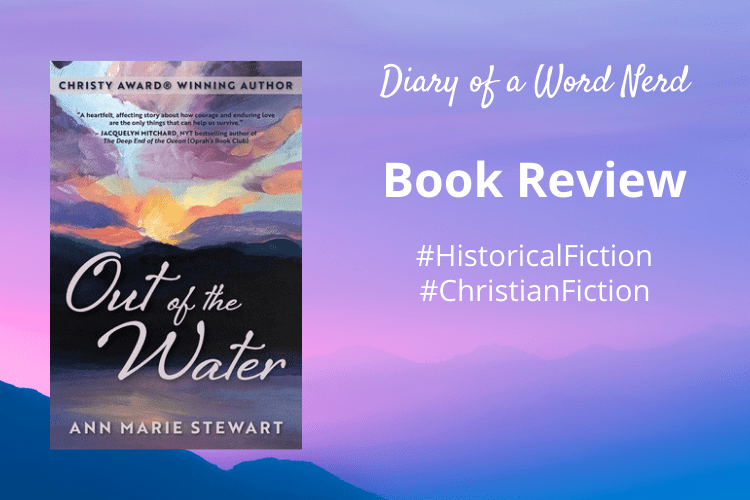
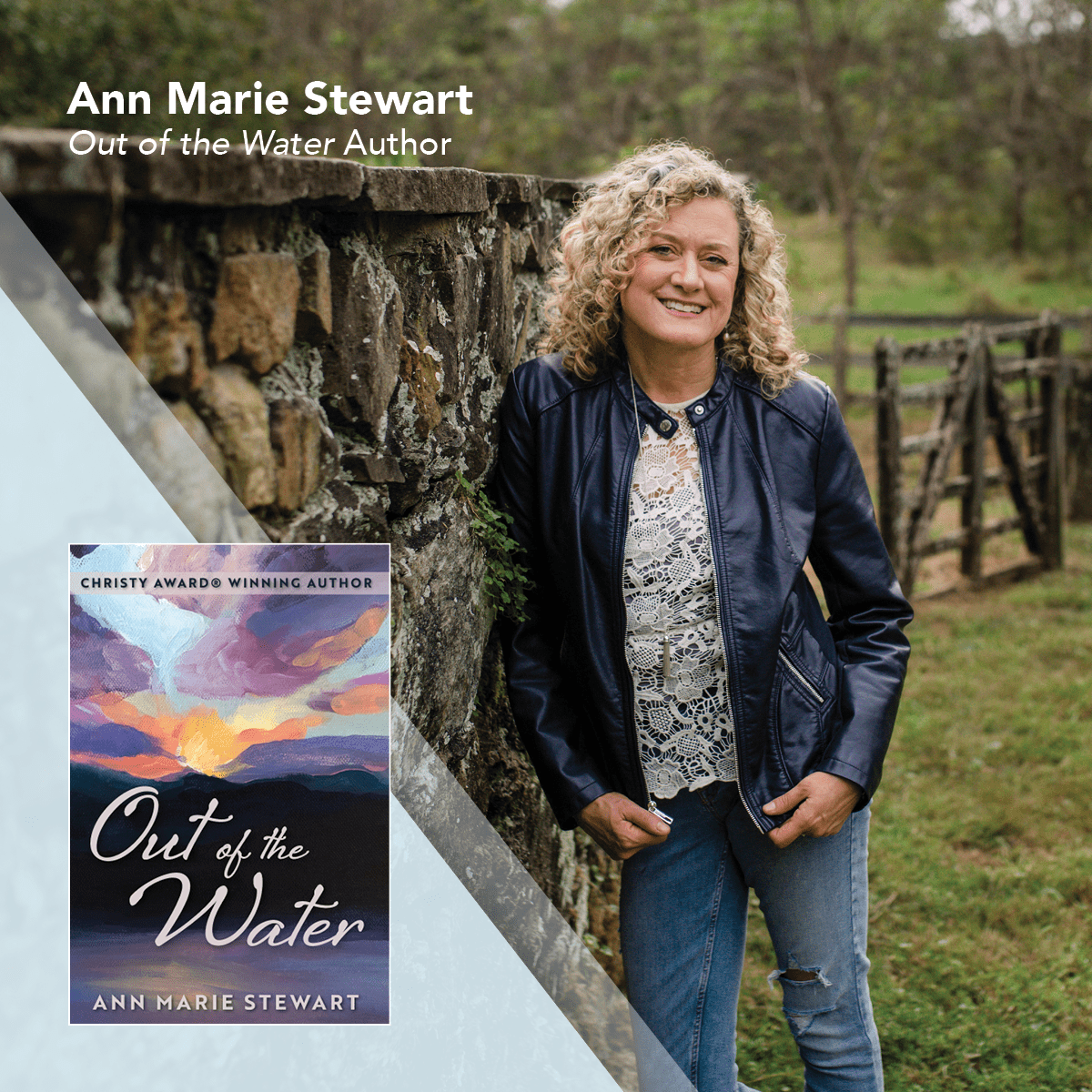
My friend Ann Stewart, winner of the 2017 Christy Award for best debut in Christian Fiction, has a new book releasing TODAY! Out of the Water spans over 60 years and three continents. It tells the story of Irish immigrant Siobhan Kildea, who in 1919 flees heartbreak and disappointment in Boston to build a new life in a Montana prison town. After tragedy tears her new family apart, she must make the most difficult decision a mother can – and the consequences ripple for years afterward.
I’m excited to have her with me on the blog to answer a few questions about her new release. But first, my review.
What I liked
I enjoyed the multiple historical settings Ann creates in Out of the Water, as well as the themes of motherhood, adoption, and the ramifications of our choices that she explores in her new novel. Out of the Water covers early 20th century Boston, the front lines of World War I, and the stark beauty of the American western states. I felt like I was right on the front with Nurse Genevieve and working the farm with Siobhan in Montana.
Ann’s characters face incredibly difficult choices about things like abortion, adoption, and what is needed to make a family. Although I didn’t always agree with those choices, I did appreciate the different perspectives and ideas each character offers. I also enjoyed the literary references and the focus on books as a way to grow and unite us.
I’m so excited to have Ann on the blog today!
Interview with Ann!
Julia: Out of the Water explores the theme of adopted/ chosen families. What inspired you to write about this?
Ann: I have always been fascinated with adoptions whether in my own family or with my friends. I always want to know the backstory, and so I chose to write one. Why do some children choose to seek out their biological parents and why are some satisfied without that information? What do they learn when they find a biological parent? Is it better to know their background or not? In each novel I write, I want a lingering question. In STARS it was “If the worst happens and there’s no one to blame, do you blame God?” Out of the Water asks, “Is it always better to learn the truth?” With some of the characters, readers may determine it is not. And yet there is an underlying lie in this novel —that is hidden –which causes a family divide. That topic is ripe for discussion in book clubs. I also volunteered at Special Delivery, a group which helped women in crisis pregnancies. Some were keeping their babies and some relinquishing. Very tough choices.
Julia: I enjoyed all of the different places and different moments in history covered in Out of the Water. Your description of the front lines of WWI was particularly memorable. (Scars on palms of the stretcher bearers – such detail!) How did you tackle research for this novel?
Ann: When readers look at the Digging Deeper section in the novel, they’ll see many books used for research. Once I learned that my daughters’ Alma mater had sent nurses to the Great War front lines at St. Denis, and I have a daughter who is a UVA graduate and nurse at UVA hospital, I researched that base. I found it particularly fascinating because they, too, were in the middle of a pandemic, and it was killing more than the guns and gasses on the battlefield. There is a Stretcher Bearer’s Manual and book entitled WOUNDED and many poignant pictures of the men up to their waist in mud. The idea that they carry no weapons but strive to recover and revive injured men in the middle of no-man’s land was both horrifying and heroic.
The research was often connected to unconnected ideas in the novel. For example, one child is mute after witnessing an unrelated tragedy. When reading in my Voice magazine, I learned of a stretcher bearer who lost his voice after being unable to retrieve a wounded soldier. They “treated” him by asking him to make the sounds of those he had left behind. I couldn’t even begin to believe that the two topics could intertwine in a 2020 magazine on Singing. Some research is straight off the internet, some books, some magazines, some interviews. I have a box of resources at my feet right now — a box under my computer desk. It’s filled with everything from Priest Lake to Deer Lodge, to Boston to a notebook full of research. That’s one phase and I have to keep going back to it over and over and over.
The PLACES are the best part of the research. I went where I like to visit: Boston, Priest Lake, Seattle, and DEER LODGE. After a friend kept talking about this quirky town, I visited and KNEW it had to be in a novel. I can’t wait to SHARE that place with readers. SUCH a fascinating back history and so much left there to mine.
Julia: Besides the mention of the story of Moses being lifted out of the water, I didn’t get strong Christian messaging in this novel. What distinguishes a novel of Christian fiction from regular / general fiction.
Ann: That is perhaps the most challenging question. Am I an author who is a Christian or a Christian author? I prefer to think of myself as an author who is a Christian. I want to write books that are read-eemable. They must have some element of hope and redemption.
But as I wrote this book, the themes of redemption, hope and reconciliation were very subtle. It became a book about appreciating and considering life at all stages: the unborn child, the baby without the possibility of parents, the elderly woman, the depressed father. I knew the title OUT OF THE WATER early on: It is straight from the verse that Moses was drawn out of the water. His mother made the most difficult decision of her life: to give him up so that he might have life. There is the parallel that God gave up His only Son that we might have life, but there is nothing heavy-handed. It’s not even being published by a Christian publisher and perhaps that’s why a Christian publisher did not take it on.
Where to find Out of the Water
Purchase Out of the Water through one of the links below: