I’ve seen it thrown around on social media and heard it discussed on my favorite podcasts: splooting. It sounds silly, and after a quick Google search, I can confirm it looks silly too! What is splooting and why is it a trending word this summer? The Word Nerd has you covered!
Definition of splooting
Splooting doesn’t show up in Merriam-Webster’s search engines, but it is popular slang. According to Dictionary.com’s slang dictionary:
Sploot is slang for the pose an animal, especially dogs, cats, and other four-legged pets, makes when it lies on its stomach with its hind legs stretched out back and flat. The term is especially associated with Welsh corgis and is used affectionately in the internet slang of DoggoLingo.
Dictionary.com – slang dictionary
My dog definitely sploots. How about your pet? Supposedly, cats sploot too. And also squirrels.
The Guardian recently published an article about splooting that quotes science professor Dan Blumstein. He explains that many mammals spread out with their legs behind them, or sploot, to cool down. By splooting, they expose the belly, which has less fur, to a cool surface.
If you see a squirrel lying down like this, don't worry; it's just fine. On hot days, squirrels keep cool by splooting (stretching out) on cool surfaces to reduce body heat. It is sometimes referred to as heat dumping. pic.twitter.com/pD1T3lPbBH
Sploot comes from the growing vocabulary of “DoggoLingo”, a popular online language that uses intentional misspellings and onomatopoeias to describe dogs and the pictures and memes people post of them. This lingo started gaining popularity in the 2010s. Ever heard someone call their dog a “doge” or say a lab is “chonky” instead of chunky? That’s DoggoLingo. It’s believed this DoggoLingo started in Australia. This video gives more (humorous) examples:
According to lexicographer Grant Barrett of the A Way with Words radio show, sploot might have started as a variation of “splat”, which describes the sprawled out position a mammal assumes while splooting.
There you go! Now you know all about splooting!
What’s another slang term you’ve heard lately and don’t understand? Can you share more examples of DoggoLingo? Please do so in the comments.
When my first child left for college, the transition shook me harder than I expected. It took me a long time to process, and overcome, what I would eventually label my grief. I feel pretty certain, looking back, that I was clinically depressed. Four years later, I am preparing to send child #3 off to college. I *think* I am ready, although emotions have a wily way of bubbling to the surface when you least expect. (Cue the tears in the Walmart cereal aisle when I see the granola my child loves.)
But I have good news for you. I survived! Not just one, but TWO children leaving my nest. Yes I cried, but I also, with the passing of time, saw that change, although difficult, can also be good. For all you moms out there preparing to drop off a first child, or maybe a last, or anyone in between, I have some wisdom and encouragement to share.
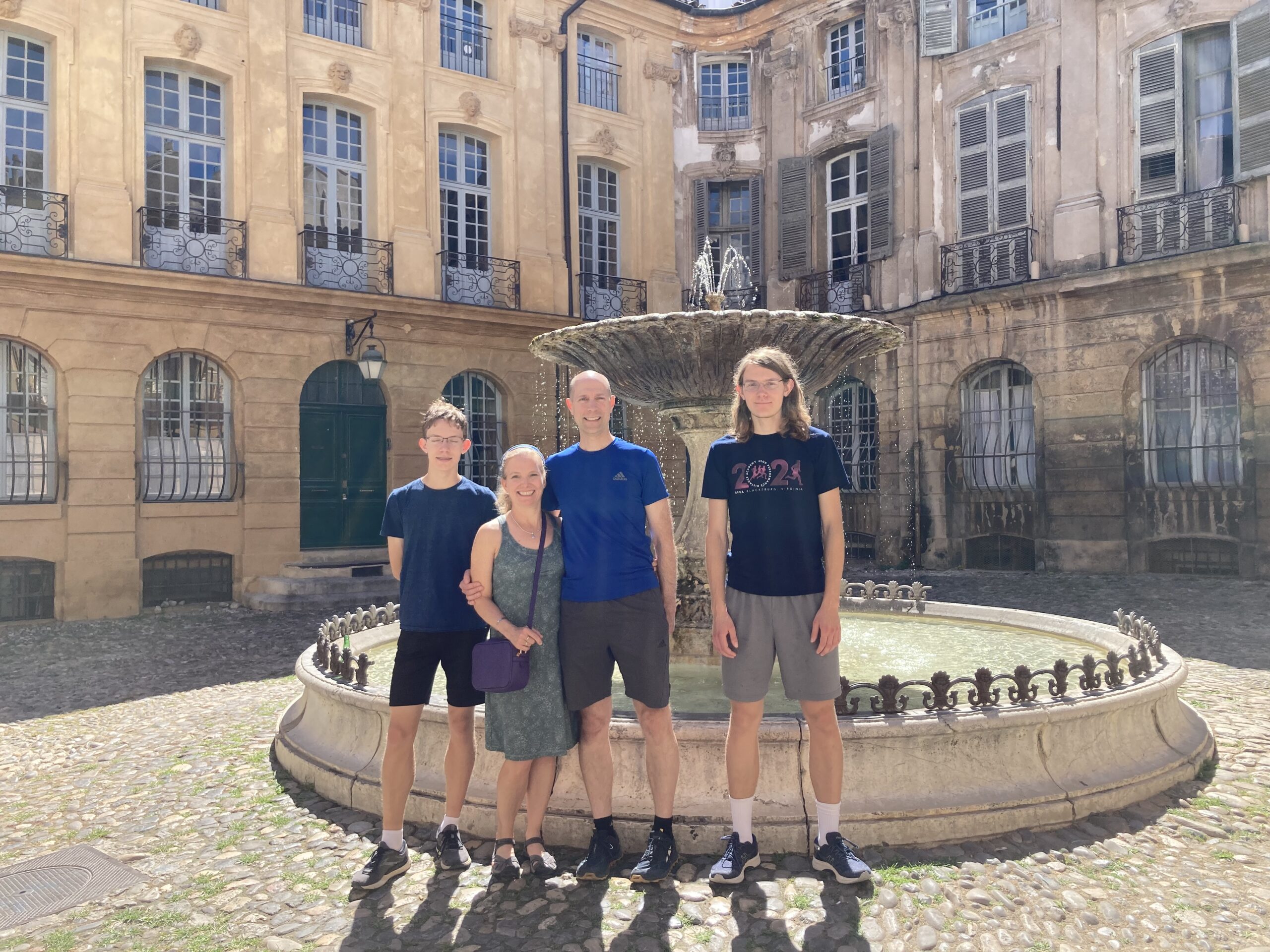
Me and some of my people in Aix en Provence, southern France.
First, and this is encouraging only in the sense of commiseration, leaving your kid in a dorm room is hard. There’s no way around it.
Yes, you are happy for them. Yes, you want them to be independent, productive adults. Yes, this is part of the normal maturing process. But it’s DIFFERENT. And in the weeks of late August and September, little reminders poke you in the heart every day. The bedroom is empty. The seat at the dinner table – vacant. The house is one child quieter, the grocery list a little shorter.
I have two vivid memories from the wake of child #1 leaving. First, my friend Caroline saying (because her first child left at the same time), “They have lives now that we won’t know about.” That seems obvious, even healthy, but after spending 18 years clothing, bathing, feeding and interacting with a person every day, a Mom feels the absence of that person with painful clarity.
Second, a few days after child #1 left, child #3 wanted to move out of the bedroom he was sharing with child #4. That meant cleaning child #1’s photos, books, and mementos out of the room. I took a deep breath and tackled the bulletin board first. The tears started violently and immediately. I mean ugly crying, with snot dripping down my chin and a little bit of hyperventilation. Child #3 didn’t quite know what to do with me. With the removal of every thumb tack and photo, the sobbing resumed.
Eventually, I got the room in order. Eventually, I didn’t cry so much. Child #1 had lots of fun at college. He made great friends, tackled leadership positions, and designed a lot of computer gizmos. (I try to keep up with all of the computer engineering lingo, but I’ll keep it basic here.) About two years into his college career, child #1 gave a presentation about his faith walk, and I got to witness it. While he talked, a realization hit me. My child could not have gotten to where he was without leaving me. I could not give him the things he needed in order to blossom, but other people and places could. And he was better for it.
Again, it sounds obvious and basic, right? But for me, it was a huge revelation. A huge step forward in my growth in the ability to let go, trust the process, and fret less. (Ironically, as I write this, child #3 is playing “Let It Be” on the piano.)
Life is definitely different with older kids, but not worse. Before child #1 left, I worried about communication, even tried to enforce a weekly phone call requirement, but that wasn’t received well. With time, we established a regular rhythm of communication that worked well for both of us, and that healthy pattern of communication remains intact today. This week, he’s off with friends in the western states, and he called me yesterday, “just to check in.” That is good. That is healthy.
My world hasn’t shrunk because my children are launching. It has expanded. Because of them, I have traveled to Europe, learned a little conversational French, tried my hand at Pinochle. I’ve discussed interesting ideas about policy, world history, and management styles. I know what a GUI is. And, I’ve met more people, seen more places, and grown in my love and appreciation for my kids more than I thought I could.
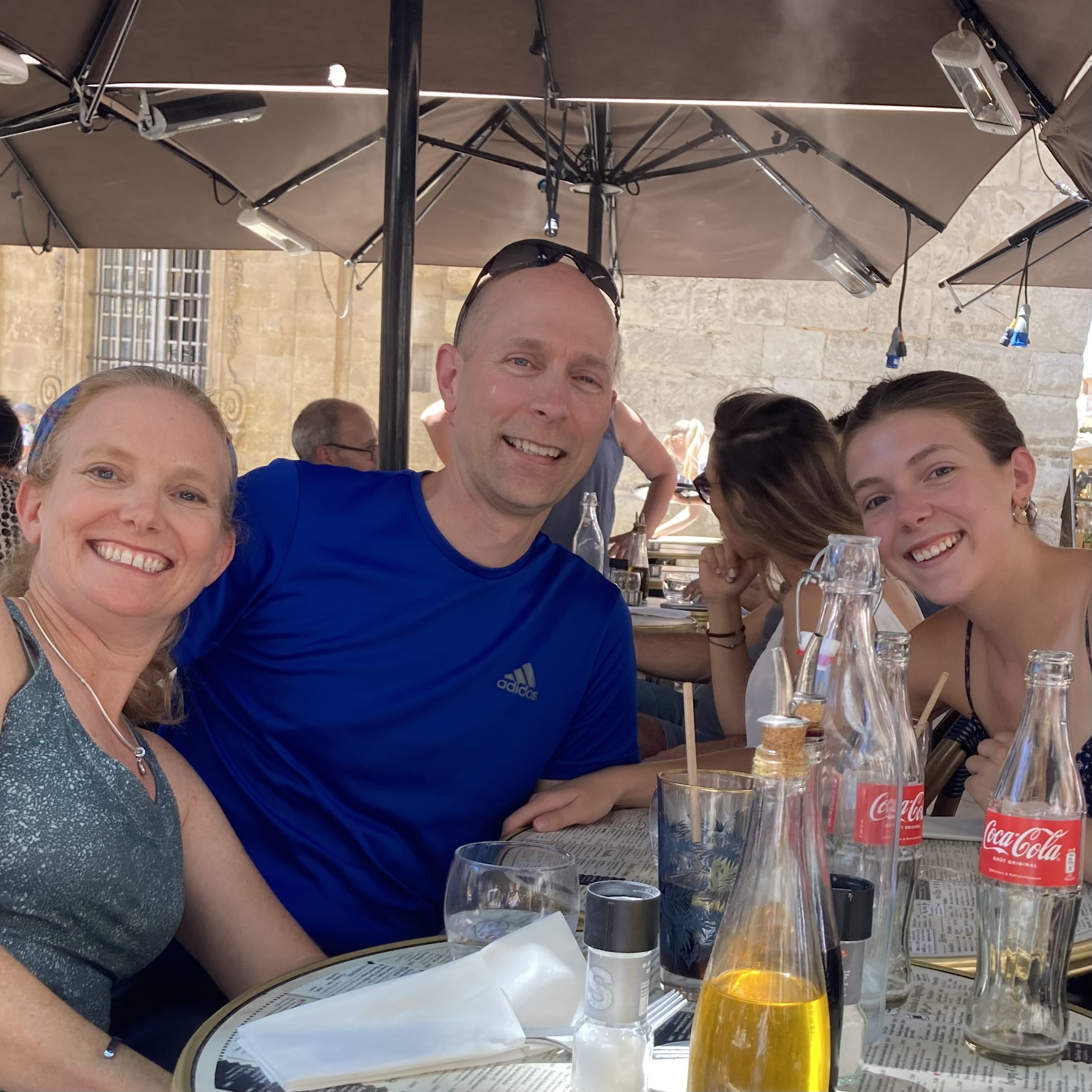
Enjoying lunch at a cafe in Aix en Provence.
Change isn’t bad, it’s just different, and it is one of the few consistent aspects of life. The sooner we learn to roll with, instead of roll against, change, the healthier and happier we will all be. That goes for moms as well as the kids we love.
I enjoyed a fabulous vacation in Europe this summer, which included the obvious benefits of time with family, many servings of pan au chocolate, and a three hour tour of The Louvre. But the best thing I got from my recent trip to France and the UK was completely unexpected: a renewed sense of hope. The people, places, and ideas I encountered brought fresh optimism to my heart.
In a time when many of us are struggling mentally and financially, and losing faith in our institutions and leadership, I want to share reasons to hope.
First, a little perspective. Yes, America is skidding through a rough patch. We’re unhappy and argumentative, favoring division over discussion, and facing serious inflation. Things look bleak. But while I stood in a church in Wales built centuries before the American Revolutionary War, I grasped how young our country is.
The main portion of St. Collen Church, including this ornate wood ceiling, was built in the 13th century.
And, our country is certainly not the first to experience challenge and division. Walking the streets of Paris that were bloodied by The Reign of Terror during the chaotic years of the French Revolution made the current state of the United States seem relatively tame. We humans have always tended toward power struggles and oppression. It’s not a great record, but it’s nothing new. Also not new: people prepared to combat the ugliest of human tendencies, to champion those without voices, and to call us all to higher moral ground. We have risen above chaos, tyranny, and war before, and we can do it again.
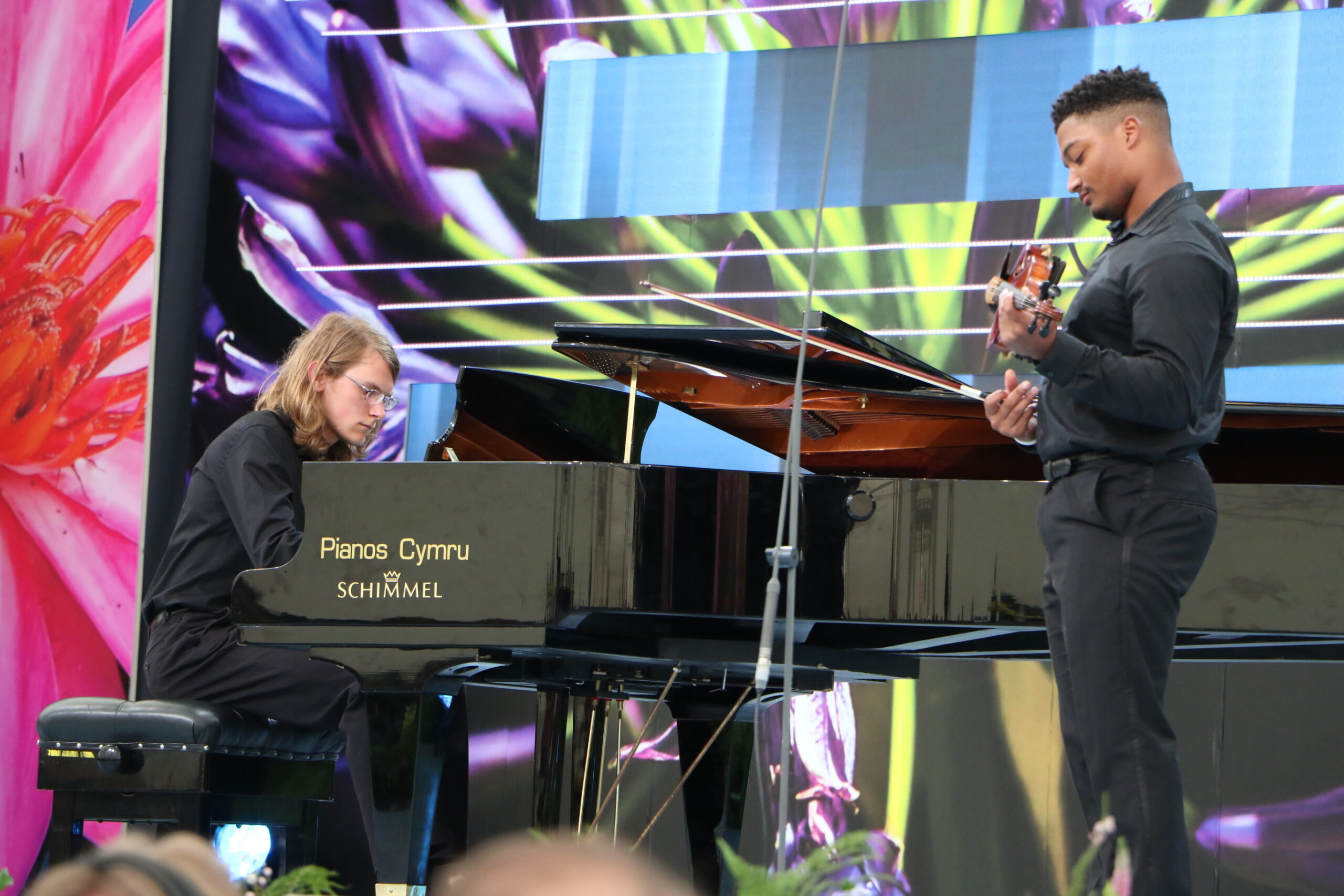
A great example of the triumph of human goodness was the Llangollen International Eisteddfod (music festival) that I attended in Wales. It’s kind of like our Chautauqua Arts Festival on a bigger scale. The people of Llangollen are very proud of their beautiful country and also quite proud of their eisteddfod. Organizers hosted the first Llangollen Eisteddfod in 1947 to promote unity after World War II. Groups from seven countries performed at that first festival alongside choirs from England, Scotland, and Wales. The idea was to facilitate harmony among countries via the common language of music. The Eisteddfod was a success and has been a standing tradition for the past 75 years.
The Llangollen Eisteddfod returned to in person performances this summer after switching to virtual festivities during the COVID pandemic, and we got to attend. Our family enjoyed performances from musicians and singers from Belgium, India, Austria, the Middle East, Kosovo, and the United Kingdom. During a particularly moving program, groups of school children with disabilities including autism and deafness sang a few songs. Then their director taught the audience how to sign the lyrics to “True Colors” by Cyndi Lauper, and we all performed it together. I got goose bumps as I sang and signed these words with hundreds of other people: “I see your true colors shining through. I see your true colors, and that’s why I love you. So don’t be afraid to let them show. Your true colors are beautiful, like a rainbow.”
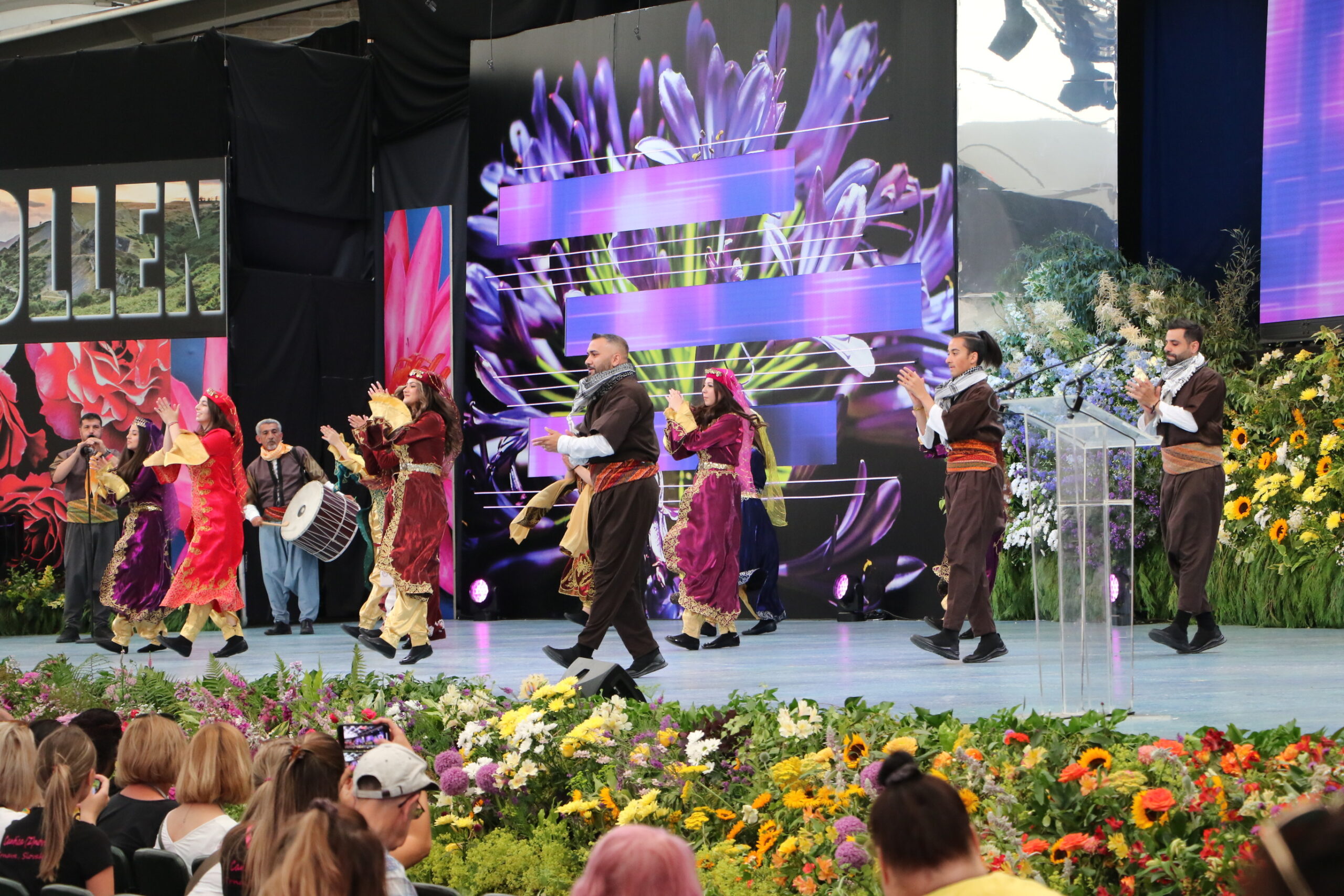
I got to watch a very special person perform. 🙂Kurdish dancers perform
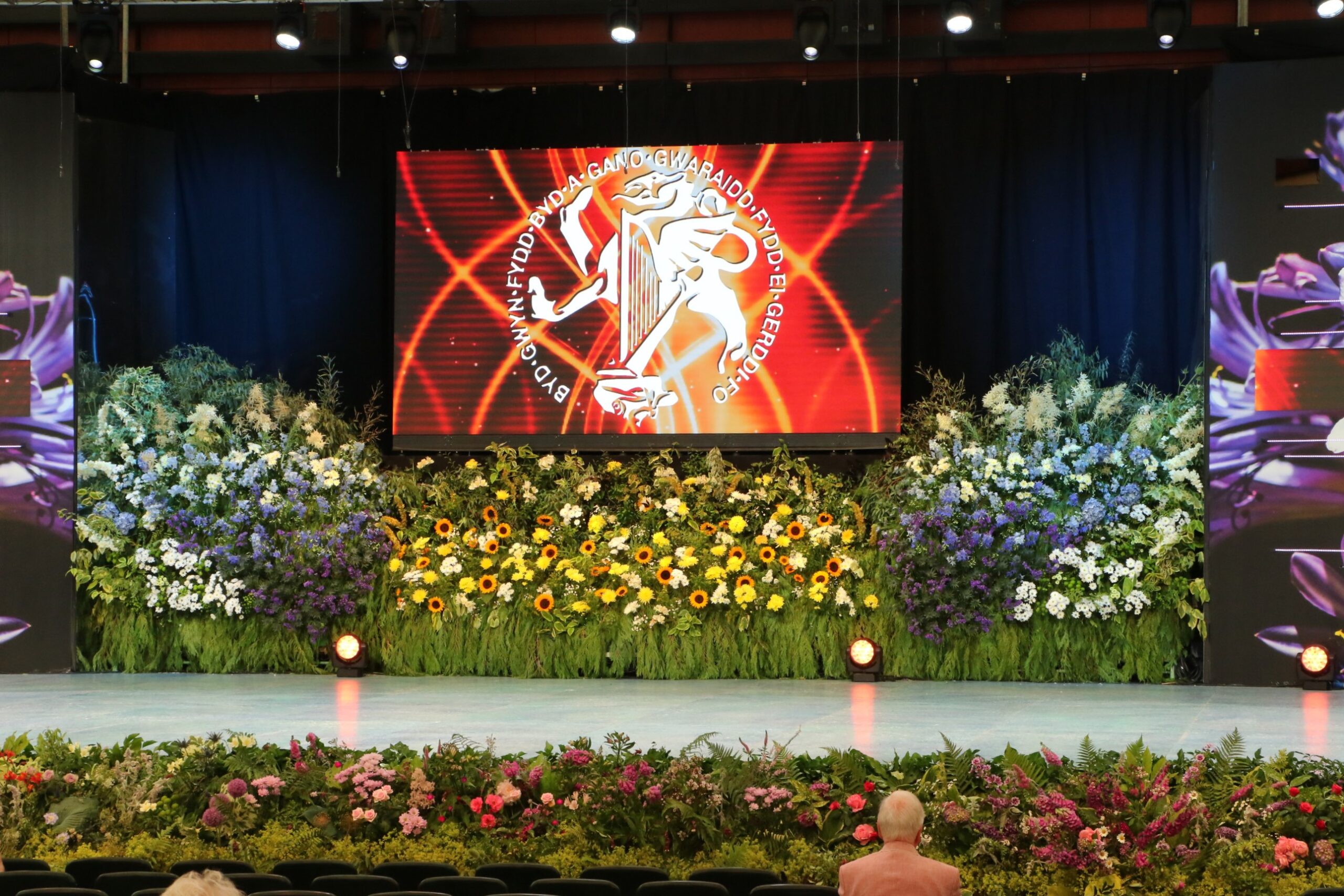
The atmosphere at the festival was positive and inclusive, celebrating diversity and embracing differences. The logo for the festival is a dragon (the symbol of Wales) merged with a harp. The motto for the festival is: “Blessed is a world that sings; gentle are its songs.” It filled my soul to be around so many people dedicated to inclusion and peace. There was also some really yummy Welsh ice cream with “flake” (aka, a stick of chocolate). Sadly, I couldn’t bring any of that back, but I do have a dragon sitting on my bookshelf.
The Eisteddfod stage was decorated with hundreds of flowers. The Welsh words circling the dragon/harp symbol say: Blessed is a world that sings and gentle are its songs.
Sorry it’s been so long without a Word Nerd post! I’ve been busy with the chaos of child number 3 graduating from high school and prepping for college. I’ve also had the pleasure of enjoying a long trip to Europe.
During my travels, I discovered plenty to share about, including some wonderful books and some fascinating insights about history, sustainability, and hope. I’ll start sharing those next week. In the meantime, I leave you with some lovely words and images from one stop of my journey.
More soon!
Blessed is the world that sings; gentle are its songs.
The words on this trophy are Welsh; they mean “Blessed is the world that sings; gentle are its songs.”The ruins of Castle Dinas Bran in Llangollen, Wales.
One of the things keeping me busy these days (and preventing me from posting sooner in June!) is tennis. Child number four has embraced this as his number one sport, and in an attempt to show motherly support, and because I can’t stand feeling like I don’t understand what is going on, I’m trying to learn all things tennis. I’ve watched more matches in the past three months (thank you, high school tennis season) than I have in the rest of my 51 years. And I’ve already picked up a few things, like what it means to “break” your opponent.
My son executing the all important serve
However, there are still many things that confuse me, like what is a “ground stroke” and most pervasively… THE SCORING! Who came up with this confusing system of games, sets, and matches? And why does the scoring jump from intervals of 15 to 10? And why, when you have 0 points, is your score called “love?”
When I asked my son, he didn’t know, so The Word Nerd got down to some research. Here is what I found. (Warning – like most things in life, tennis scoring does not have a well defined explanation.)
The scoring in tennis
I tried to type this up, got confused, and then found the scoring system efficiently and humorously explained at Neilson Active Holidays. Here’s how they put it:
Tennis is played in points: Four points win a game, six games win a set, and two or three sets win a match. You can decide how long you want your game to be but most matches are played as best-of-three or five set contests.
Service stays with one side for the duration of each of those four-point games, which – thanks tennis! – use a numerical sequence and French words that have no relation to actual values.
The sequence is:
0 points = love 1 point = 15 2 points = 30 3 points = 40 4 points = game
And that’s it!
Thanks again to tennis history you must win a game by at least two points, so if the two sides are drawn at 40 – 40 then “deuce” is called. The winner of the next point is awarded “advantage”, and can then win the game by taking the next point or be brought back to deuce if their opponent scores. There is no limit in the rules to the number of times players can tie at deuce.
Neilson Active Holidays
Oof. At the region semifinals, my son and his doubles partner went to deuce almost every game. The match took over two hours, but it was very exciting. As you can see, the scoring system is not intuitive or consistent. It’s also hard to follow because, in the case of high school tennis, there is no score board and often you cannot hear or the athletes do not call out the score. I even used a notepad to keep tally marks and still got the score messed up. Surely I will get better at this with time and practice. Luckly, child #4 is just a freshman.
The history of tennis scoring
Where did this crazy system of scoring come from? The short answer: nobody knows.
A longer answer has a bit more information but no more clarity.
Elizabeth Wilson, author of Love Game: A History of Tennis, from Victorian Pastime to Global Phenomenon, told Time.com in 2019, “I don’t think anybody really knows how it started or why it developed how it did.” Wilson says part of what makes the sport romantic and interesting is the history behind it that isn’t really history. More like legend.
Our modern game of tennis probably originated in a game played in 12th century France called “jeu de paume.” Players hit a ball with the palm of the hand until rackets were introduced in the 16th century. The game was very popular among royals and played at court as well as by clergy and commoners. In 16th century Paris, there were more than 1,000 tennis courts in use!
The article “Why is tennis scored so weirdly” from Time.com offers some interesting ideas as to why each point in a game has such a wide variety of values (15, 30, 40…). Some theories include relating points to the minutes that have passed on the clock, the distance between lines on the court, and influence of scoring systems from other games. But no one knows for sure.
Another thing I don’t understand: why is 0 points noted as “love?” Perhaps it came from the similar sounding word l’oeuf from the French, which means egg, which looks like a zero. Or the Dutch/ Flemish word for honor, lof, which would have been used by players relating a tennis match to a battle. Incidentally, “love” has been used since the 18th century to mean nothing in other racket sports as well as some card games, like bridge.
The etiquette surrounding tennis is also (supposed to be) different from other sports. Overall, the matches I attended this spring were much more pleasant than most other high school sporting events I’ve been to. (However, cross country meets remain the most positive sporting enviroments I’ve experienced. 🙂 ) The high school tennis coach encouraged us to stay quiet during the matches and to applaud or cheer only when a player made an exceptionally good shot. It is considered poor form to cheer when a player makes a bad play and loses a point.
Moving forward with tennis
Some people think the odd scoring system keeps an aura of mystery around the game. Some even argue it gives it a certain amount of pomp and formality that separates the tennis fans “in the know” from other sports enthusiasts. Whatever the origins or reasons behind the rules, I am determined to master the scoring system, and perhaps some tennis related skills, so that I can appreciate my son’s play and perhaps hit the ball with him on occasion.
Do you have other questions about tennis, or better yet, some explanations? I’d love to hear them!
As a Word Nerd, I believe it’s important to understand the words and terms we use. In my little corner of the Internet, I like to pose questions, gather information, look at nuance. Consider it a nice alternative to Twitter. This week, I’d like to take a nerdy look at a frequently used term from recent current events: The Great Replacement Theory.
What is replacement theory?
On May 14, 2022, a white 18 year old man entered a Buffalo, NY grocery store and started shooting. Eleven of his 13 victims were Black. Ten victims died. Authorities are trying to determine if a lengthy screed posted online was written by the shooter. That screed includes references to “white replacement” as well as “white genocide.”
So what do these loaded phrases mean?
According to multiple sources, replacement theory is a belief that there is an active, ongoing, and secret effort to replace white populations with non-white people in white majority countries. This effort is supposedly perpetuated by elites or globalists. Some followers of the theory accuse Jews of plotting the effort.
The term “the great replacement” was originally coined by Renaud Camus, a French man who published a book in 2010 called Le Grand Remplacement. It in, Camus asserts that Europe is being invaded by Black and Brown immigrants from Africa. His ideas sparked a far right, anti immigrant movement in Europe often called the “identitarian movement.”
Camus said he was influenced by Jean Raspail, the author of a 1973 dystopian novel The Camp of Saints in which starving third world refugees overrun Europe. The book went out of print, but in 1994, John Tanton’s publishing house, The Social Contract Press, brought it back into circulation. Tanton is considered a modern day leader of the anti-immigrant movement. He has founded several anti immigration groups in America, including Federation for American Immigration Reform (FAIR) and the Center for Immigration Studies (CIS).
The history of replacement theory
Concerns about white replacement or white extinction have been around since at least the 19th century in both America and Europe. In 1892, British/Australian author Charles Pearson cautioned his readers that white people would “wake to find ourselves elbowed and hustled, and perhaps even thrust aside by peoples whom we looked down upon.” His book National Life and Character inspired American authors to write similar books, such as The Passing of the Great Race by Madison Grant.Grant warned of the decline and extinction of America’s “Nordic” racial demographic.
Grant’s work contributed to the eugenics movement, which is “the practice or advocacy of controlled selective breeding of human populations (as by sterilization) to improve the population’s genetic composition.” (Merriam-Webster). Advocates of eugenics wanted to control reproduction to preserve “superior” races and ethnic groups.
In the early 1900s, Harry Laughlin was a leader of the eugenics movement in America. He helped design a quota system for American immigration policy that made its way into the 1924 Immigration Act signed by Calvin Coolidge. (The provisions of this act were overturned in the 1960s.) Laughlin also supported forced sterilization laws that were passed in 31 states plus D.C. and Puerto Rico. NPR reported in 2016 that 70,000 Americans, many of them women of color, were sterilized during the 20th century. Eugenics ideology spread around the world, and it permeated Nazi policies during the 1930s and 1940s. Eugenics gained notoriety later in the 20th century because of this association Nazi activities.
How replacement theory is showing itself today
Now, ideas about “white replacement” and “white genocide” fertilize the seeds sown by men like Laughlin, Grant, and Pearson. “White genocide” is a term recently coined by white supremacist leader David Lane. He wrote “The White Genocide Manifesto” while serving time in a U.S. prison for crimes he committed while active with the white supremacist terror group The Order. White genocide is also mentioned in the online screed attributed to the Buffalo shooter.
People concerned with white genocide fear that non-white immigration, mixed race families, abortion, same sex relationships, and drug and alcohol dependence will undermine White America with violence and crime.
Recent events show that not only is replacement theory still around, but also it might be gaining traction. Replacement theory, and/or white genocide, have been associated with several violent incidents from the past few years:
At the August 2017 rally in Charlottesville, VA, marchers chanted “You will not replace us. Jews will not replace us.”
The murder suspect in the October 2018 shooting at a Pittsburgh Synagogue cited replacement theory as motivation.
The shooter who attacked a mosque and community center in in Christchurch, New Zealand in March 2019 cited replacement theory in his screed .
The suspect who in 2019 fired shots in a synagogue in Poway, CA and set fire to a mosque in Escondito, CA also cited replacement theory as his motivation.
Ideologies like white replacement and white genocide are moving from extreme edges of American society into the mainstream. Tucker Carlson of Fox has talked about The Great Replacement on his show. And he is indoctrinating his audience with terminology and ideas from a replacement mindset. A study conducted by The New York Times reviewing five years of Carlson’s evening Fox show found 400 occasions when Carlson talked about Democrats actively seeking to change demographics, and therefore affect elections, via immigration policy.
Replacement ideology has been around for a while, but it seems to be getting more popular with Americans. Currently, one in three Americans believe that there is an ongoing effort to replace US born Americans, or legacy Americans, with immigrants for the purpose of electoral gain.
This is clearly an issue to keep an eye on. Many believe it has racist undertones and fuels racist violence. After doing much reading and research, I share that concern.
Learn more about replacement theory
If you are interested in learning more about replacement theory, white genocide, eugenics, or the people related to these ideologies, here are some places to start. As always, I recommend consulting multiple sources from a variety of viewpoints.