

The Host opens this week. It’s the movie adaptation of the book by Stephenie Meyers. In case you haven’t had access to media for the past five years, she’s the lucky lady who wrote the  Twilight series.
Before you run to the theater, there are a few things you should know:
- The Host is science fiction. No vampires, just aliens.
- No Robert Pattinson. Sniff.
- The Host, as a novel, was billed as “adult” fiction, but from what I can tell, they are gearing the movie to teens.
- The plot includes a love triangle, well, really a quadrilateral, with only three human bodies.
Let me explain.
Note: This is all based on the book.
Premise
An alien race has invaded Earth. They are small, silvery “souls” that insert themselves into human hosts. You know that a human has been “taken” because their eyes have a silver glow once a new “soul” implants.
The main character, Melanie, refuses to surrender. When cornered, she throws herself to a violent death rather than be used by the invaders. But they recover her body, heal her (they have amazing medical powers), and implant “Wanderer.”
Very quickly, Wanderer realizes that Melanie has not fully left her body, and the two souls must coexist.
Melanie wants to find Jared, her human boyfriend. Eventually, Melanie and Wanderer discover him, with many other free humans, hiding in an extensive community carved into desert caves, away from the prying eyes of the invading species. The humans in hiding take Melanie/Wanderer in, but with serious reservations.
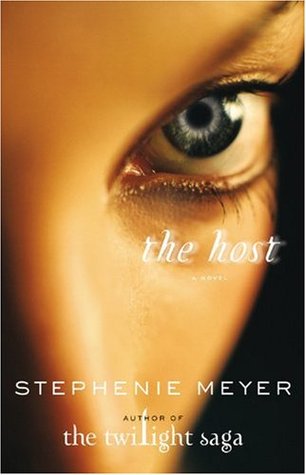 While Wanda struggles to fit in, Melanie longs to be with Jared. But she gets irritated when she senses Wanda’s attraction to him. And then Wanda falls for a different human, a guy named Ian, who actually likes her for being Wanda, not Melanie.
Confused yet?
I didn’t really like The Host book, but as a disclaimer, I don’t like aliens much. Meyers explores some interesting themes, like loyalty, courage, and the enduring power of love. Maybe the caves made me uncomfortable; I’m claustrophobic. My friend Kate, who had not read The Twilight series first, loved The Host.
The Movie
The Host movie trailer features more chase scenes, car crashes, and guns than I remember in the novel. It’s also got driving music a la Michael Bay and Transformers. In the book, Meyers portrays Jared as an “older” guy, like, closer to thirty. Worldly, experienced, strong. Max Irons, who plays Jared, looks mighty young. Cute, but young.
My guess? The studio hopes to hook guys with the action and girls with the pretty boys and drama.
Of course, I tried to sell my husband on Eclipse with the “action” line. At the end of the movie, he turned to me and said, “Really?”
Will I see The Host? Definitely not in the theater. And I’m afraid that once I tell my husband the source of the story, he’ll roll his eyes and refuse even a download later on. If I do watch it, I’ll be on my own.
How about you? Have you read The Host? What did you think? Do you plan on seeing the movie?
Thanks for stopping by!
Julia