
Vocabulary from Code Name Verity: Parsimonious

wondrous memeAre you ready to learn today?  Great!  We can all pick up some new words thanks to Kathy at Bermuda Onion and her Wondrous Words Wednesday meme.

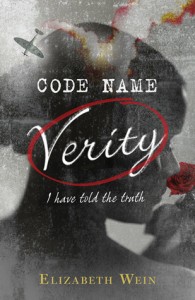
My new vocabulary word comes from the novel Code Name Verity by Elizabeth Wein.  Set during World War II, it is a story of deep friendship, told by a young woman who is a British spy and has been captured by the Germans.  She writes her confession for the Gestapo as a story, and that’s the story we read.


Early in Code Name Verity, a group of British women who have signed up to help the war effort hide in a shelter during an air raid.

A couple of them had had some sense to grab their cigarettes.  They passed them ’round, parsimoniously sharing.

Parsimonious is definitely one of those words I know I studied in school and forgot from lack Code Name Verityof use.

parsimonious \pär-sə-‘mō-nē-əs\ adj; parsimoniously = adv; from the Latin parsus and parcere, to spare; exhibiting or marked by parsimony, the quality of being careful with money or resources; stingy, thrifty

With this definition in mind, I’m guessing the women reluctantly shared their cigarettes, letting each person only take one.

Word Nerd Workout

Think of a parsimonious character and write a sentence about him or her.  My example:

Ebeneezer Scrooge ran his business parsimoniously, counting out his profits at the end of each day.

Your turn!

Thanks for stopping by!

Julia 
Poetry + Children = Silliness

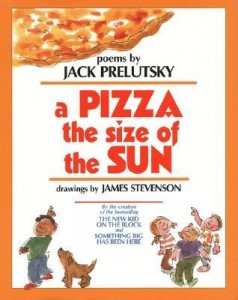
Please welcome my guest and fellow Wordsmith Studio member Mary Bauer.  She has Jack Prelutskysome great ideas about what motivates kids to enjoy and actually write poetry!

A colleague and I were sharing one day when we learned to love poetry: second grade.  Each of us had a teacher who celebrated our writing in some way.  I had a poem put up on the office wall.  She had one included in an anthology.  I hope that I inspire my elementary students in this way.

I enjoy reading and writing poetry, and I share my enthusiasm at school.  From my student teaching days twenty-five years ago until now, I always have Shel Silverstein or Jack Prelutsky within reach to read aloud when we have a spare moment.  I am excited when I see students picking out poetry on their own.

I always liked teaching various poetry forms, but over time I have learned the value. Reluctant writers are willing to tackle short pieces.  I can incorporate so many language arts objectives: parts of speech, syllabication, spelling patterns, and literary devices.  My students learn to use the dictionary and thesaurus as well.

More recently, I have been creating resources for other teachers.  I have a poetry blog called Poems of Silliness that can be searched by topic or tagged by poetry form.  I have written several paid and free poetry units for other teachers to use in their classrooms.  My favorite of these is the April Poetry Challenge where students write their version of NaPoWriMo – Thirty Poems in Thirty Days.

Here are some of my favorite online resources for poetry:

I love to connect with others who are interested in introducing children to poetry.  Please visit me at Artistry of Education or my Facebook Fan Page.

Mary Bauer


Mary Bauer has been teaching for 22 years in a district just north of Seattle.  Over the years she has taught kindergarten through sixth grade.  She currently teaches fourth grade.


Vocabulary from Code Name Verity

wondrous memeReady to learn some new words this week?  Welcome to the Wondrous Words Wednesday meme, hosted by Kathy at bermudaonion.net.  Join me, Kathy, and a bunch of other bloggers sharing words that we looked up recently.

My favorite word from last week was one of Kathy’s: termagent: an overbearing or nagging woman.  This word can also be used as an adjective.  Very cool.  We all agreed that we never wanted to be called a “termagent.”

This week I’ve started a new book: Code Name Verity, by Elizabeth Wein.  I felt pretty sure I knew what verity means, but I wanted to double-check.

Code Name Verityverity \’ver-ə-ty\ noun from Latin veritas, true; something that is true, especially a fundamental and inevitably true value, such as honor, love, or patriotism; the quality or state of being honest

This book has started off very slowly; it’s about a young female British spy caught by the Germans in WWII.  She’s writing her “confession”, but it’s a long, rambling, and often interrupted story. The reviews on Goodreads and Amazon give it four out of five stars, so I’m hanging in there.

Word Nerd Workout

Name a “verity” or inevitably true value besides the three I listed above.  Think of books that you have really enjoyed- did they have a theme that centered around a verity or “big idea”?  What was the truth that meant something to you or the characters?

Also, has anyone read Code Name Verity and if so, am I right to stick with it?

Thanks for stopping by!

Julia 

Eight Tips for Inspiring a Love of Poetry

Please welcome my guest and fellow Wordsmith Studio member Bolton Carley as she shares some suggestions for helping kids learn to love poetry.

DSC_0018Do you have a mini-me poet on your hands, or a budding writer, or are you just hoping your child can be one of the learned ones?  Whatever your reasons, I can help entice your child into loving poetry.

Age may play a factor in which approach you take, but these are all tried and true ways to get your child on board with poems:


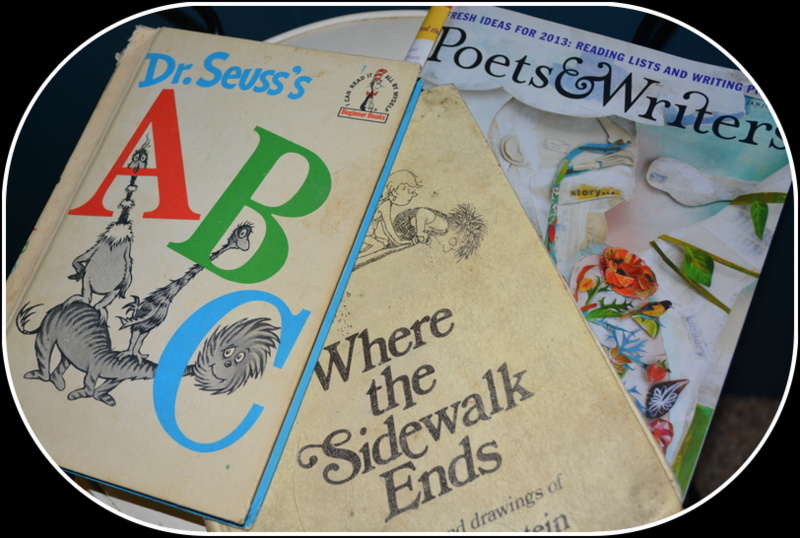
  •  Start early, with the best poet of them all:  one Dr. Seuss aka Theodor Geisel.  Who can resist the nonsensical rhymes and fabulous illustrations?


  •  If you’re past the Seuss stage, but still ready for some fun, be sure to read Shel Silverstein or Jack Prelutsky at bedtime.  Both offer quality humor and rhyming for any age, but getting an ingrained love of reading early on age always helps out later in life!


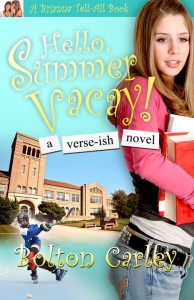
  •  If you’ve already hit the less-than-receptive years, don’t worry.  Try out some verse novels. book cover They are perfect for reluctant readers.  Poems that tell a story are a quick read.  No kid can resist easy AR points when the book looks short and easy.  Check out Shakespeare Bats CleanupLove That Dog, or even my own Hello, Summer Vacay!  If you put it on their phones for easy access, I bet they’ll pick it up (probably at a sibling’s boring sporting event or sitting in the car while you run errands, lol).


  • But if the struggle is even getting them to open a book, I still have answers.  First off, wait till they’re singing loudly in the car to a song on the radio.  Politely ask how they feel about poetry, to which the standard answer will be “ew” and then point out their vocal prowess suggests otherwise because they are listening to lyrical poetry.  Print off some lyrics to their fave songs (the appropriate ones of course) like Natasha Bettingfield, Taylor Swift, or even Bieber if you must, to show how the words make a poem on paper.


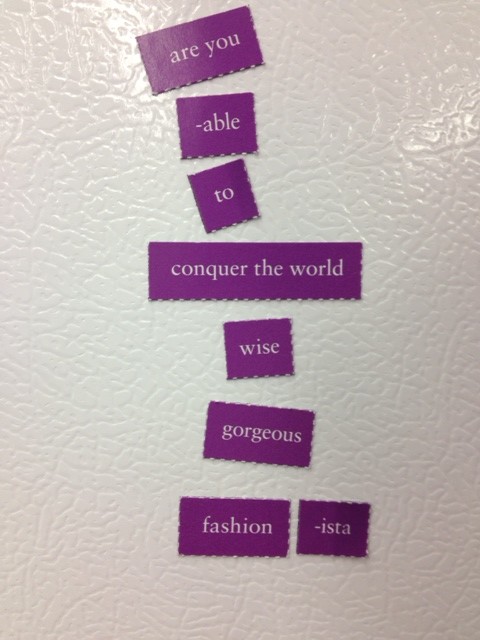
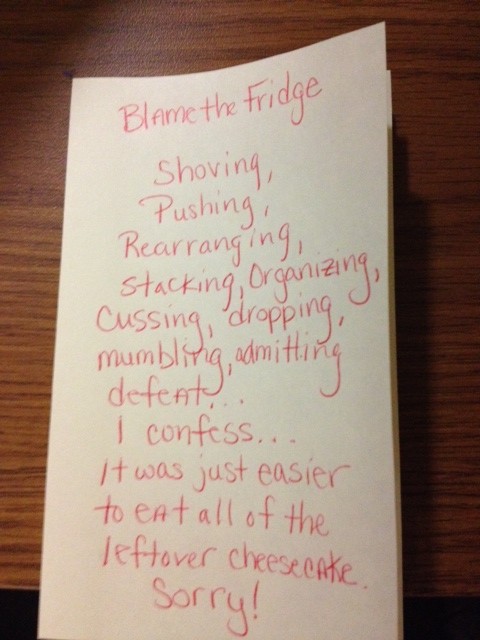
  • Not sure that will work?  Sneak the poems into their daily grind.  Try loading up on some refrigerator magnet poetry.  Leave messages on the fridge in poem form.  Get the rest of the family to join in with funny verses, instructions for chores, or appointment times in haiku form.  A new note everyday leaves kids wanting to check out the fridge and makes them feel included.  If a kid assigns a warm, cozy feeling to poetry they are more likely to keep it close to their heart.

 photo (34)

  • Afraid your kids won’t find the fridge fun?  No worries.  What about texting them pictures of post-it note poetry or random poems you find that sound exactly like them?  Perhaps they are the epitome of Sara Cynthia Stout who refused to take the garbage out (Silverstein).  Maybe they just went through a horrible break-up or got their first zit.  Just check the internet for poems about any topic or send them to YouTube.  You can never go wrong with a text, nor with words that flatter them.  Trust me.

 photo (33)

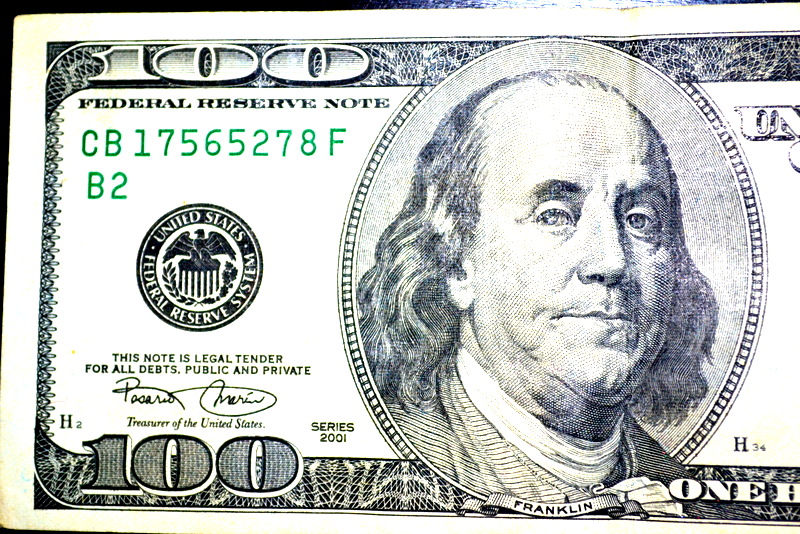
  • Think your son or daughter needs motivation to play the poetry game?  Well, show ‘em the money, scholarships, and places on the internet they can submit their poems.  Nothing like money and press to get kids involved.

 DSC_0049

  • When all else fails, find some poems with innuendo or foul words and be sure to insist they don’t read it.  They’ll be on it for sure.

And if none of that works, you can always go back to the tried and true “Do it because I said so!!” lol.

What methods can you recommend to encourage a love of poetry?


Bolton CarleyAs a self-proclaimed herder of kids, cattle, and words, Bolton Carley is a blogger, writer, teacher, and farmer’s daughter keen on finding the humorous side of life.  Residing in Bellevue, Nebraska, Bolton Carley lives with her fabulous husband and laptop.  She teaches middle school, enjoys photography, and loves all types of writing including chick lit, poetry, blogging, flash fiction.


Visit Bolton at her funny slice-of-life lessons blog, her poetry and photography blog, or her e-vice column.  Readers can purchase her young adult verse novel, Hello, Summer Vacay!  at www.amazon.com.   Or catch all of her activities on Facebook or Twitter.


Vocabulary from The Fault In Our Stars: Ontologically

wondrous memeWelcome to Wondrous Words Wednesday, hosted by Kathy at bermudaonion.net.  It’s a great chance to expand on your (already awesome, I’m sure) vocabulary.

My favorite word from last week:  mysophobia- a dread of dirt, filth, or unpleasant subjects, shared by Kelly at The Well Read Red Head.  My eleven year old daughter suffers from mysophobia- especially at the dinner table.

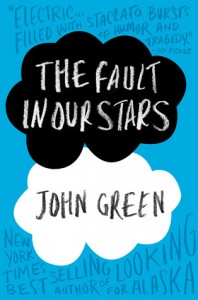
This week I’m sharing still more vocabulary from an awesome book that you must read: The Fault In Our Stars, by John Green.  I first read it last spring, and at that time highlighted inexorable and sobriquet in a vocab post.  But John Green packs so many awesome words into his book, I had to mention another one.

“Well,” Peter Van Houten said, extending his hand to me.  “It is at any rate a pleasure to meet such ontologically improbable creatures.”

Hazel, the protagonist, goes on to wonder, among other things, what ontologically means.  So did I.

Ontology \än-tāl-ə-jē\ noun, from the Latin ontologia; a branch of metaphysics concerned with the nature and relations of being

TFIOSSo, Peter is apparently impressed that Hazel and her friend Augustus, both cancer patients, have being- that they are alive.  Ontologically a perfect word for this book, as the main characters have a lot of metaphysical discussions about existence.

Word Nerd Workout

Good grief, I’m not going to ask you to put this word in a sentence.  Or try to figure out a synonym.  How about you share your favorite method for finding words you don’t know.  Now that I have my Merriam-Webster app, I use that a lot.  Or the good, old-fashioned hard copy of Webster’s.

What do you use?  Thanks for stopping by.

And go read The Fault in Our Stars!

Julia


How To Get Kids Excited About Poetry: Reverso

Mirror, MirrorWelcome to April: Poetry Appreciation Month!

I know, I know.  You read books.  Not poems.  Believe me, I hear it from my family every year at this time, when I pull out the poetry anthologies and force them to *endure* some haiku, Silverstein, and rhyming couplets.

Reading poetry serves any word nerd well.  It gives you appreciation of word play, rhythm, figurative language, and rhyme.  Sometimes, it will make you laugh.


For kids, it’s a great way to play with rhyme and practice expressive reading.  I guess that’s good for us grown ups too.

Don’t worry, I’m not going to subject you to Shakespeare or Wordsworth here (although a sonnet could be fun).  However, for the next few Fridays, I want to coax you into the world of verse.  Hopefully, you’ll find something appealing.

Reverso

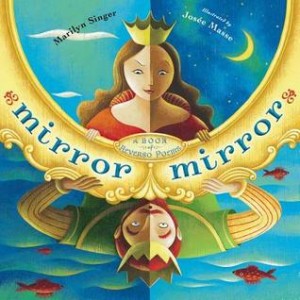
Today, I’d like to introduce you to “reverso.”  Poet Marilyn Singer, in her children’s book Mirror, Mirror, presents poems, based on fairy tales, that can be read two ways: up or down.   By only changing capitalization and punctuation, she gives the same poem a different meaning by flipping it, and writing it from end to beginning.  For example:

A cat

without

a chair;

Incomplete.

Reverses to:

Incomplete:

A chair

without

a cat.

Pretty cool, huh?

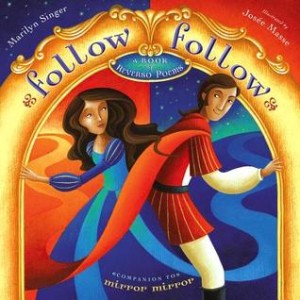
Singer suggests that reverso poems can be a creative way to tell two sides of one story.  Just Follow, Followthis year, she released a second book of reverso, called Follow Follow.

Now, normally, this is the spot in the post where I’d ask you to create your own reverso poem.  But I’ve tried.  For a long time.  This flipping thing isn’t as easy as Singer makes it look.

So maybe just check out her books, enjoy the fantastic illustrations, and marvel at her Word Nerd prowess.

And pull out a book of poetry sometime.

What poems or poetic forms have you enjoyed?  Can you recommend any books of poetry for the rest of us?

Coming up next week, Bolton Carley, author of Hello Summer Vacay!, a young adult verse novel, shares some tips for encouraging a love of poetry.

Thanks for stopping by!

Julia