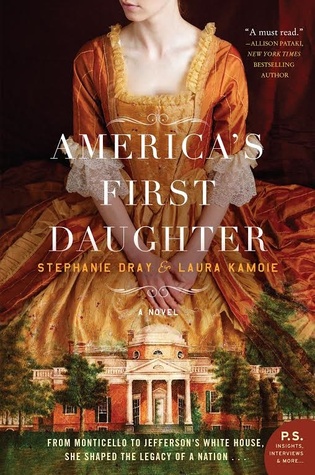
Historical fiction is not my favorite, so when I find a book in this genre that I like, I share it! America’s First Daughter, by Stephanie Dray and Laura Kamoie, is a fascinating novel that explores the life of Thomas Jefferson’s oldest daughter Patsy.
At first, I worried about reading America’s First Daughter. I am a graduate of Jefferson’s University, a frequent visitor of Monticello, and an avid admirer of Jefferson’s intellect, curiosity, and ingenuity. I know he had flaws, but I feared the novel would irrevocably tarnish my opinion of him. It didn’t. It did, however, give me a more accurate portrait of this Founding Father and the contradictions and challenges that colored his life.
The Story
America’s First Daughter opens in 1781 with the Jeffersons fleeing their family home at Monticello to avoid capture by British soldiers. A few chapters later, Jefferson’s wife Martha becomes gravely ill, and before she dies, she begs Jefferson to never remarry and tells her oldest daughter Patsy to take care of her father. At the tender age of 10, Patsy inherits the enormous responsibility of holding the Jefferson family together and protecting her father’s reputation. This unusual position brought Patsy a lifetime of burden as well as privilege.
What I Liked
- Every chapter begins with a snippet of a letter. We know so much about Jefferson because he kept detailed notes and wrote many letters. One such snippet, written by Jefferson in April 1820, reveals the inner conflict of the man who wrote the Declaration of Independence and who also depended on slavery for his livelihood:
There’s not a man on earth who’d sacrifice more than I would, to relieve us from slavery, in any practicable way. But, as it is, we have the wolf by the ear, and we can neither hold him, nor safely let him go. Justice is in one scale, and self-preservation in the other.
- I learned a lot about history. For example, I never realized that British troops threatened Monticello or that Jefferson suffered criticism for fleeing. I also never realized the link, both timely and philosophically, between the American and French Revolutions.
- Patsy Jefferson’s story is fascinating. Jefferson gave her some access to and influence in the world of politics, unlike most women of her time. And yet, she still faced enormous challenges serving her father both in public and private life while still managing a family that had many of its own problems. Her father was the “author of independence” and yet she often felt trapped. She says,
“… I never would have a say, because in the world…, men did as they pleased and women were left to simply accept the consequences.”
- Since I’ve been to Monticello many times, I enjoyed reading about events that took place in the house. I’ve stood in Jefferson’s office and other rooms at Monticello and could easily visualize scenes from the novel. For a floor plan and photos of the rooms, visit the Monticello website.
- I knew that Jefferson died in debt, but I never realized that it was largely because he was generous to a fault. He took his role as public servant seriously and entertained a constant stream of visitors at Monticello. He also took on debt to help and protect his extended family.
What I Didn’t Like
At times, the narrative felt slow, and it took me a while to finish the book. That might stem from my lack of enthusiasm for historical fiction as well as my current state of fatigue. Also, at times the wording sounded melodramatic. However, the authors used notes and letters from the time to replicate authentic speech for their characters.
My new view of Jefferson
America’s First Daughter deepened my understanding of Jefferson’s life and character. The things I love about this great man remain, but he was by no means perfect.
On the issue of slavery, no one can deny the paradox of a man who wrote “all men are created equal” yet kept slaves. Jefferson was a child of Virginia and believed wealth and stability were found in owning land. He, like many Virginia landowners, considered slavery a necessary evil. However, other Virginians, including his son-in-law Tom Randolph and close associate William Short, abhorred slavery and took steps to abolish it. While Jefferson manumitted (released) several of his slaves, he always owned some, a troubling fact.
On the issue of his slave Sally Hemmings, DNA evidence suggests that Jefferson fathered several children with Hemmings. His affair with her probably began several years after his wife’s death, when he was serving in France. Hemmings was actually the half-sister of his wife Martha. (Martha’s father had relations with one of his slaves, and Sally Hemmings was his daughter and apparently looked a lot like Martha.) According to the book, it was not unheard of for men to have slaves as concubines or for wives to find slaves for their husbands so they wouldn’t have to bear too many children. Nevertheless, the relationship is troubling on many levels, especially when one considers the power Jefferson held over Hemmings since he owned her and that she was close to his daughter’s age. Patsy Jefferson spent great effort protecting her father from this scandal, however he faced criticism for it in the press. In fact, Jefferson had many critics in his day, for the Hemmings scandal and other issues, something I never realized.
Recommendation
America’s First Daughter is a great read if you are interested in historical fiction, the Founding Fathers, or the role of women in the 18th and 19th centuries. And if you are a Thomas Jefferson fan, don’t shy away from the opportunity to learn more about him.
Have you read America’s First Daughter or other books about Jefferson? What did you learn?
Thanks for getting nerdy with me.