Spice up your vocabulary in 2020!

Today, my guest Isabel Cabrera from Global English Editing has a few suggestions for updating your vocab this year. Check out her infographic!

A strong vocabulary can set you apart from other writers.

To boost your vocabulary, put away the thesaurus. Using larger, complex words that mean the same thing will alienate your readers and encourage them to click away from your writing. Instead, try using new words that have recently become mainstream. Not only does it make your writing fun to read, but the content feels much more natural.

The new words you need are in the infographic below.

Global English Editing has compiled a list of the 19 best new words to use in your writing. They’re words everyone knows, especially younger readers. From social media to promotional pieces, these words can be used virtually anytime, anywhere. If you spend a lot of time on the internet, you may already know some of these. But even if you don’t, it won’t take long for them to be added to your writers toolbox.

You want your writing to be unique, and using these words is what will help get you there. Pretty soon, people will begin to stan everything you write.

Infographic on 19 new words to use in speaking and writing from Global Editing, geediting.com
Graphic credit: Global English Editing, geediting.com

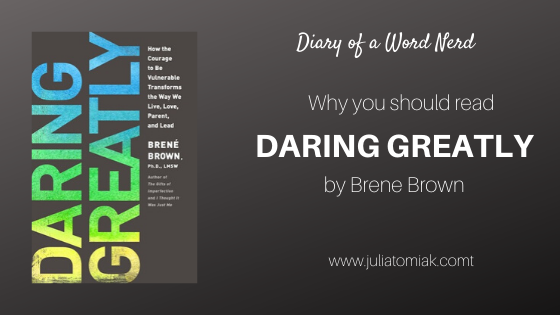
Why you should read Daring Greatly

“It’s not the critic who counts… The credit belongs to the man who is actually in the arena, whose face is marred by dust and sweat and blood…” I first heard this quote from Theodore Roosevelt on a bus full of anxious runners traveling to a state cross country meet. A fellow coach used it to remind our team of the importance of striving for greatness even if you might fall short.

Such an important message, especially for teens, for all of us, in a world that is increasingly critical and intolerant of failure.

This quote appears at the beginning of Brene Brown’s book Daring Greatly: How the Courage to Be Vulnerable Transforms the Way We Live, Love, Parent, and Lead. Brown, a professor of social work at the University of Houston, has spent lots of time studying shame, vulnerability, and courage, and she sums up some of her life changing realizations in Daring Greatly.

What I liked

I could relate to Browns tendency toward perfectionism and her fears about taking risk and being vulnerable. Her words and research reminded me of the importance of taking risks to become, as she calls it, a “whole hearted” person- someone in touch with- but not overwhelmed by- her feelings.

Brown argues that perfectionism crushes creativity. Some things in the world require perfectionism – computer coding and the design of airplanes, for example- but not everything fits into a perfect box. Creativity and art allow space for the things that don’t make sense and make us human. Brown also suggests that perfectionism is a hiding mechanism – a way to avoid risk. We need to get more comfortable with “good enough”, because perfectionism is the enemy of done.

Brown writes a lot about the need for self-compassion. To be healthy functioning adults, we need to accurately observe our feelings without over identifying or exaggerating them. We also need to speak to ourselves kindly.

Finally, Brown has some great thoughts on parenthood, including a parenting manifesto necessary in a culture that uses acquisitions and accomplishments to define worth. She asserts that who we are and how we interact with the world have more influence over our children than what we know about parenting. She also points out that HOPE is a function of STRUGGLE, and it is therefore important to allow ourselves, and our children, to struggle.

I now think rescuing and intervening are dangerous, and I think twice before I let my discomfort dictate my behaviors.

Brene Brown, Daring Greatly

What I didn’t like

Although Brown frequently shares personal stories and practical application of her ideas, sometimes the book is repetitive and lost my attention.

Word Nerd notes

I listened to the audiobook of Daring Greatly, which Brown reads herself. Again, a few times I got distracted or lost interest while listening. However, I think Brown’s ideas are important enough that I have bought a printed version of the book so I can revisit the points I think need emphasis in my life and skim over what doesn’t. I can’t wait to read The Gifts of Imperfection, another book by Brown. I need to embrace imperfection!

Brown has been on several podcasts. I enjoyed her interview with Oprah Winfrey on Super Soul Conversations. You might want to listen to that podcast or watch this video of her interview with Oprah to get a feel for her take on vulnerability and daring greatly.

Have you heard of Brene Brown and are you familiar with her other books?

Thanks for getting nerdy with me!

Favorite books of 2019

I’m a little sad. Usually I get more suggestions for my Favorites book list. I’ll blame it on Facebook’s algorithm. 🙁 Anyway, here they are, my readers’ favorite books for 2019. I also added a few from the Goodreads Choice Awards 2019 winners to give you more ideas. Happy book shopping!

Favorite books of 2019

The Great Alone by Kristin Hannah (fiction)

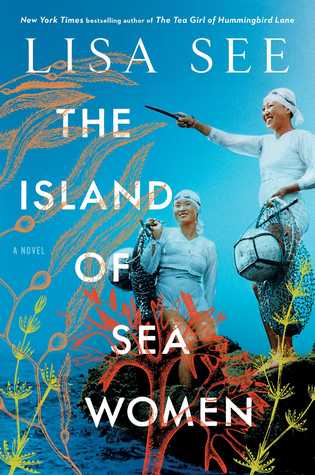
The Island of Sea Women by Lisa See (historical fiction) Amy said on her website maisymak.com: “I had to read and soak in every detail of this masterpiece. The life of a female Jeju sea diver is so perilous it’s almost unbelievable! I’m in awe of these women and mothers. See is a terrific storyteller and wordsmith; I’m so excited to finally have read her. Itching to get to her other books.

Where the Crawdads Sing by Delia Owens (fiction)

The Most Fun We Ever Had by Claire Lombardo (fiction) Dana said: “It’s an honest, layered exploration of one family, spanning five decades. I loved it because each character and each relationship is complex, and I found a bit of myself in each one.”

Braving the Wilderness by Brene Brown (non-fiction) Cindy said: “Encourages me not to be afraid to voice my opinion even when it is so different from all the polarized opinions and mindsets around me. I often find myself in the “wilderness” between the two poles. Great book! Great author!

One Day in December by Josie Silver

Jar of Hearts by Jennifer Hillier Jennifer said: “It’s a scary thriller but so good! (Plus, you get an inside peek at the prison system.)

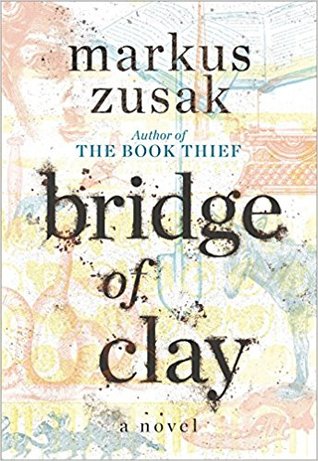
Bridge of Clay by Markus Zusak (YA fiction) Five parent-less boys with only a mule named Achilles to watch over them. A story of family, love, and loss. My full review here

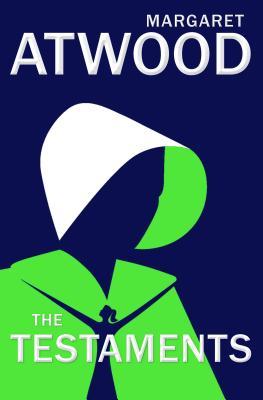
The Testaments by Margaret Atwood. (Goodreads Choice Award for fiction) The sequel to The Handmaid’s Tale, it picks up the story 15 years after Offred is taken away in a van.

The Silent Patient by Alex Michaelides (Goodreads Choice Award for mystery and thriller) Amy’s review on Maisymak.com : “Sometimes you just want an exciting, heart pumping page-turner with a twist at the end that you didn’t see coming – here you go!

Girl, Stop Apologizing by Rachel Hollis (Goodreads Choice Award for non-fiction)

The Tyrant’s Tomb by Rick Riordan, the next book in The Trials of Apollo series (Goodreads Choice Award for middle grade and children’s)

The Fountains of Silence by Ruta Sepetys (Goodreads Choice nominee for young adult – it’s historical fiction set in Spain after the Spanish Civil War and it looks really good!)

Favorite Books Giveaway Winner

Congrats to this year’s giveaway winner, Erin! She will be getting a B & N gift card to spend on some new books!

Thanks for getting bookish with me!

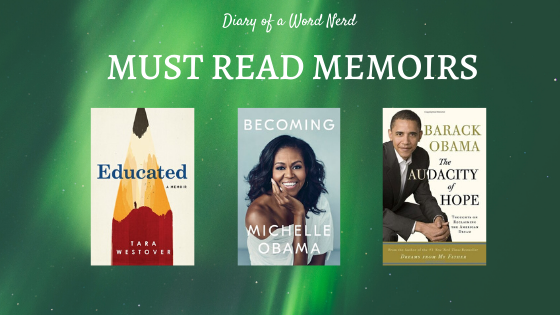
Three must read memoirs

Memoir is becoming one of my favorite genres. I love reading about, and being inspired by, other people’s lives. Tell Me More, a memoir by Kelly Corrigan about the “things she is learning to say to the people she loves” was one of my favorite books of 2018 – and all time. In the past few months, I’ve read three great memoirs I want to share with you.

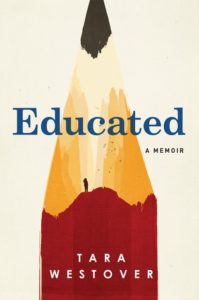
Educated by Tara Westover

Educated tells the fascinating story of Tara Westover’s childhood in the mountains of Idaho. Her parents were survivalists, so she grew up helping her mother blend herbal remedies, stockpiling home canned food, and sleeping with a “head for the hills” bag next to her bed. Her father didn’t trust the government, so no one in Westover’s family attended public school, utilized traditional medicine, or held a driver’s license. Educated describes, in sometimes painful detail, how Westover struggled first to see that her family was atypical and then the need to escape from it.

Without any formal education, Westover gained admission to Brigham Young University as well as Cambridge and Harvard. Her story is one of strength, perseverance, and wisdom. She journey to being “educated” involved much more than books.

While studying at college, Tara learned took Psychology and discovered her father displayed symptoms of bipolar disorder. She writes:

I understood that disease is not a choice. This knowledge might have made me sympathetic to my father, but it didn’t. I felt only anger. We were the ones who paid for it.

Tara Westover, Educated

While reading Educated, I often cringed at the violence and dysfunction Tara describes, including a car accident in which her mother sustained a head injury and a fire that severely burned her brother’s legs. But I found her story of struggling for independence from her family’s, especially her father’s, peculiar ways, gripping and admirable. Later in life, after she graduated from school, she attempted to reconcile with her parents. Her father insisted that Tara was the one who had sinned and “turned away from the truth”, and he would only forgive her if she chose his way of living. She says:

If I yielded now, I would lose more than an argument. I would lose custordy of my own mind. This was the price I was being asked to pay, I understood that now. What my father wanted to cast from me wasn’t a demon: it was me.

Tara Westover, Educated

What is Tara’s relationship with her father like now? You’ll have to read Educated and find out! 😉

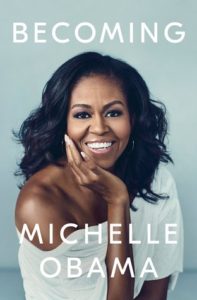
Becoming by Michelle Obama

Becoming book cover

Michelle Obama’s memoir isn’t about politics. It’s the story of a girl from the south side of Chicago who grew up with few financial resources but many personal ones.
Obama used those resources to earn degrees at Princeton and Harvard, to launch a legal career at a prestigious Chicago law firm, and to realize that she wanted to do more with her time and talent than earn money and try cases – she wanted to make a difference.

Oh, yeah, and along the way she met this guy who kinda had a big influence on her life.

Michelle Obama shares her struggles with the demands of relationships, career, family, and politics. Her energy and intelligence clearly come through in her story, and yet, so do her faults and limitations. Regarding her early years of marriage, and her struggle to accept her husband’s call to politics, she says:

I began to see that there were ways I could be happier and that they didn’t necessarily need to come from Barack’s quitting politics… I’d been stoking the most negative parts of myself, caught up in the notion that everything was unfair and then assiduously, like a Harvard trained lawyer, collecting evidence to feed that hypothesis. I now tried out a new hypothesis: It was possible that I was more in charge of my happiness than I was allowing myself to be.

Michelle Obama, Becoming

I could totally relate to that!

The end of the memoir covers President Obama’s years in office and includes more details about Michelle’s political activity. By then, the political climate in our country was quite polaraized. Obama says:

It seemed they weren’t prioritizing the governance of the country or the fact that people needed jobs. Their own power came first… This was politics, yes, but in its most fractious and cynical form, seemingly disconnected from any larger sense of purpose… we had no choice but to stay positive and carry on.

Michelle Obama, Becoming

I fear these words could be used to describe our current political climate as well. I am often discouraged by the ugly rhetoric I hear from both parties, but Becoming offers encouragement for unrelenting optimism in the face of disappointment and adversity.

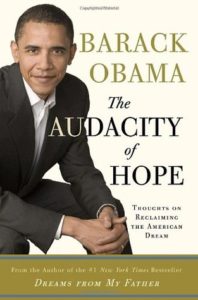
The Audacity of Hope by Barack Obama

While reading Becoming, I wanted to learn more about the man Michelle Obama married. So I decided to listen to The Audacity of Hope, Barack Obama’s memoir about his time in the United States Senate. This book has a political focus, but the “Obama optimism” remains a central theme.

Barack comes across as thoughtful, introspective, and empathetic in his memoir (which he reads himself for the audio version I listened to). He says of his political rival George W. Bush, “George Bush is a fine person, I just disagree with most of his policies.” Throughout his book, Barack focuses on what unites us rather than what divides us and champions the idea that we can achieve more working together than working independently. He also offers an interesting perspective on the history of politics, including how the 1960s might have influenced the conservative movement today, and how the arguments between Jefferson and Hamilton contributed to the systems of governance we currently use.

I was encouraged and saddened while listening to this book. Encouraged to hear the voice of someone who is eloquent, rational, and reasonable. Saddened to think that he published The Audacity of Hope thirteen years ago, and not much has changed in our federal government.

Have you read a good memoir lately? Please share! And don’t forget to tell me about your favorite book from 2019! You could win a Barnes and Noble gift card!
What was your favorite book of 2019?

It’s that time of year – when I’m printing up my “gift list” spreadsheet and brainstorming ideas for friends and family. “Gift giving” is not my love language, and I need all the help I can get, especially when there are so many people I want to show love to at Christmas.

I’m asking you, my fellow Word Nerds, for assistance. It’s a win/ win for all of us. Will you please tell me the best book you read this year? (You could even share more than one, if you have lots of ideas!) I will compile a list of all the suggestions and share them on the blog December 16. Then we will all have ideas to guide us with holiday shopping (or provide a little bookish escape for ourselves at this busy time of year). As a BONUS, I will randomly pick the name of one person who contributes to the favorites list, and that person will win a Barnes and Noble gift card! I like to call this my annual Favorite Books Giveaway.
Here are the details for 2019’s Favorite Books Giveaway

  • You may enter the giveaway by commenting here on the blog, my Facebook profile, my Twitter feed, or my Instagram Favorite Book post by Friday, December 13, 2019.
  • Your comment should include your favorite book from 2019 and a short explanation of why you recommend it.  All genres welcome.
  • The book doesn’t have to be published in 2019, just read in 2019.
  • I will announce the winner on Monday, December 16 with the full list of favorites. That will give you plenty of shopping time. 😉
  • The giveaway winner must provide a mailing address for the gift card.

Questions? Comments? Time to share our favorite titles! I’ll go first.

2019 Recommendations

One of my favorite books this year is a recent YA release from Markus Zusak, author of The Book Thief, but his novel has great appeal for adults too.

Bridge of Clay is a complicated study of family, loss, and the power of memories. Zusak writes with a distinct staccato style, and his language is arresting, beautiful, and heart breaking. This book made me cry. But I also often laughed at Zusak’s main characters- a rowdy family of five boys – young teens and young men- who are quirky and endearing, with only a mule named Achilles to watch over them.

Are you curious? You should be! You can read my full review of Bridge of Clay here. Next week I’ll add a few more recommendations, three fabulous memoirs I’ve read in recent months.

Until then, start sharing your suggestions!

The meaning Behind Black Friday

To be clear, I detest shopping, and I certainly never set foot in stores the day after Thanksgiving, I don’t care if the jeans are 50% off. But this year, my youngest son and I had to know, how did Black Friday get its name?

Turns out, Black Friday has some very dark history.

According to History.com and Businessinsider.com, the term was first used way back on Friday, September 24, 1869, when investors Jay Gould and Jim Fisk decided to drive up the price of gold by purchasing as much as they could. Their efforts caused a stock market crash, a cease of foreign trade, and a 50% drop in the value of wheat and corn. Farmers suffered significantly that year.

Very black indeed.

According to thebalance.com, the term was popular again in the 1950s when Philadelphia police used “Black Friday” to describe the chaos caused by increased pedestrian and auto traffic on the busy shopping day after Thanksgiving.

Retailers didn’t like the negative connotation of “Black Friday” and tried to spin the name to reflect the profits made on the first official shopping day of the Christmas season. (Accountants say a business is “in the black” if it operates with a profit.)

However, the chaos of Black Friday continued, with most Black Fridays of the past decade or so marred by fights, shootings, and even death. The worse incident happened in 2008 when 2000 people rushing into a New York Walmart broke through the doors and trapped a man in a vestibule. He died from asphyxiation.

See why I stay home? This is what I don’t like about Christmas – the endless consumption spurred on by retailers and advertisers. Where are we as a society if we are shooting people over a parking space or fighting over a discounted T.V.? We have lost the meaning of the holiday.

If you are out there today, or any other Black Friday, be careful. Don’t be distracted by the traffic or the sale signs. That’s not what the holiday, or we, should be about.

Do you venture out on Black Friday? Why is it worth it to you?

Thanks for getting thoughtful with me!