What’s the story behind the trench coat?

trench coat

I’ve been pretty serious on the blog lately, with pandemic inspired vocabulary and book reviews about sobering topics. So I thought I’d tackle a light issue for Wondrous Words Wednesday: the trench coat.

My youngest child, and most frequent inspiration for blog posts on word etymology, asked upon leaving my daughter’s science fair (pre-quarantine), “Why is it called a trench coat?” The kids presenting their projects were dressed up in “professional attire”, and a few boys donned trench coats before heading outside.

Trench coats have also been on my brain because I’m rereading Eleanor and Park, a great contemporary YA set in the 80’s, and main character Park wears a trench coat. Like Eleanor and Park, I suffered through high school in the 1980’s, and I remember a certain population of kids who liked to trudge through the halls in black trench coats and bulky combat boots.

So trench coats. This was supposed to be a light topic, but sadly, if we look for the origin of trench coats, we find ourselves in World War I. 🙁

History of the trench coat

Photo of woman wearing a trench coat
Khaki Burberry Trench Coat Spy Baroness1 atomtetsuwan2002 via flickr CC-BY-SA

As you may have guessed, the trench coat was born out of the need for a lightweight, flexible, and weatherproof coat to wear in the trenches of WWI. But, this article from the Smithsonian Magazine shares a few more interesting details about the rise of the trench coat in the 20th century, and why it’s still so popular today.

Turns out the origins of the trench coat began in the early 1800’s, when fashion designers were striving to find weatherproof material that was still classy enough for gentlemen. There was the “mack”, created by Charles Mackintosh in 1823, a coat made of rubberized cotton that unfortunately smelled bad and melted in the sun.

Later, John Emary developed a water repellent fabric to use for wet weather gear, and he named his clothing company “Aquascutum”, from the Latin for water (aqua) and shield (scutum). Shortly after that, Thomas Burberry came out with gabardine, a breathable, waterproof twill material that didn’t smell so bad.

When WWI started, British officers wore heavy, uncomfortable great coats made out of wool. As they spent more time in the muddy, rat infested trenches, it became obvious they needed something more functional. At the time, officers were from the upper classes and bought their own uniforms. They appealed to fashion designers for a coat that provided adequate protection but still kept them looking sharp, since fashion reinforced social hierarchy, even in the trenches. Thus the trench coat was born. Both Burberry and Aquascutum take credit for the design.

The trench coat has remained a fashion staple until today. A trench coat typically is double breasted, with a wide cut below the waist that allows ease of movement yet still covers much of the body. The belt at the waist gives visual appeal; it also gave officers in the trenches a place to attach accessories. The cape inspired shape encourages water to roll off, and the deep pockets are perfect for carrying things like smart phones (British officers used them for maps).

Unfortunately, the trench coat made officers easy to identify, and many were shot by snipers. After suffering significant losses, the military had to pull officers from the lower classes, and these “temporary gentleman” (yes, they actually called them that), sought out more affordable versions of the trench coat to garner respect in their new status. The coat also gained popularity in broader social circles because people liked wearing military inspired clothing, perhaps as a sign of patriotism or to feel connected to those fighting on the front. Soon, the trench coat was everywhere.

After the war, the trench coat became a symbol of worldliness and ruggedness, which was underscored by popular Hollywood movies. Humphrey Bogart wore a trench coat in iconic movies like The Maltese Falcon and Casa Blanca.

Experts think the trench coat remains popular today, because, like blue jeans, it is a fashion item that rose of out necessity yet remains timelessly functional and stylish.

Do you have a trench coat? Mine is bright green and I love to wear it on rainy days in the spring! 🙂
Wondrous Words Wednesday

If you like to learn new words and the origins of their meanings, visit the Wondrous Words Wednesday meme at Bermuda Onion. Each Wednesday, bloggers share new words they’ve learned.

Got another fashion term, or any word, that inspires your curiosity? Share it in the comments!

Thanks for getting nerdy with me!

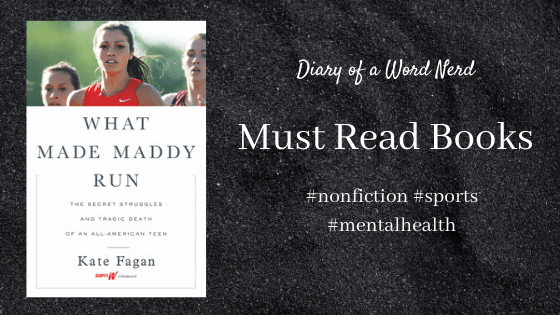
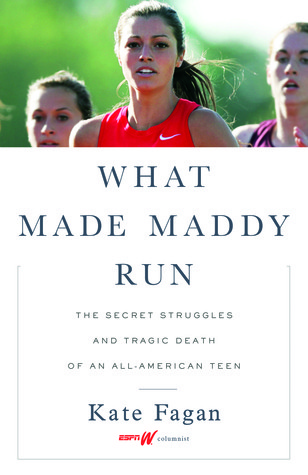
Why you should read What Made Maddy Run

What Made Maddy Run is a challenging book to read in this time of pandemic and quarantine. But it’s important.

Madison “Maddy” Holleran was a superstar athlete and student from an affluent town in New Jersey. She had straight A’s, a beautiful smile, a reputation for winning, and an Instagram profile that documented her fabulous life. She was recruited to the University of Pennsylvania to run college track and cross country and started at U Penn in August, 2013, thrilled to be attending the Ivy League school of her dreams.

In January, 2014, after struggling for months with disappointment and depression, Maddy committed suicide.

In What Made Maddie Run, sports writer Kate Fagan explores the forces, including depression, anxiety, and the pressure to perform in a social media driven world, that might have contributed to Maddy’s struggles. It is an informative and insightful look into college athletics, mental illness, and the challenges young adults face. Fagan uses interviews with Maddy’s friends and family, as well as information from Maddy’s interactions via text and email, to assemble clues about what Maddy was thinking and why she decided to take her life.

What I liked

I’ve long been concerned about the negative effects of social media and the excess of omnipresent, but shallow, connections it encourages. In What Made Maddy Run, Fagan explores the influence of social media on all of us, but especially teens and young adults. She says, “Comparing your every day existence to someone else’s highlight reel is dangerous for both of you”, and points out that while its easier to “stay in touch” via text, “efficient communication does not mean effective communication” and cites evidence that texting and interacting via Instagram and Snapchat do little to help people when they are in distress.

Here is a quote that spoke to me:

Very little of what we say in text is a literal representation of how we feel, what we’re doing, how we’re behaving. It’s an animated, easy to digest version, an exaggeration or a simplification, but not a reflection. And that would be fine, if it weren’t the main way we now communicate with one another.

Kate Fagan, What Made Maddy Run

Fagan also looks at the shift from high school to college and how the transition can contribute to stress, anxiety, and depression, especially for athletes. In high school, the steps to “success” are easy to see: get good grades, excel at sports, do well on the SAT, participate in volunteer and leadership activities. It’s exhausting, but not confusing. High achievers just keep reaching for the next rung on the ladder. But once students get to college, the ladder morphs into a tree with many, many branches. Choices are more plentiful, and progress is harder to track. It left a girl like Maddy Holleran, used to straight A’s and first place medals, overwhelmed and confused about who she was and where she fit in. Important things for me, the mother of a daughter transitioning to college this fall, to consider.

Finally, What Made Maddy Run looks at how our society has come to measure success in very narrow terms, and how that can negatively affect the physical and mental health of our children.

What I didn’t like

I listened to the audio book of What Made Maddie Run, which Fagan reads herself. While I could at times hear the emotion in her voice and could tell how invested she was in telling Maddy’s story sensitively, often her reading was stilted. Also, sometimes, Fagan digresses into comparisons into her own life, which included playing basketball for the University of Colorado, and while I suspect she intended to add dimension and legitimacy with these side stories, (she struggled as a college athlete too), I mostly wanted to hear about Maddy’s story.

Recommendation

What Made Maddy Run is a great book to read if you are a young adult who struggles with anxiety or depression or pressure to perform, or if you are the friend or parent of someone who does. It does not sensationalize Maddy’s suicide, but instead offers important things to consider and is a much needed conversation starter about the difficult, but very real, issue of mental illness and the influence of social media on our society. It is of course sad, (no surprise, I cried), so if you are feeling down during the quarantine, perhaps you should wait.

Have you heard of Maddy Holleran? Can you recommend other books that address mental illness, pressure to perform, or the influence of social media?

Thanks for getting thoughtful with me today.

A peek into celebrity bookshelves

Today, a guest post from Isabel Cabrera of Global English Editing.

Reading books has so many benefits. Science shows that reading can make us mentally sharper and healthier, and it is a great way to unwind and relax too. Not to mention, reading books is just plain fun. However, with so many books out there, what should you read? 

When it comes to book recommendations, your first point of call may not always be celebrities. Yet on social media and in interviews, celebrities are often touting their favorite books and the new ones they’re enjoying reading. You may be surprised to learn that some of their recommendations are actually really good.

Global English Editing found the book recommendations of 20 popular celebrities and created this great infographic, The Book Shelves of 20 Surprisingly Smart Celebrities.

Did you know that Amy Poehler’s favorite books include A Tale of Two Cities by Charles Dickens and Away by Amy Bloom? Or that Dwight Shrute (aka Rainn Wilson) loved The Seven Mysteries of Life: An Exploration of Science and Philosophy?

As you’ll see, the bookshelves of these 20 celebrities are as diverse and interesting as the reading list of any bookworm.

Check out the infographic below and you may just find your next great read.

Thanks for getting nerdy with me!
How do you pronounce GIF?

As COVID-19 restrictions continue, and we all start to get a little shifty in our self-containment, let’s ponder something light, entertaining, and very Word Nerdy: GIFs.

I never use My Story on Instagram, but if I’m going to gain traction on that platform (my personal favorite), I need to learn. A writer friend shared a template that I needed to fill with GIFs to post on My IG Story. I recruited help from my 18 year old daughter to assist with the project, and GIFs came up.

Daughter: (Swiping quickly and repeatedly across my phone screen). Save the template, now just search for GIFs to fill it in.

Me: Is it pronounced JIF or with a hard G, like guts?

Daughter: I don’t know! I hear it both ways.

Well, this Word Nerd had to find out.

According to an article in Time magazine dated Feb 25, 2020, the history of the pronunciation of GIF has been colorful and controversial. The GIF, or Graphics Interchange Format, is the name for a looping animations used in social media and texts. It was invented in June 1987 by Steve Wilhite at Compuserve. He said it was pronounced “JIF”, like the peanut butter, but debate started immediately.

In 2012, Oxford Dictionaries USA selected GIF as its Word of the Year and stated it could be properly pronounced with either a hard g (like graphic) or a soft g (like giant). However, in 2014, President Barack Obama declared his official position of pronouncing it with a hard g. A survey conducted in 2014 found that most Americans agreed with Obama (or perhaps he influenced them?). The use of a hard g beat the soft g, 54% to 41%.

A popular argument for the hard g pronunciation: since Graphics uses a hard g, GIF should too. However, if we held to that rule, we’d have to pronounce JPEG as JPheg, since the P stands for Photo, and we’d need to pronounce SCUBA as SCUhBA, since the U in underwater is a short u.

In the years following, various media outlets, like Mental Floss and Newsweek, got the help of linguistics professors to back up different pronunciations. At this point, there is no definitive way to pronounce GIF, but this video makes a compelling, if not somewhat hostile, argument for using a soft g.

So, at this point, I guess you can go with your preference, but I prefer “JIF”. It’s easier to say, and it’s the name the creator gave it. I respect that.

How do you pronounce GIF? What other tech words do you want to know more about?

Wondrous Words Wednesday

If you like to learn new words and the origins of their meanings, visit the Wondrous Words Wednesday meme at Bermuda Onion. Each Wednesday, bloggers share new words they’ve learned.

Thanks for getting nerdy with me!
A poem for your pocket 2020

Poetry is an awesome way to celebrate words, emotions, and events. And right now, as we shelter in place, poetry is even more important. According to the American Academy of Poets:

Now, as we face an unprecedented circumstance, National Poetry Month has taken on new meaning and importance. More and more people are turning to poetry at this moment, because poetry and inspiring language can help bring solace and needed strength.

American Academy of Poets

Every April, poets, authors, librarians, and people who love words celebrate National Poetry Month, sponsored by the American Academy of Poets and Poets.org. And today, April 30, is a special day in a month of special days. The American Academy of Poets encourages everyone to share poems today, in person and on social media. Write a poem in chalk on the sidewalk! Share it in a note that you drop on a neighbor’s porch. Post it on Instagram! Do whatever it takes to get poems out there! We need them!

In honor of Poem in Your Pocket Day, here’s a short, inspiring poem for you to share:

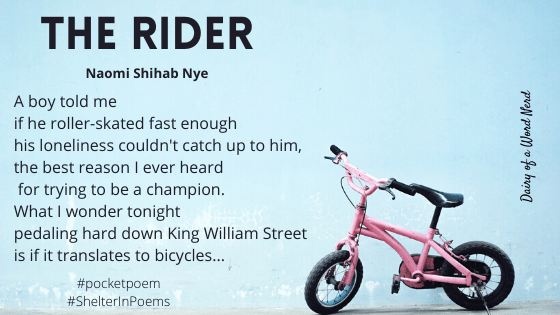
The Rider

by Naoimi Shihab Nye

A boy told me

if he roller-skated fast enough

his loneliness couldn’t catch up to him,

the best reason I ever heard

for trying to be a champion.

What I wonder tonight

pedaling hard down King William Street

is if it translates to bicycles.

A victory! To leave your loneliness

panting behind you on some street corner

while you float free into a cloud of sudden azaleas,

pink petals that have never felt loneliness,

no matter how slowly they fell.

Isn’t it lovely? What poem will you share? #pocketpoem #ShelterInPoems

Thanks for getting poetic with me!

Pandemic vs. epidemic and other COVID terms

As the Coronavirus pandemic continues, we are having more discussions in our house about the terms used to discuss it. This week, we’ve tackled the difference between epidemic and pandemic and an explanation of herd immunity. We’ve also had serious discussion about bias and the importance of evaluating fact versus opinion, as there are many loud voices out there touting opinion as fact, and now is NOT the time to confuse the two.

So, from my Word Nerd home to yours, some critical terms for the “time of corona”.

Epidemic vs Pandemic

As I explained in my first post on pandemic terms, a pandemic is an outbreak of disease that covers a wide geographic area and affects a significant proportion of the population. It is usually used to describe disease from new or novel bacteria or viruses and/or those that spread quickly. Pandemic comes from the Greek pan (meaning “all”) and demos (meaning people, district, country).

Epidemic comes from the Greek epi (at, or on) + demos (people, district, country), and it describes an outbreak of disease that spreads quickly and affects many people at the same time, but is usually contained in one region, state, or country.

To compare the two terms, pandemic has increased scope and coverage than an epidemic. It’s basically a worse form of an epidemic, however there is no clear line between the two. Epidemic is used more often than pandemic in a broad, non-medical sense. (e.g., overuse injuries have become an epidemic among high school athletes)

To learn more about the words epidemic and pandemic, visit Merriam-Webster.

Herd immunity

As talks begin about how to “return to normal” after the pandemic, I’ve been hearing a lot about the need for vaccines and the concept of herd immunity. Herd immunity occurs when so many people in a population become immune to a disease that it stops the spread of that disease. If one person susceptible to disease is surrounded by people who are immune, it is unlikely that vulnerable person will get the disease.

Herd immunity is achieved two ways. The first comes with natural immunity, when a large number of people in a population are exposed to a disease and develop antibodies to fight it. This process requires significant exposure and time, and people involved may or may not show symptoms of disease. The second way occurs when enough people within a population are vaccinated against the disease.

Herd immunity is different for each disease and is influenced by how quickly a disease spreads. Currently, we cannot use herd immunity to stop the spread of COVID-19 because:

  • There isn’t a vaccine for COVID-19 yet, and probably won’t be for about a year
  • It would take a very long time for populations to develop natural immunity to COVID-19
  • Scientists don’t know if you can develop disease from COVID-19 more than once
  • Some patients experience serious side effects with COVID-19, and doctors are not sure why some people are more vulnerable
  • Some severe cases lead to death
  • Hospitals may get overwhelmed by high numbers of cases

For more helpful information about herd immunity, see this Healthline article on herd immunity and this piece by Dr. Eduardo Sanchez, American Heart Association Chief Medical Officer for Prevention.

Expert opinion

We’re hearing a lot of opinions on the possible course of COVID-19, how best to combat its spread, and when it might be safe to ease protective measures. Sadly, the advice we hear is often conflicting and confusing, and we have so many “experts”, it’s hard to know who to trust. One friend asked me, what exactly is medical opinion and how does it differ from other opinions?

According to Dictionary.com, opinion can mean A LOT of things (Emphasis added):

  • a belief or judgment that rests on grounds insufficient to produce complete certainty
  • a personal view, attitude, or appraisal
  • the formal expression of a professional judgment: to ask for a second medical opinion.
  • Law. the formal statement by a judge or court of the reasoning and the principles of law used in reaching a decision of a case
  • a judgment or estimate of a person or thing with respect to character, merit, etc.: to forfeit someone’s good opinion
  • a favorable estimate; esteem:

According to USLegal.com, medical opinion is defined as “statements from physicians and psychologists or other acceptable medical sources. The opinion of a treating physician should be afforded substantial weight in a court case.”

The Code of Ethics of the American Medical Association lists specific guidelines for how a physician should testify in a court case. Physicians must ensure their testimony:

  1. Reflects current scientific thought and standards of care that have gained acceptance among peers in the relevant field.
  2. Appropriately characterizes the theory on which testimony is based if the theory is not widely accepted in the profession.
  3. Considers standards that prevailed at the time the event under review occurred when testifying about a standard of care.

These guidelines apply to a very specific situation – testifying in court about a medical case they were involved with- however, I imagine these could also be used to characterize the statements of opinion given by physicians in an official capacity.

Speaking of official experts and their opinions, you should know:

  • According to the Office of Health and Human Services, the Surgeon General is responsible for providing Americans with “the best scientific information available on how to improve their health and reduce the risk of illness and injury.” Our current Surgeon General is VADM Jerome M. Adams, M.D., M.P.H. and his motto is “better health through better partnerships”.
  • The National Institute of Allergy and Infectious Diseases (NIAID) is a part of the National Institute of Health, and its mission is “leading research to understand, treat, and prevent infectious, immunologic, and allergic diseases”. The current director of NIAID is Anthony Fauci, MD. He was appointed in 1984 and has advised six presidents on issues about domestic and global health concerns. He also has extensive research experience with respiratory infections, infectious disease, and emerging diseases.
  • The Centers for Disease Control and Prevention has a mission to “to protect America from health, safety and security threats, both foreign and in the U.S.” and it has extensive information about COVID-19 on its webpage. It is currently directed by Robert R. Redfield, MD.

I believe the medical opinion of these people deserves our trust during this unusual time.

Wondrous Words Wednesday

If you like to learn new words and the origins of their meanings, visit the Wondrous Words Wednesday meme at Bermuda Onion. Each Wednesday, bloggers share new words they’ve learned.

What other COVID-19 terms are you curious about? How do you filter out all of the conflicting opinions in the media these days?

Thanks for getting nerdy with me!