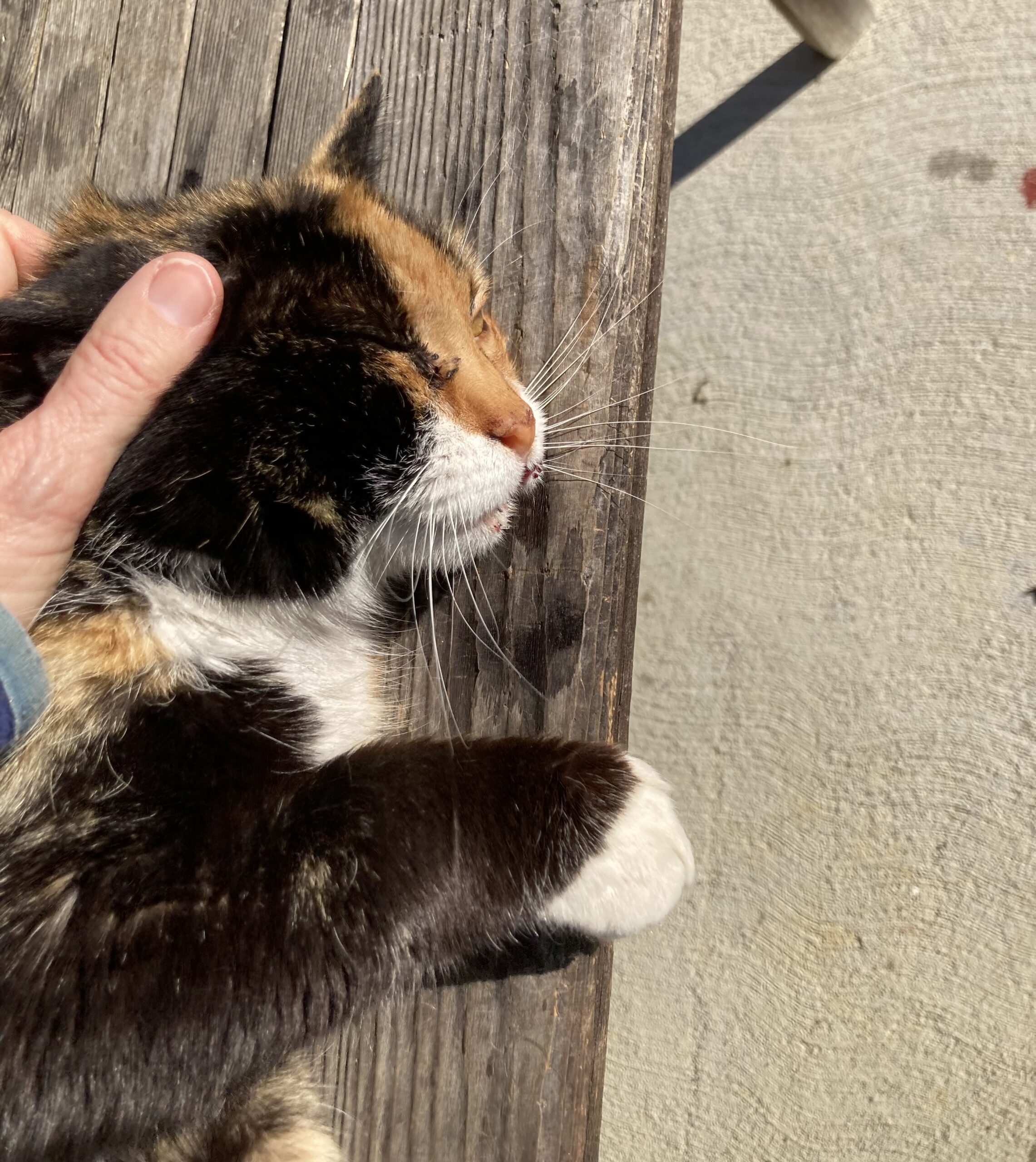
Our cat, a spunky calico, is fading. Every morning when I venture out to the porch to deliver her food, I fear what I will find. Stillness. Coolness. Or worse, nothing. But each new day, she hears my approach and perks up from her nap in the sunshine to greet me. She moves slowly; her coat hangs limp over her ribs. I must lean close to hear her purr, but it’s there. She often doesn’t eat the food I leave, and that makes me sad. I’ve seen end of life signs before. I pet her and tell her how happy I am to see her. What a pretty, good cat she is.
Love our morning visits
I often return to the house from visiting the cat with tears in my eyes. Why do we do this to ourselves, get attached to pets we will eventually lose? As I ponder this, I sit to take off my shoes, and my two year old puppy nudges me. Licks my hand. Forces me to be grounded in the here and now of wet noses. She sniffs the tears on my cheeks and picks up her old tennis ball. It’s time for play, and of course, I indulge her. As I watch her chase her ball, I know I’m setting myself up for hurt someday. But I also believe it’s worth it.
I turned 52 last week. While I’m not showing my age as much as my cat, I understand I have more years behind me than ahead of me. That my body is starting to wear. That each day is a gift to welcome. I have officially surpassed my mother’s time on this earth; she died at 51. This milestone is not lost on me. For whatever reason, I have more time than she did, and I intend to use it well.
Thankfully, with five decades comes wisdom for living well. I can slow down a bit now, physically and mentally, to nourish a quiet appreciation that only comes after years of emotions and failures and painful growth. Don’t get me wrong, I’m still active and fighting, lifting heavy weights to combat muscle loss and osteoporosis. My go to adjective is “resilient.” But I’m comfortable with my middle aged self, leaning into my 50s eager to keep growing out of the foundation I’ve built. Time is a resource I must use well. Thanks to decades of experience, I’m finally able to hold conflicting emotions in the same hand with acceptance: joy and grief, desire and contentment, worry and release, death and life. It’s the contrasts that make life full.
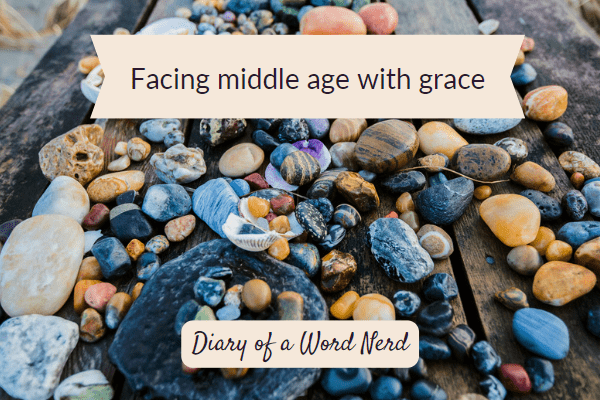
Instead of seeing my life as a finite timeline, I envision my 52 years as collection in a large glass jar. I marvel at the people and experiences I’ve known, many shiny and pretty, some sharp and rough, that make up this life I’m living. I mentally dig out my trinkets and cherish them, more often these days, while looking for new treasures to add.
Bolt, my fading calico, is a gem in my collection. I love her because she acts more like a dog then a cat, coming with us on our morning walks, seeking love and attention with her raspy voice. I will keep searching for her in the mornings. And when she’s gone, I will be glad I’ve had her.
Life is smooth, shiny stones mingled with sharp edged rocks, and it’s the mix that makes it beautiful. Holding my collection, I forge onward.
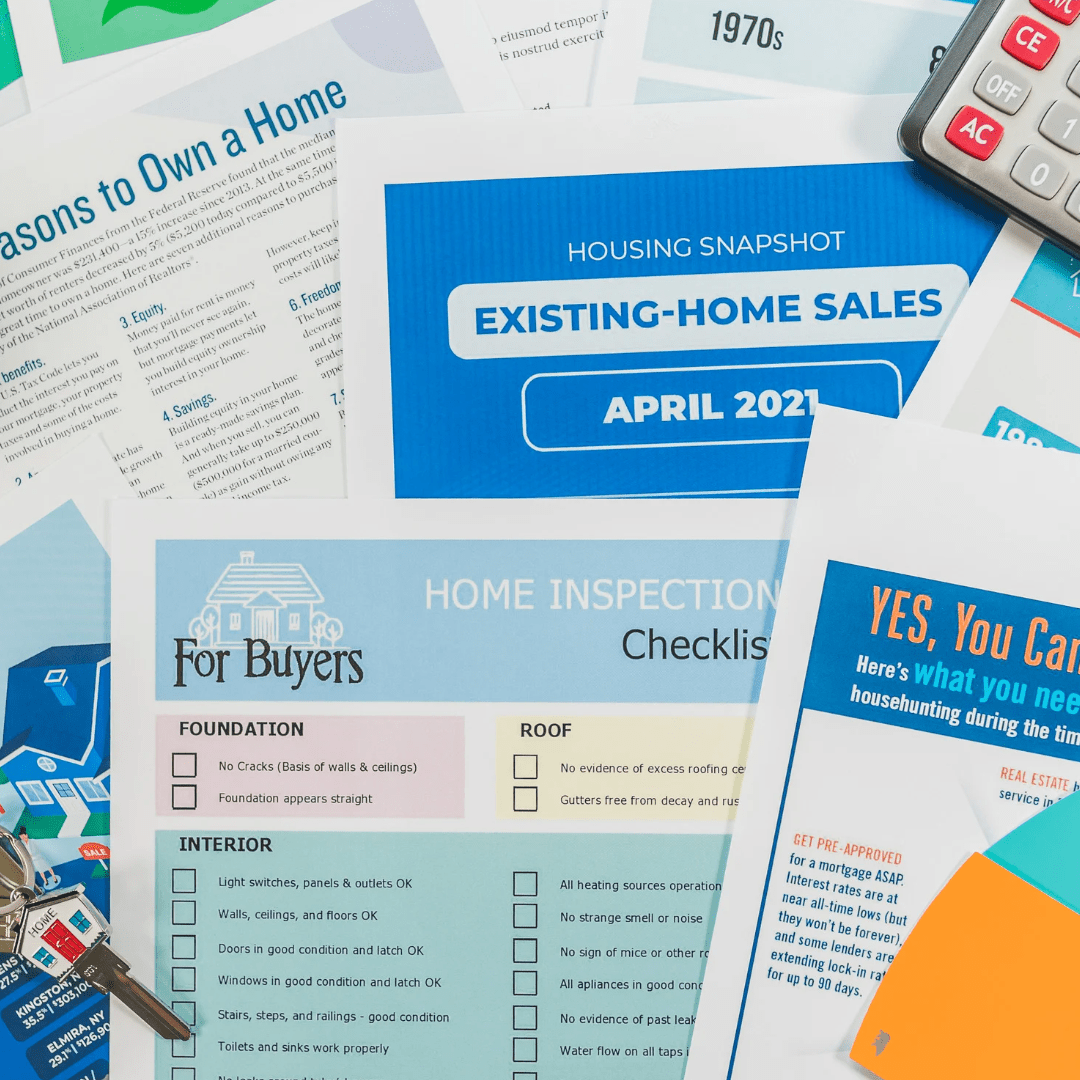
As I prepare to launch a writing contest and a campaign for local office (the Word Nerd wants to serve on the school board, of course), I am designing, emailing, and printing many a Canva designed flyer. (Have you looked into the awesome design tool Canva? The free version works quite well, but I signed up for Canva Pro last year and LOVE IT. More on that later.)
According to M-W, a flier refers to one who flies planes or an “airman.” It can also describe a reckless venture. However, a flyer is most often used for “an advertising circular.”
So that confirms it, I’m designing FLYERS. I like that better. There’s something appealing about the Y.
Do you have a word spelling or usage you are wondering about? Share it! We all can learn.
Part of the beauty of a book club is it forces you to read books you might not choose on your own. Our last two book club reads sparked a lot of contemplation for me, and some great discussion for the group. These are great reads to broaden your perspective.
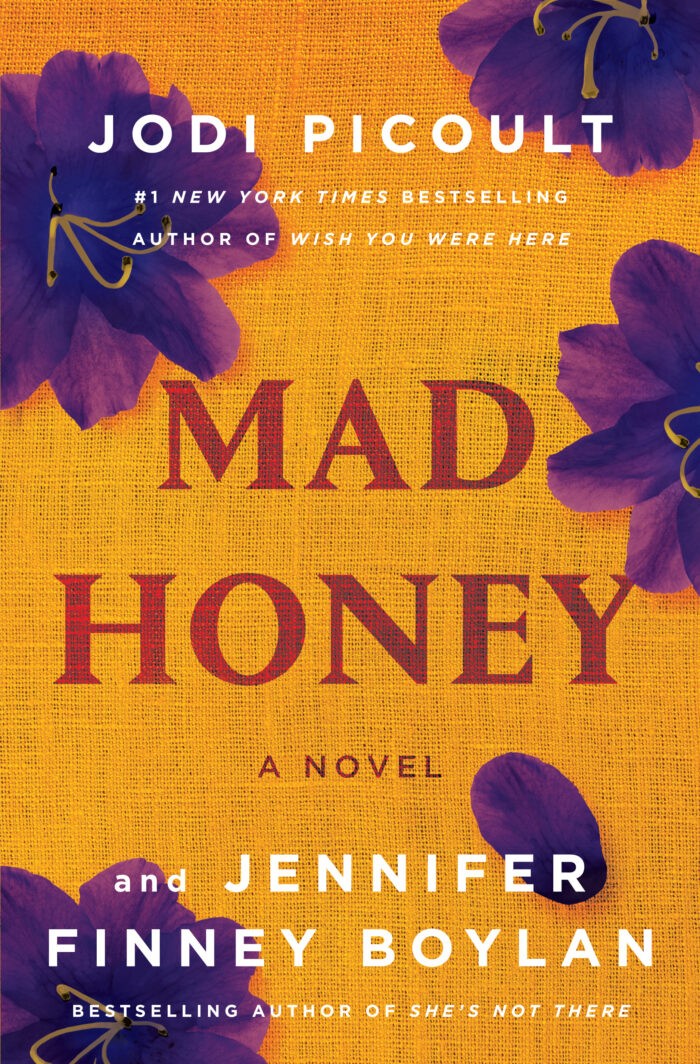
Mad Honey by Jodi Picoult
I hate to say too much about Mad Honey, as I don’t want to spoil anything for readers. I admit, I didn’t really want to read it. Jodi Picoult can be hit or miss for me, although she did write one of my favorite books of all time, Small Great Things, which is a fascinating study of racism.
In Mad Honey, Picoult uses two points of view to tell the story of the suspicious circumstances surrounding the death of a teenager and the subsequent court case. One POV’s narrative moves forward in time, and the other moves backward. This was a great tool to heighten suspense.
Mad Honey explores what characters choose to hide from people and what they choose to share. It also examines what we choose to keep from our past and what we let go. It was a solid three star read for me, and it gave me a lot to think about and discuss.
Here’s a great quote that highlights one of the important themes of Mad Honey:
“If you want to understand something, you first need to accept the fact of your own ignorance. And then, you need to talk to people who know more than you do, people who have done more than just thought about the facts, but lived them.”
Olivia, in Mad Honey by Jodi Picoult
If this isn’t a sentiment necessary for our time, I don’t know what is. Here’s another one that struck me:
How similar does someone have to be to you before you remember to see them first as human?
Olivia, Mad Honey by Jodi Picoult
The Moment of Lift by Melinda Gates
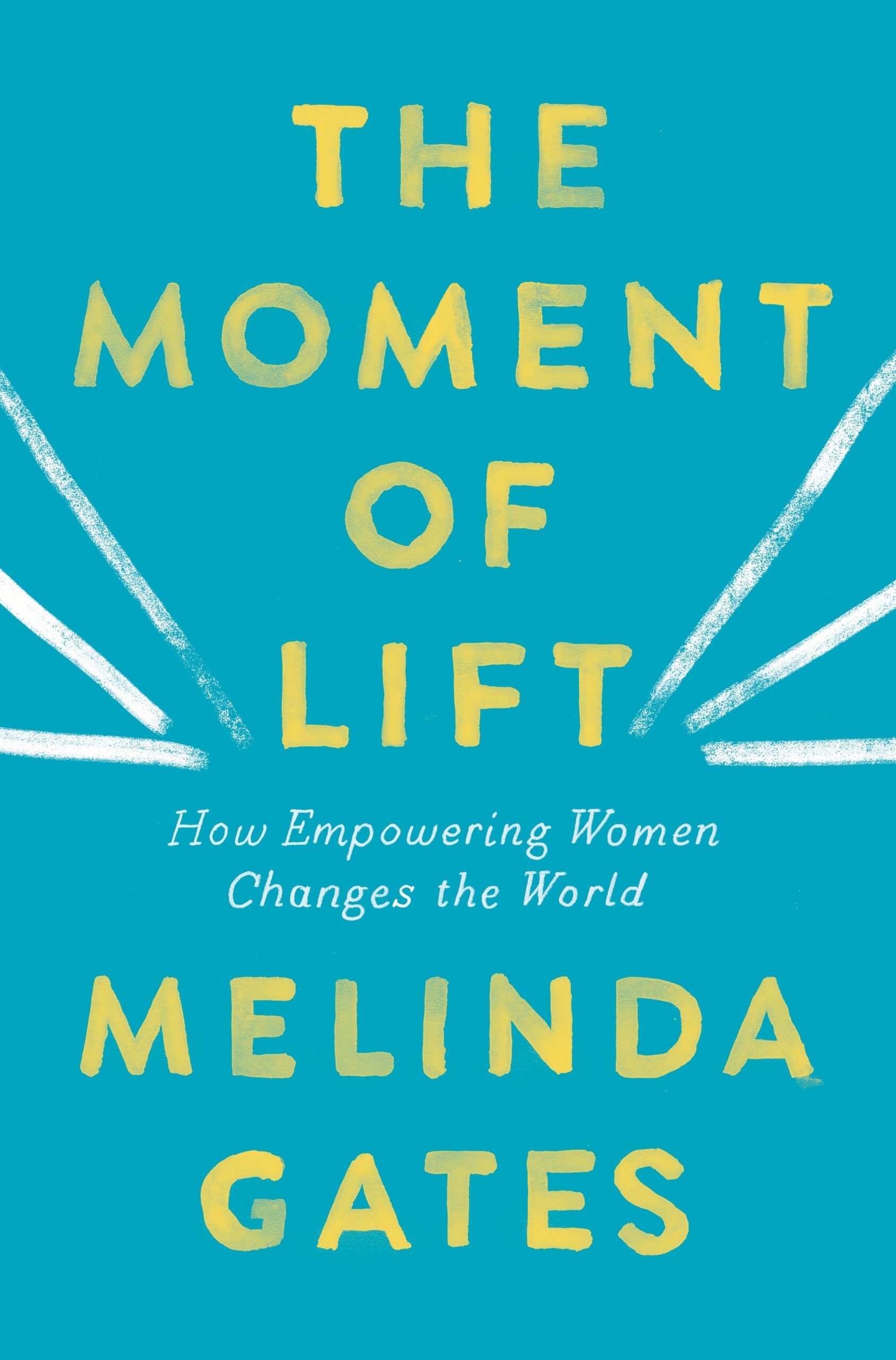
I’ve wanted to read The Moment of Lift by Melinda Gates for a while. I even gave a nice hard back copy to my daughter. I borrowed that copy to finally enjoy the book, and it’s a good one. Gates’ writing isn’t spectacular, but her thoughts and ideas are.
In light of her recent divorce, I expected this book to be about personal redemption and strength, along the lines of Rising Strong by Brene Brown. But it’s not just about Melinda – it’s about all women, everywhere. The Moment of Lift was a nice nonfiction segue after reading Lessons in Chemistry.
In The Moment of Lift, Gates describes, with data and stories from women she’s interviewed, how giving women more information, power, and autonomy can improve society. She focuses on the areas of family planning, education, the workplace, maternal and newborn healthcare, and agriculture. I really appreciate how she highlights the importance of understanding women where they are in order to help them bring about positive change.
For example, in her discussion about contraception, she points out that in certain communities, giving women condoms will not provide adequate birth control. The Gates Foundation figured out, after talking with women, that sometimes when husbands are asked to use condoms, they take offense. They see it as an accusation or a confession of adultery. In these cases, a wife who asks her husband to use a condom can expect a beating. Melinda and the Gates Foundation modified their approach.
Here are some great quotes from the book:
“It’s the mark of a backward society — or a society moving backward– when decisions are made for women by men. That’s what’s happening right now in the US.”
The Moment of Lift, Melinda Gates
About the importance of education, Gates says,
“Women can use the skills they learn in school to dismantle the rules that keep them down.”
Gates helped me better appreciate the mentality I see in my Southwest Virginia community about going away to college. Very few students in each graduating class leave for a four year college. She interviews a girl who left her small town to study at a university. Here’s what people said to the girl: “‘Why do you want to leave home, anyway? Everything you might ever need is here. Are you saying we’re not good enough for you?” Gates points out, “As [these families] see it, their culture doesn’t hold people back; it holds people together. In their eyes, pursuing excellence can look like disowning your own people. “
I am a transplant from Northern Virginia and have never understood the fear of sending kids away to school. Gates opened my eyes. I am glad we have a community college right in town that offers associate degrees and certificates, and training in relevant fields to help young adults launch into jobs that will earn them a decent living wage.
Word Nerd note: Since I borrowed my daughter’s copy of The Moment of Lift, and she is HIGHLY opposed to marginalia and keeps her books pristine, I had to use a note card to keep track of my notes.
If you are interested in broadening your perspective on relevant issues for our time, I highly recommend each of these books.
Can you recommend other books that have opened your mind to new ideas?
Exactly 30 years ago on February 14, my hubby bent down on one knee near the glowing lights of The Rotunda and asked me to marry him.
This, after he’d said many times in the previous months that he would NEVER pick an obvious day, like Valentine’s Day or my birthday, to propose. He truly surprised me that cold February night. I also got a dozen roses to commemorate the day.
Several decades later, I still love that wonderful guy who proposed on The Lawn. Even if he never gives me flowers anymore. Things change, like…
Ten years ago, I had four children at home, and Valentine’s Day triggered The Great Writing of the Cards. Sometimes I, in a fever dream inspired by Pinterest, dreamed of making handmade Valentines. My creative side loved the idea! But here’s the thing. Four children x 24 classmates = a lot of red paper to cut. So, instead, I escorted my kids, aged 5 through 12, down the red and pink holiday aisle of Walmart to find the right cards to hand out at school. Everyone gravitated to something different. Foldable basketball hoops for the eldest. Princesses for the girl. Super heroes for the younger two. And we couldn’t forget to buy candy for all those cards.
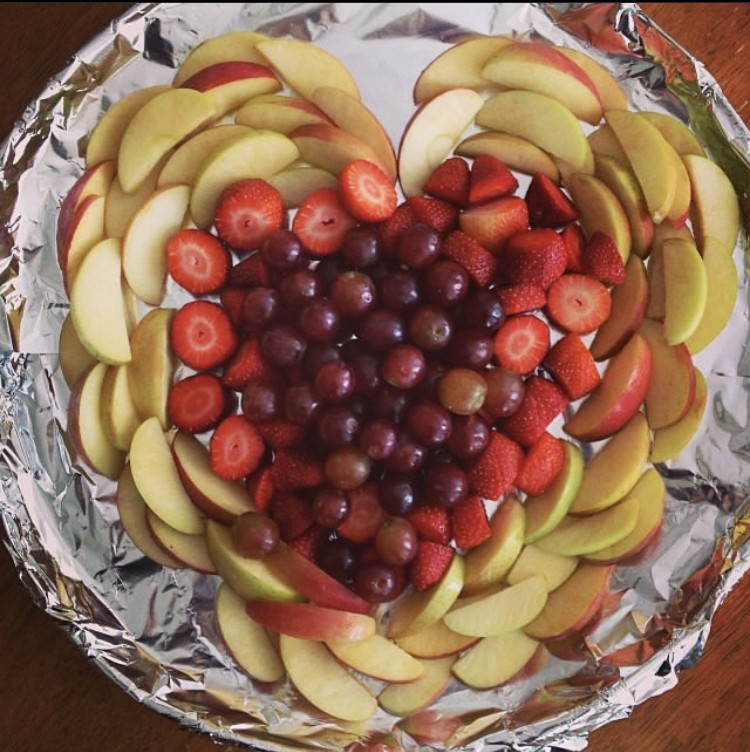
A fabulous Valentine party idea inspired by Amy Makechnie!
Back at home, we spread out (and sometimes punched out) the cards on the kitchen table. Got out the class lists and pencils or pens. (Again, everyone wanted something different.) Chose a card for each classmate and wrote their name on the card (not too big!) While I appreciated the exercise in penmanship (Wait, do parents print up Valentine labels now? Or are Valentine greetings delivered via TikTok?), and the even more important lesson of being generous and inclusive with the giving of greetings, Valentine’s Day wore me out. Let’s not even discuss the aftermath of the classroom Valentine party. (I was the mom who always brought in a fruit tray.)
As my kids morphed into teens who would NOT DREAM of sending Valentines (except for my girl who made them for her friends), I shifted to a cookie baking tradition. I found a fabulous recipe that included a touch of almond extract and an awesome frosting. My giant heart shaped cookies always got rave reviews.
This year, I’m not sure how we will “do” Valentine’s Day. I do not expect, or even desire, roses or a romantic dinner. My youngest, the only child at home, and hubby will surely appreciate the giant heart sugar cookies, but shouldn’t there be something else?
It occurred to me while pondering this upcoming Hallmark holiday that “pink” (the ubiquitous color for Valentine’s Day) looks a lot like the word “kind.” Check out the letters in each word. Shuffle the i, n, k, and rotate the p 180 degrees. You get kind!
How about, instead of rolling our eyes every time we see pink and red in the next week, we take those cupids and hearts as a reminder to BE KIND. You don’t need a special “Valentine” to celebrate the holiday. You just need to bring kind-heartedness to the people around you.
You also need chocolate. Just a few pieces. I like Ghirardelli’s Dark Chocolate, caramel, and sea salt. What about you?
One common criticism of ChatGPT, or a point that some techies use to placate fears that ChatGPT will displace writers and journalists, is that ChatGPT creates “boilerplate” text. It’s good at filler and forms, but not poetry or novels.
Yes, this is comforting to a Word Nerd who would like to publish, but it also brought up another question. Where in the world does “boilerplate” come from and why do we use it to refer to boring filler text? A lawyer recently used “boilerplate” to describe the lengthy and clearly not personalized trust that my father paid another lawyer for years ago.
The term boilerplate was first used in 1893. Back then, small town newspapers depended on copy from large publishing syndicates to fill their pages. The syndicates sent editorials and feature articles already set in type on plates to the small papers, making the copy easy to print. Printers called the plates “boiler plates” because they looked like the plating used for steam boilers. Eventually, “boilerplate” referred to the stories on the plates as well as the plates themselves. Since the quality of those stories wasn’t great, “boilerplate” came to refer to unoriginal writing.
Chat GPT, an Artificial Intelligence chat bot, launched in November 2022, and now, it’s everywhere. Each day I read something about Chat GPT in my news feed or hear hosts discussing it on podcasts. Tech enthusiasts revel in its possibilities. Teachers fear it will promote cheating. Creatives worry it will steal their jobs. But what is it?
What is generative AI?
Artificial intelligence has been around for a while, and most of us use it every day. Do you talk to Siri or customer service robots? Then you use AI. In simple terms, traditional AI analyzes large amounts of data to find patterns and make predictions. The new trend in AI is generative AI, which is what ChatGPT is. Generative AI collects tons of data inputs, such as words, descriptions, images, or computer code, and creates something “novel” in response to a prompt. For example, one could ask a generative AI model to create a painting of a dog in the style of Van Gogh, and it would create something that looks like a Van Gogh painting. But isn’t.
What is ChatGPT?
ChatGPT is a language processing model that provides “human like” text responses to prompts. For example, you can ask it to write a poem about cats or an essay about World War II. Chat GPT is run by Open AI, a research lab backed by Microsoft. ChatGPT is a form of generative AI.
Generative AI models have been around for a while, but lately they are getting more attention because Chat GPT is free and open to the public. All you need to use it is an account with Open AI and ChatGPT.
Open AI says ChatGPT has huge potential for more efficient work. It could help content creators by providing tips on marketing strategies and copy for websites, blogs, and social media posts. ChatGPT can take over tedious tasks and open up more time for employees to work on higher level thinking, like research and strategy.
Some argue ChatGPT can do some basic tasks better than humans can, because it sees patterns humans do not. For example, ChatGPT might do a better job of writing copy for a website to maximize search engine optimization. It can also, ironically, do a better job of personalizing text.
Another benefit: improved internet searches. Some believe a model like ChatGPT will eventually replace search engines like Google. The generative AI can give users actual information, not just links to websites.
ChatGPT has its issues. To work well, generative AI models require millions of data points and significant computing power. They also need human input at the beginning and end of each process. For example, a person has to give ChatGPT a prompt so it can generate a response. Then, the person has to evaluate the response, and if necessary, provide new prompts to refine the final output. Because generative AI depends on data to produce things, it has inherent bias. It learns from the information you give it. Even if it’s bad information.
Also, ChatGPT is trained on data up to 2021, so you cannot use it to generate up to date text about breaking news or current events. Also, since it is easy to manipulate, it may produce offensive, biased responses and misinformation.
Educators worry ChatGPT will make it easier to cheat. Students can ask GPT to write an essay on The Great Gatsby, for example. Or to write a paragraph explaining the Krebs Cycle for biology class. Universities are scrambling to respond to the implications of ChatGPT. Some professors are contemplating oral exams and in class writing assignments, with, dare I say it, pen and paper! (This old Word Nerd thinks that’s a good idea with or without ChatGPT.)
One of my biggest concerns is regulation of AI. Or the lack thereof. Currently, artists are suing Microsoft and other tech companies over AI models. The artists say AI models scrape images and text from the internet to create items that are basically collages of original work. The AI models do not ask for permission to use the copyrighted material, nor is AI currently required to follow any licensing guidelines. The artists say that’s intellectual property theft, and I agree.
AI can blur the lines between what is human made and what is computer made. We already have trouble figuring out if what we read on the internet is true. Generative AI has just complicated that problem.
And what about accountability and responsibility? If a generative AI model produces something offensive, inaccurate, or slanderous, and it goes viral, who is to blame? The person who prompted AI to create the offensive material, or the company that runs the AI model?
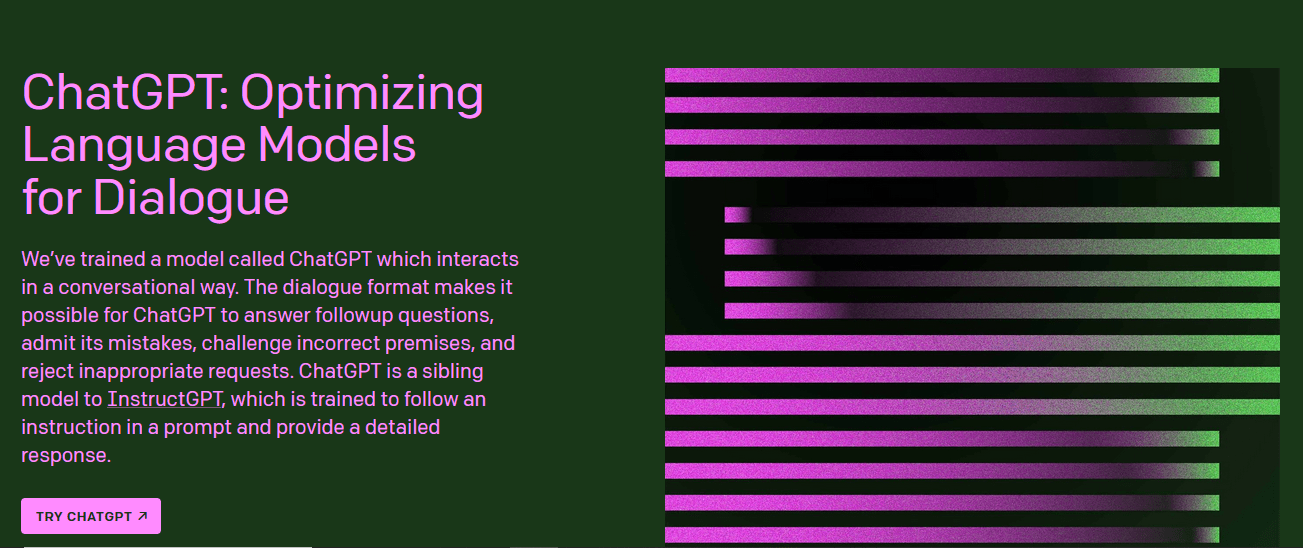
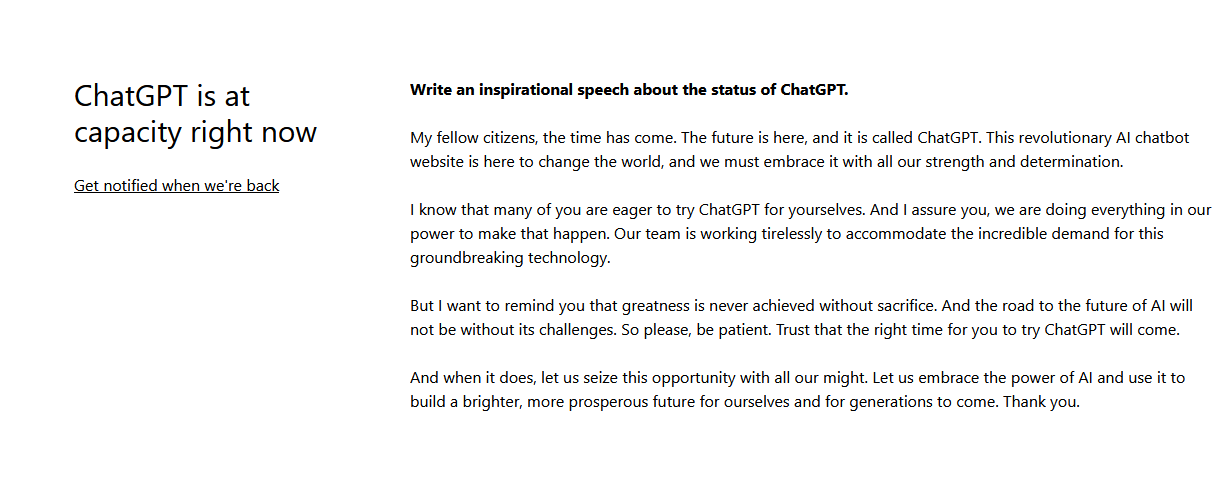
When I tried to log in to ChatGPT, this is what I got. I assume AI wrote this speech.
We do not have legal and ethical standards established to govern AI and its use, and we need them. Quickly. You may be thrilled with the possibility of AI. It may scare you. But we all should be paying attention. Generative AI is here, and we need to make sure we use it wisely.
What are your thoughts on ChatGPT? How are you staying informed?