Happy National Poetry Month! Today, April 27, 2023, the American Academy of Poets celebrates Poem in Your Pocket Day. The idea is to get more poetry out into the world. Read a poem, share it with others. If you love language, if you enjoy grounding yourself in a thought or moment or idea, or in the present, poems serve as a wonderful guide.
I write prose, not poetry, but reading poetry informs my prose. It also helps me appreciate and explore the world. I’m trying to embrace the habit of reading more poetry to make my writing efficient and descriptive, but I never read enough. National Poetry Month, and especially Poem in Your Pocket Day, give me the nudge I need. And in turn, I’m nudging you today with a short poem.
Don’t let poems scare you. There’s more to poetry than iambic pentameter and William Shakespeare. Many modern poets don’t even rhyme. If you visit poets.org, you can find several short poems to memorize and pass along.
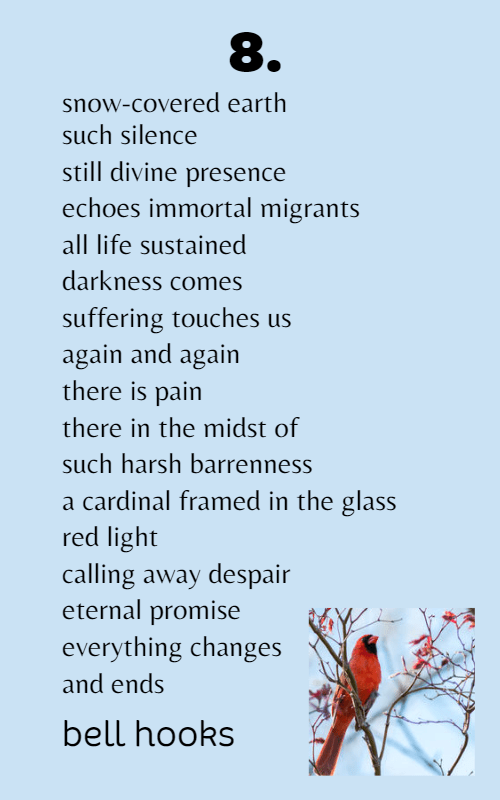
Let me get you started. This poem, “8.”, was written by bell hooks, a prolific author of multiple genres, including kid lit, self-help, memoir, and of course, poetry. She passed away in December 2021, but during her life she used her voice to explore gender and race and bring feminism beyond white middle class boundaries. I’ll read it for you, since I find poetry, like a Shakespearean play, is best appreciated by the ears.
from Appalachian Elegy: Poetry and Place, University Press of Kentucky (2012)
Oh my goodness, no one needs to see me this big. If anyone has tips on how to make videos smaller, let me know! Enjoy the poem!
I also bring more poetry in my life through The Slowdown Podcast, hosted by Major Jackson. Each episode features a poem and a little bit of framing to support it. I love listening to The Slowdown in the evening, when I’m cooking dinner. It helps me settle my thoughts from the day into a useful and nourishing shape. Try it!
I love April. It’s FINALLY getting warmer, and it’s the month we celebrate poetry and the planet. In honor of Earth Day, April 22, let’s think about sustainability.
According to the Environmental Protection Agency, sustainable thinking acknowledges that everything we need for our survival and well-being comes, in some way or another, from our natural environment. “To pursue sustainability is to create and maintain the conditions under which humans and nature can exist in productive harmony to support present and future generations.”
In short, we need this planet to live. So, let’s take good care of it.
Inspired by Europe
When my family and I traveled to Europe last summer, we witnessed sustainable living on a new level. Europeans do it so well, and I was inspired to change some of my habits. We traveled through several different countries where sustainable practices were the norm, and everyone embraced them. Millions of people live this way every day, and I can too.
Some examples: Straws did not exist. Nor did plastic bags. I never saw a bead of Styrofoam floating across the sidewalk. Cups, water bottles, even yogurt containers were all made of composable paper-based products.
Everything was smaller over there. Smaller cars, smaller homes, smaller portions. Maybe we Americans should re-evaluate why we need everything SO BIG! It’s expensive, not just financially, but for our health and for nature.
Now, I’m not going to pretend I loved everything about it. We were a family of four, and every Air BNB I booked had a “washer and dryer” or “laundry facilities.” This didn’t work out as well as I hoped. Every unit had a machine, as advertised. Just one machine. It washed and had a “dry” setting, but that was more like a five-minute air fluff than a drying cycle. The clothes always came out damp. That was fine in arid Aix-en-Provence, but in a muggy basement apartment in Paris, it took a long time for underwear and socks to dry. And we had a lot of underwear and socks.
Lots of people where I live in SW Virginia line dry their clothes, and since our European adventure, I’ve contemplated hanging a line myself. It would save on electricity and decrease wear and tear on the clothes. Then my husband mentioned pollen. I’m still debating that one. Perhaps I could try it when it’s not spring and high allergy season.
Small, easy changes anyone can try
I’m making small changes in our home to decrease our consumption and waste. They haven’t been hard or expensive, and they are moving us toward a more sustainable lifestyle. Perhaps you will find them useful too.
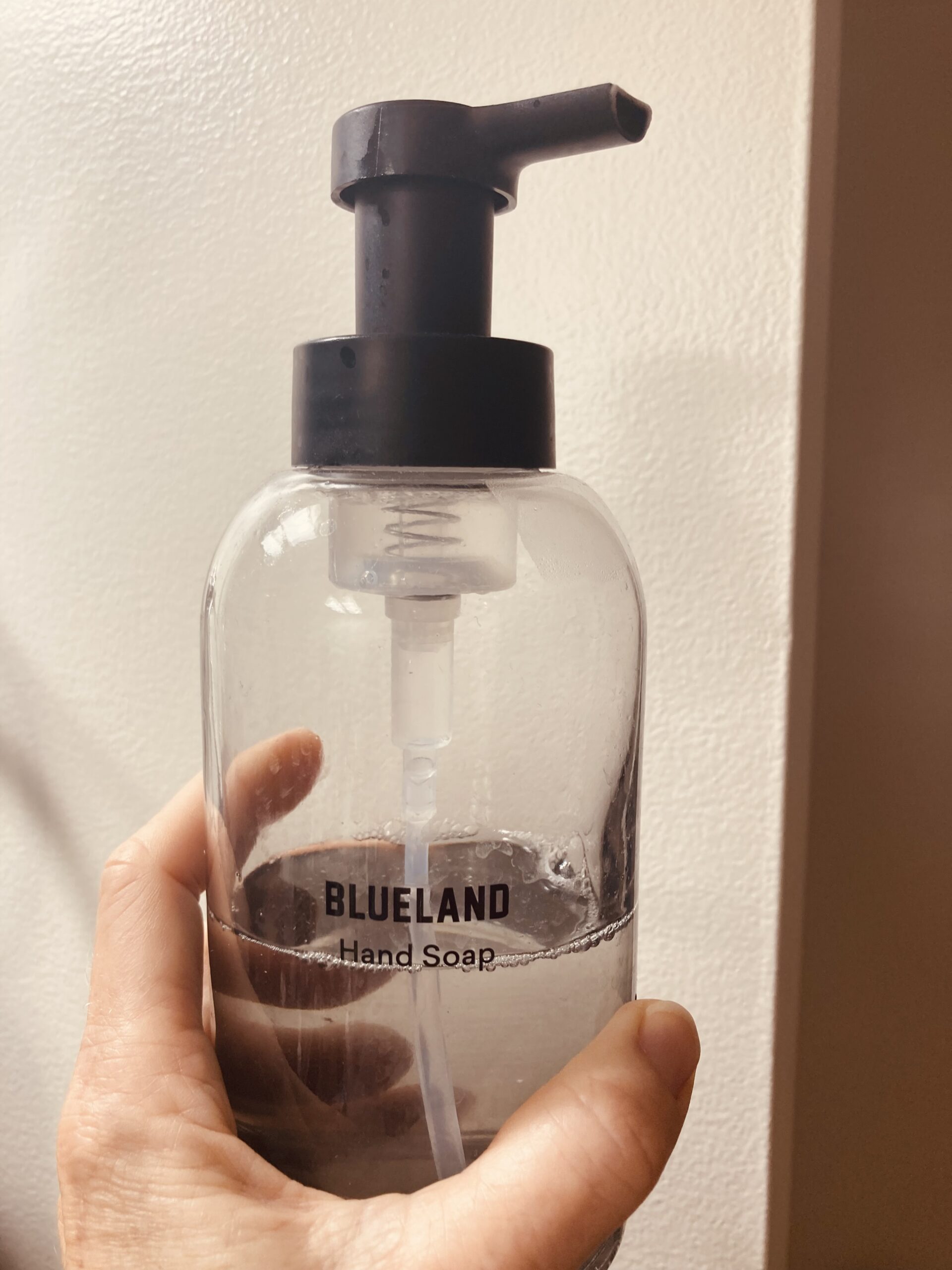
I also use Blueland cleaning solutions and their refillable bottles for bathroom and all-purpose cleaners. Put the tablet in the bottle, add water, let it dissolve. These cleaning solutions are super easy and smell great. However, I tried the glass cleaner, and it didn’t work well.
I use Everything Touches Everything Else dish washing detergent concentrate. It ships in wax, compostable tubes, and you just add water to create the detergent. I love the fresh lemon smell. Sometimes I still need to use Dawn for greasy dishes.
I’ve seen advertisements for refillable candle products I’ve thought about trying, but they look expensive. For now, I’m switching to scented pillar candles to avoid glass waste.
I’ve also switched to matches so I stop using and throwing away plastic lighters that can never be refilled with lighter fluid.
I rarely, if ever, leave a store with a plastic bag. I have plenty of reusable bags and keep them in handy places, like my car.
I use reusable silicone bags instead of plastic baggies when I can.
And with the addition of each easy changes, I’m motivated to continue looking for more sustainable living options.
Our resources may seem infinite, but they aren’t. Everything we use comes with a cost and a limit. We can use many things longer and be happier if we moderate our consumption and are mindful about the costs of our choices. Living a sustainable life style means thinking not just about now, but also five or ten years from now. Sustainable mindsets consider not just ourselves, but also the people we share the world with and who we will hand it off to.
What changes are you making to live more sustainably? Try the small changes I’ve listed above, and please share more ideas in the comments.
The sudden change of temps in March and early April frustrate me. What is one supposed to wear on a sunny spring day when it’s 35 degrees outside?! My daughter said she was complaining to a friend about the bright warm days followed, without warning, by gray rainy days, and he said, “Hmmm. Sounds like spring.” (***insert sarcastic tone***) Which prompted me to wonder, does spring get its name from the springing up and down of temperatures?
Not exactly.
According to the Online Etymology Dictionary, before the 14th century, people called the early season of the year Lent. This came from the Old English lencten, meaning lengthen. It referred to the increasing length of daylight as the season progressed. Lent is still used by some religions to mark the time between Ash Wednesday and Easter Sunday, but by the 1500s, “spring” took over as the name for the season.
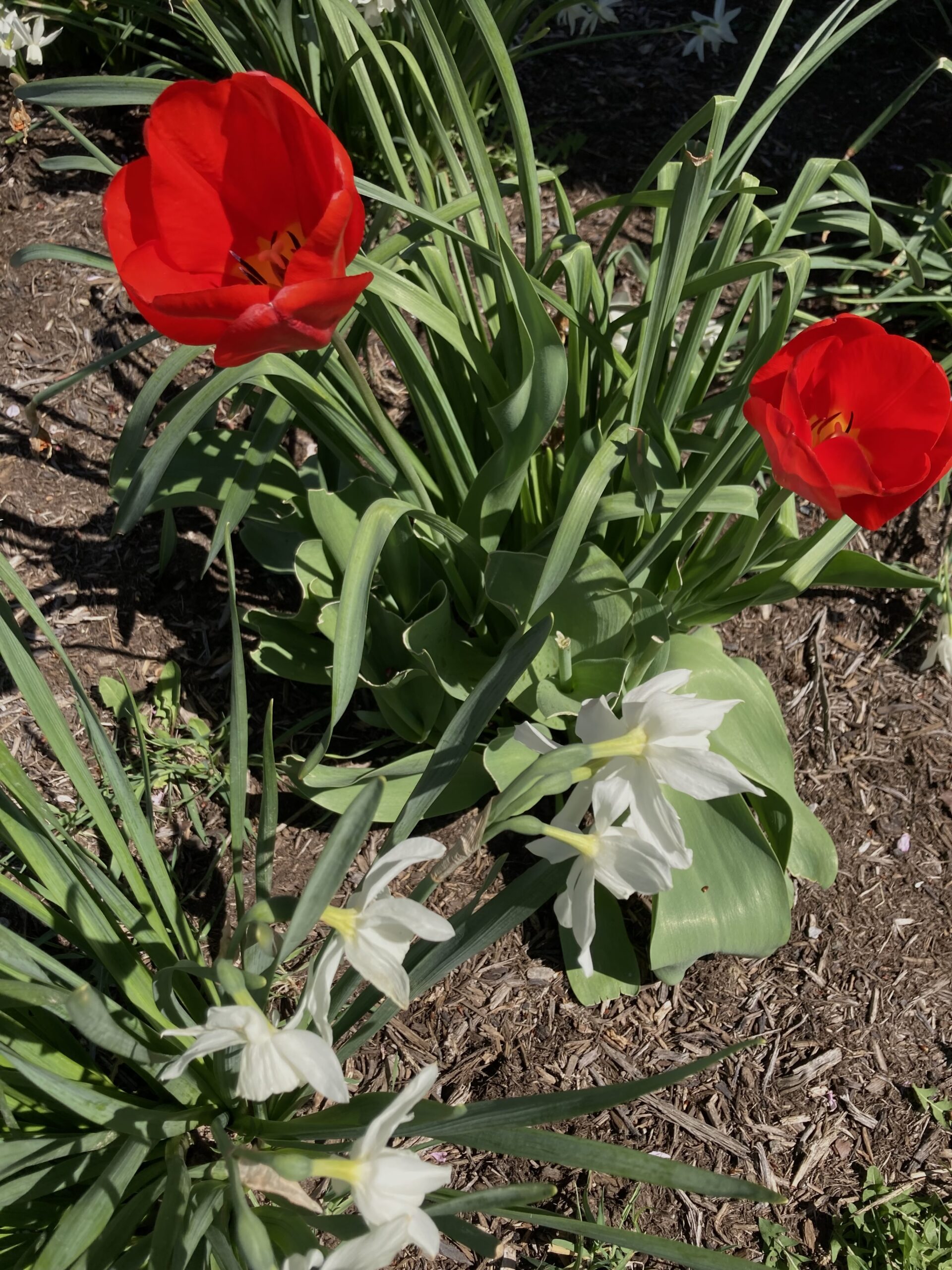
Spring on the farm. I wish you could smell the sweet narcissus and hear the buzzing bees with this photo.
Spring comes from the Old English springan, meaning “to leap, burst forth, fly up; spread, grow.” It also has roots (pun intended) in the Dutch springhen, and the German springen. Seems fitting that we should use a springy word to describe the time of year when plants spring up out of the ground and leaves bud on trees. Early forms of the term in the late 14th century included “springing time.”
I thought it was also interesting to see spring related to the Sanskrit word sprhayati meaning “desires eagerly” and the Greek word sperkhesthai “to hurry.” All of those seem to fit, right?
Fun Word Nerd note: the first known use of “spring fever” was seen in 1843 to describe a “surge of romantic feelings.” Previous to that, spring fever had referred to a kind of disease or cold often seen during spring. Love and disease. Now, there is something to ponder.
So, spring isn’t meant to describe the daily high temperatures that bounce up and down like a wire coil. (Although it could.) Instead, it describes a season of sprouting growth bursting forth. I’ll take it, along with a cardigan sweater for layering in case it’s one of those cool days. 😉
Have an interesting word etymology you’d like to share? Has spring sprung where you live?
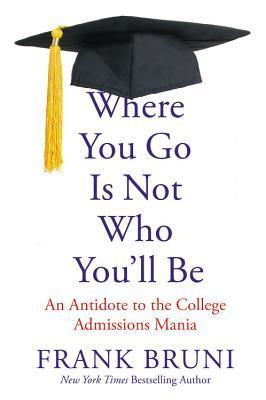
It’s the season of college admissions. I know several families debating (or let’s be honest, fighting and crying about) college choices and potential majors. In this precarious economic environment, I hear a lot of concern about spending tens of thousands of dollars on an English or Biology major. If there isn’t a golden ticket to a job, as one gets with a health care or engineering degree, most parents and students cannot justify spending lots of money on a liberal arts education.
This spring, potential college students must decide if, in this STEM focused world currently debating the pros and cons of AI, a liberal arts education has value. If it can serve as a path to a living wage. All complicated by the fact that most 17- and 18-year-olds I know have no clue what they want to study or do for a living.
Etymology of “liberal arts”
I’m not going to come down one way or the other, because different families have different needs. And I recognize my privilege. I was a liberal arts major (English- shocker!) but I also got a teaching degree and later a master of science in Physical Therapy, so I always had a “career based diploma” to lend practical purpose to my classes on Shakespeare and American History.
What interests me for this post is the etymology and definition of “liberal arts,” a term we’ve been using since the 14th century. According to Merriam-Webster, the liberal in liberal arts does not refer to a left leaning or progressive political position. It comes from the Latin word liber meaning free or unrestricted.
We adopted liberal arts from the Latin liberales artes, which described the education given to free men and the wealthier classes. It included coursework in grammar, logic, and math to “train the mind.” Conversely, poor people or those in the lower classes trained in servile arts, which involved mechanical or occupational skills.
Liberal arts in the 21st century
Knowing this makes me wonder how tightly freedom is and will be tied to “training of the mind.” As we see the divide between the poor and the wealthy widening, will we see a similar divide in education? A reversal of access that we saw in the 20th century? Will the rising cost of higher education force more people who do not have wealth into “servile” occupations?
And most importantly, can our liberal democracy survive if only the wealthy have access to study of liberal arts like philosophy and history?
One of my favorite podcasts, Make Me Smart, recently made me smart about an acronym that has gained popularity in the past few decades. Do you know what a NIMBY is? Let the Word Nerd explain.
NIMBY is a goofy sounding word for a serious problem. It stands for “Not in my backyard,” and it refers to a person who opposes the placement of something, usually undesirable, like a power plant, wind farm, prison, or incinerator, in their neighborhood or near their neighborhood. It’s use started in the 1970s and has seen a dramatic rise and steady use in the last decade.
Usually, people accused of being NIMBYs don’t want a project built near their home because they are worried about damage to property values or their personal well being. They are fine, however, with having these things built near poor or marginalized neighborhoods. Therefore, NIMBY usually carries the stench of hypocrisy.
The result of NIMBY is that, in practice, municipal projects like landfills, prisons, and public housing tend to end up being located in low-income neighborhoods. That’s because wealthy neighborhoods, which hold more political power, usually protest vociferously against have such projects located in their “back yards.” It’s not that the wealthy object to prisons, landfills, and public housing, but they do usually object to having them located near their homes. Meanwhile low income neighborhoods usually hold much less political power, and can’t effectively prevent undesirable projects from being put in their areas.
Political Dictionary
The NIMBY attitude also poses a serious challenge to a green energy revolution. New and renewable energy sources, like wind and solar power, have a large footprint, but some counties are banning new energy development before plans are created.
On Urban Dictionary, I found a bunch of other interesting slang terms related to NIMBY. They included NOPE (Not OnPlanet Earth), the BANANA (Build Absolutely Nothing Anywhere Near Anyone), and the TEDAO (Tear Everything Down At Once).
I get it. I would have reservations about living near a bunch of giant wind turbines and low income housing too. But here’s the thing. We need new forms of energy and ways to manage trash and treat water and provide affordable housing. It’s a burden of living that we should share and not dump on the poorest and least powerful among us. Of course, that’s the way it always goes, but that doesn’t mean it’s right.
Last weekend, I heard the author Ross Gay speak at the Virginia Festival of the Book. One of the excellent and hopeful points he made in his discussion of his writings on joy was this: we experience joy when we practice our entanglement. He noted that although so many of us want to live “independently”, we need each other. Even people who grow gardens so they can be “self-sufficient” need people to provide the seeds and starter plants. And need bees to pollinate the blooms. We live, Gay emphasized, “in dependence.”
In summary, don’t be a NIMBY. When you feel that NIMBY response rising in you, think about the bigger picture, and what we all need to do to take care of each other. Try to practice that currently neglected concept of compromise.
Heard any interesting slang lately? Share, and make us smart, in the comments.
We were ready for March Madness in our house. We had our brackets filled out on the ESPN site and eagerly hoped our Hoos could get to at least the Sweet 16. Even the dogs were decked out in UVA orange. Truth be told, I picked my teams based on my love for Tony Bennet, team name recognition from past tournaments, and school colors. I didn’t expect big rewards. Good thing, because UVA lost in the first round. Again. Cue the March Madness, and what I call, on a personal level, March Mayhem.
We were so ready! 🙁
March is my hardest month. It always brings chaos, thanks to the shift to Daylight Saving Time and the erratic weather. The dark mornings make it hard for me to get out of bed. The budding trees and daffodils tell me warmer weather is coming, but the chill wind chides me, NOT YET. And let’s talk about the wind. Here in our valley between the Appalachian Mountains and the Blue Ridge, the wind howls most days of March. Relentlessly. The cold bursts of air sap my excitement for going outside or tackling my to do list. I just want to curl up under a blanket and sleep. Or read.
My friend Lanny told me she’s likes March because it’s “bipolar.” “You never know what you’ll get!” she said gleefully. Clearly, she’s more comfortable with change than I am. When I complained to my husband about the lingering cold and unpredictable weather of March, he said, “But March is the month when everything turns green.”
Clearly, if I am going to survive March, I need to shift my perspective.
A long time ago, I wrote down a piece of advice from productivity guru Michael Hyatt .
“You get more of what you notice.”
Michael Hyatt
If I want to remain blue and listless, I can keep on focusing on the thermometer and listening for gusts against my windows.
Or, I can decide to defeat March Mayhem, one day at a time. One thought at a time.
Here are five things I’m doing to combat March Mayhem. Maybe you will find them helpful too:
Thinking of others instead of me, specifically, writing cards to people who are sick, lonely, struggling. You know, with a fun pen on a colorful card.
Baking or cooking for others. When it’s cold, it’s fun to bake. Doing something with my hands helps reset my mind.
Movement is critical, even when the weather is unpleasant. I like yoga, walking the dogs, and on crummy days, the stationary rower.
Volunteering. This week I went back to the Open Door Cafe, our town’s donation based community cafe. The new perspective helped. Immensely.
Purging. I have proclaimed 2023 The Year of the Purge. I only have one kid left at home, but lots of toys, books, clothes, and general stuff remain. Also about eight boxes I kept from my father’s house. I plan on tackling the extra junk this month, so when the weather turns, I can work outside and not feel guilty about the mess inside. Physical purging also helps with mental purging, have you noticed? “Get rid of what no longer serves.” (Thank you, Yoga with Adriene.)
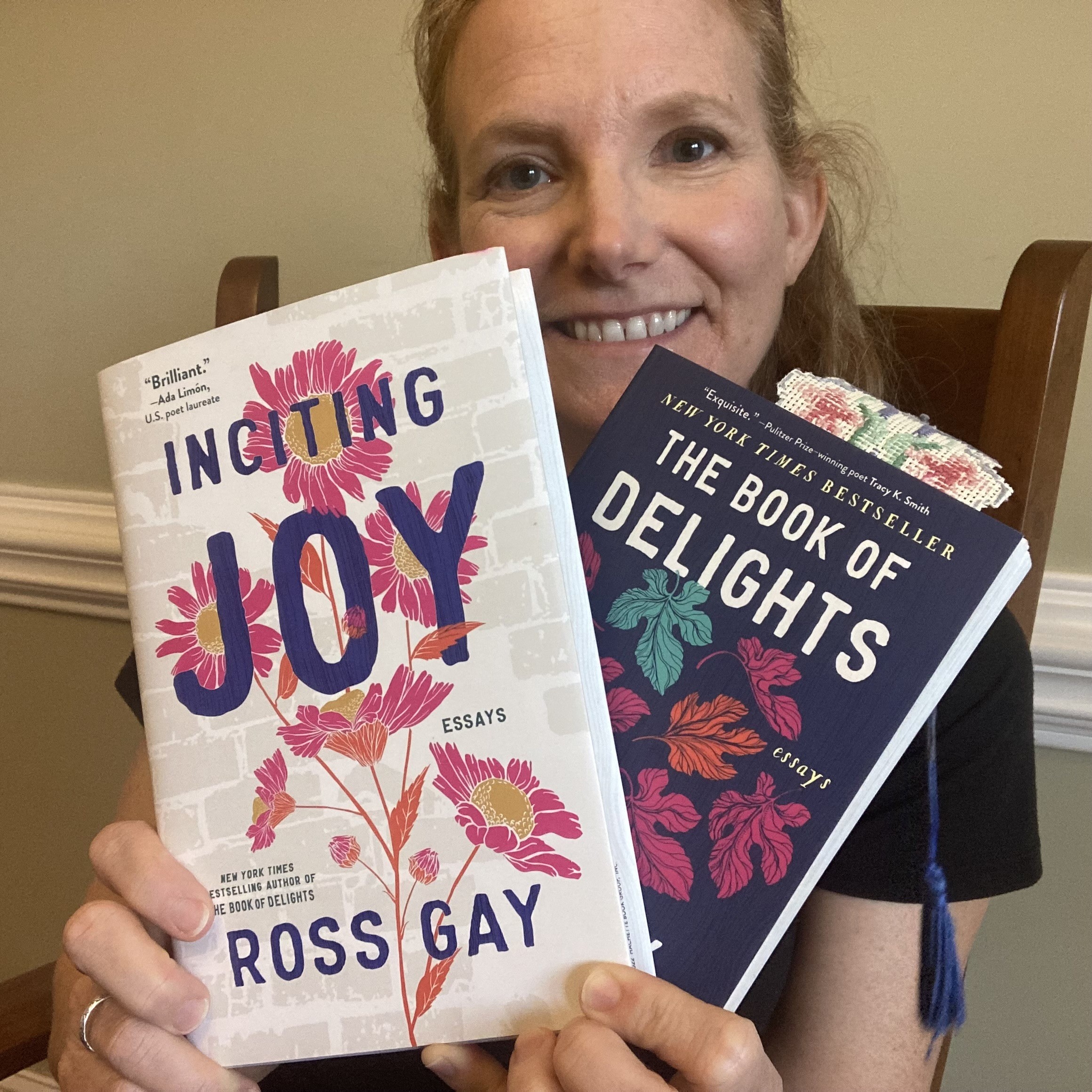
And, I am excited to hear author Ross Gay speak at next weekend’s Virginia Festival of the Book. He will be talking about his two books of essays, The Book of Delights and Inciting Joy.
I started The Book of Delights this week. Gay set out to write one essay each day for a year, starting and ending on his birthday. The topic is always something that brings him delight. His short essays include meandering, humorous, grateful thoughts, as well as some cussing. And his perspective on being a black man in America. Excellent stuff to combat my moody March Mayhem.
How do you feel about March? Can you add any suggestions for combating the mayhem?