Liebster Awards

Besides being a word nerd, I’m also an extrovert, so I love meeting new people.  Thanks to the power of modern technology, I don’t have to live in a densely populated city to find other folks who enjoy reading, writing and all things wordy.  The blogging world has brought me in touch with many other talented, experienced, and most importantly, helpful and supportive word nerds. 

Last month, I participated in a “Platform Challenge” through Robert Lee Brewer’s excellent (and very popular) My Name is Not Bob blog.  Robert offered daily challenges to writers who wanted to improve their platform (aka online presence) and give focus and direction to their writing.  Through that challenge, I have “met” many more writers.  Two of them, Michelle Pond and Bonnie Vesely, graciously nominated me for the Liebster Award, a “pay it forward award” to recognize blogs that deserve more attention!  (More specifically, blogs with less than 200 followers.  Let’s think of them as budding blogs.) 

I am honored and flattered; thank you ladies.  You can learn more about  Michelle at her poetry blog and Bonnie at her life coaching blog.

As a recipient of the award, I must:
1. Thank the one who nominated me by linking back.
2. Nominate five blogs with less than 200 followers.
3. Let the nominees know by leaving a comment at their sites.
4. Add the award image to my site

Now it’s time to share the love (note the heart in the image above).  I’d like to recognize the following blogs for having interesting, inciteful, and helpful content.  (It’s not the suggested 10, but it’s close.  Did I mention that I have four children and it’s the end of the school year?)
 
One Trailing Spouse:  Emily McGee’s travel and relocation blog.  Great pix and reflections  for a homebody like me to enjoy.
Milk of Moonlight:   Kris Swanguarin’s beautiful poetry and writing blog
The Artistry of Education  Mary Bauer offers teaching resources, book suggestions, and other great info for teachers and parents interested in the education of their children!
Travels with Books  Elizabeth Saunders  shares photos and historical information from the research she’s doing for her historical fiction book set in colonial America.
Blogmama Susan: great tips for starting and establishing a blog
Kim’s Ponderings Beyond Breast Cancer: insights and inspiration from a woman who has walked a long and challenging road
Read, Write, Repeat: book reviews and recommendations from avid reader and reading professor Lori Oster
Strong Women Grow Here:   by Mona Alvarado Frazier.  The title says it all. 
Happy reading and writing everyone!
 
Julia

Improving Vocabulary with The Night Circus, Part 2

I know I should have moved on to my next book club book, but I found another vocabulary word from The Night Circus that I really want to share: amalgamation.

Maybe it’s just because this word reminds me of dentist bills (ever have to pay for “amalgam” fillings?), but it sparked my curiosity when I read it. Here’s how Morgenstern used it:

The image in the glass, which could be a grey-haired man in a finely tailored coat, or could be an amalgamation of reflections from customers and waiters and bent and broken light from the street, ripples slightly before becoming completely indistinguishable. 1

Here’s the information from Webster’s:

Amalgam \ə-‘mal-gəm\ n, from Middle English amalgame: an alloy of mercury with another metal that is solid or liquid at room temperature and is used especially in making tooth cements; a mixture of different elements

Amalgamation \ə-mal-gə-‘mā-shən\ n : the state of being amalgamated or the result of amalgamating.

Clearly, Morgenstern isn’t talking about tooth cement, but rather the combinations of reflections and colors that could suggest the image of a man.  Such a lovely word!

Word Nerd Workout: use amalgamation in a sentence.  (Well, maybe first you have to practice SAYING it.  I did include the pronunciation guide.)  Here’s my try.  You moms out there should enjoy this:

When I pulled the fabric cover off of the car seat, I found a multicolored blob, an amalgamation of goldfish crackers, pretzels and cheerios held together by raisins and an unknown yellow substance.  *gross*

Now your turn, and thanks for stopping by.  Be sure to come back on the first Friday of June for a vocabulary REVIEW; it’s been six months folks, we need to see if we’re retaining any good vocabulary knowledge!

Related posts:

1.  Erin Morgenstern, The Night Circus, New York: Random House, Inc. 2011, p. 379.
Julia

Enter the Fantastic World of The Night Circus

Chocolate mice.  Cinnamon pastries.  A cloud maze to explore.  These are only some of the exciting treats waiting for you in The Night Circus, by Erin Morgenstern.  After reading the sober, but worthwhile, Unbroken, I couldn’t wait to devour every fantastical page of Morgenstern’s wonderful story.  Great for reading, very bad for getting adequate rest!
Here’s the premise: near the turn of the 20thcentury, two young magicians, Celia and Marco, are chosen by their masters to compete in a challenge staged at The Night Circus.   At the onset, Celia and Marco don’t know the rules of the game, but as “play” progresses, they realize two important things.  First, many people’s lives have been affected by their challenge, and, second, they have fallen in love.  Unfortunately, they do not know until it is almost too late that the game must end with only one survivor.    
Morgenstern’s narrative jumps around in time, which reminded me of The Time Traveler’s Wife, another favorite of mine.  It’s different and a little confusing, but mirrors the disorientation visitors feel when they enter The Night Circus.  Instead of presenting acts to seated observers, The Night Circus invites patrons to wander the concentric paths around its tents, allowing them to choose what they would like to see, yet at the same time manipulating their perceptions. 
Like those patrons, we as readers see many different perspectives on the circus and the game, and Morgenstern invites us to determine what is real and who to trust.   Ironically, everything in The Night Circus, from the costumes to the tents to the food, is either black or white, suggesting simplicity and clarity.  Yet, in this color scheme, the circus achieves its biggest illusion. 
The Night Circuscloses with an interesting commentary on the nature of stories.  A character complains that modern tales no longer have clear winners and losers, or heroes and villains.  The notions of good and evil have evolved into a complicated web that readers cannot easily untangle.  Ultimately, truth is determined by perspective.
Do you agree?  Have stories in modern literature gotten more complicated, or can we still find and enjoy straightforward tales of good versus evil?  Does the much loved Harry Potter series fit neatly into the format of good versus evil, or does it allow for some gray?  (think Professor Snape)
I enjoy a book that challenges me to think, even if I have to flip back and forth between pages and reread certain passages to pick up important clues.  (Note: Do NOT read this on an eReader!)  This book has so much fun and mystery, I would like to read it again.  It’s an excellent example of a novel that uses setting to compliment its plot.
Please click on the comments button below to add your thoughts about The Night Circus or the nature of stories.  Thanks for stopping by!


PS:  For our book club meeting, I made these delicious strawberries that follow the color scheme of The Night Circus.  Here’s the recipe for Tuxedoed Strawberries.  Special thanks to Crystal for helping me brainstorm the idea!
Julia

Honoring National Poetry Month

In last week’s post, I tried to get you in touch with your inner poet by sharing some great works of poetry to read.  This week, I’m going to encourage you to write some.

Breathe.  It’ll be okay.  In fact, I hope it will be fun.  If my 10 year old daughter can do it, surely you can at least try.  You don’t even have to show anybody (but I’d love it if you did, especially here.)

The poems I cited in my last post were quite long: 12 lines of iambic pentameter with a specific pattern of rhyme.  That’s a sonnet for you.  Today, since we’re thinking about actually creating our own poetry, let’s try a shorter form.  How about Haiku?

Modern Haiku started in the late 19th century with Masaoka Shiki, but the form has deep spiritual and cultural roots in its home country, Japan.  Various rules and forms have existed over the years, and in it’s most basic structure, Haiku  is deceptively simple.  Three lines, no rhymes, but a syllable requirement:  5, 7, 5.  It should also have a “cutting” component, a sense that there are two parts to the poem with a clear splitting point.  Traditional Haiku often uses nature as a muse, but poets can focus on any theme.  (This brief description does not address all of the subtleties of the form; for more information see haiku.com or Haiku for people
Seventeen syllables.  Now, that’s not a whole lot of space to work with, so you have to choose your words carefully.  And yet, what a great exercise- shouldn’t we be doing that all of the time, anyway?

I love my daughter’s fourth grade science teacher, Mrs. Susan Jones.  When the class studied plants, they didn’t just read about them in a textbook.  They went outside to the school garden and dug some up.  Then they did leaf rubbings.  Finally, they wrote poems about the leaves- for science class!  Cross – curriculum instruction is such a beautiful thing.

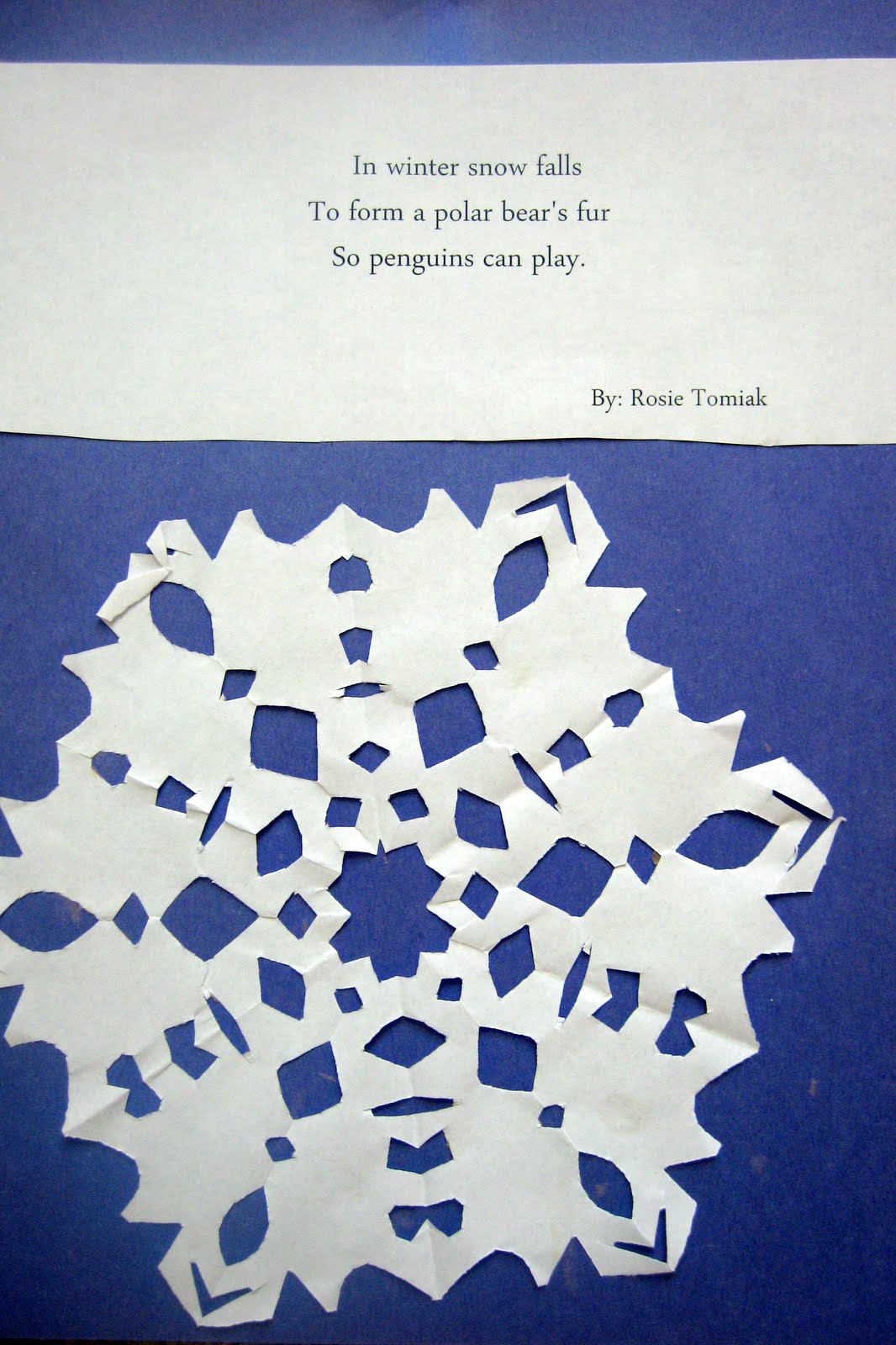
This January, as the class studied weather, Mrs. Jones invited her students to write Haiku poetry about winter.  And here’s what my daughter came up with:

In winter snow falls
To form a polar bear’s fur
So penguins can play. 

Now, it’s our turn.  I’m not a poet, nor have I ever taken poetry writing classes, but this is how I suggest starting:

·         Think of a topic – weather, seasons,  a specific emotional event

·         Brainstorm words about that topic, especially lots of verbs and adjectives

·         Link a few of those words together in phrases that fit the syllable structure for each line

Don’t laugh, here’s my attempt:
I empty myself;
Precious head against my chest
Fills me with peace.

Now, your turn! Let the words flow and don’t allow that critical voice to stifle your creativity.  Also don’t be afraid to share your wonderful poems with us here.  I can’t wait!  

Note: those sweet baby fingers are now almost six years old.  Turned in kindergarten registration forms today.  *Sigh*

Julia

Exposing My Family to National Poetry Month!

Poetry.

Does this word make you smile, or cringe? 

Word nerds should love poetry.  It’s concentrated language, without all of the articles and prepositions to interrupt the flow.  With poetry we hear the rhythms, the musical quality of words.  Remember iambic pentameter? 

My husband does not share my enthusiasm for poetry.  During college, I read him profound lines of Keats or Wordsworth, hoping to foster some interest.  Invariably, he wrinkled his brow, shook his head, and went back to memorizing the structure of Benzene rings.   

Nevertheless, I suggested that our wedding ceremony include a poem.  I knew the perfect piece: Shakespeare, Sonnet 116, the one I’d memorized for class:
  

Let me not to the marriage of true minds
Admit impediments; Love is not love
Which alters when it alteration finds,
Or bends with the remover to remove. 
O, no, it is an ever-fixed mark
That looks on tempests and is never shaken;
It is the star to every wand’ring bark,
Whose worth’s unknown, although his height be taken.
Love’s not Time’s fool, though rosy lips and cheeks
Within his bending sickle’s compass come;
Love alters not with his brief hours and weeks,
But bears it out even to the edge of doom.
     If this be error and upon me proved,
     I never writ, nor no man ever loved.

The enduring power of love.  Perfect, right?  My betrothed did not think so.  Nobodywill understand it,” he argued.  So, I went with the more modern, less cryptic, Elizabeth Barrett Browning, Sonnet 43:

How do I love thee? Let me count the ways.

I love thee to the depth and breadth and height
My soul can reach, when feeling out of sight
For the ends of being and ideal grace.
I love thee to the level of every day’s
Most quiet need, by sun and candle-light.
I love thee freely, as men strive for right.
I love thee purely, as they turn from praise.
I love thee with the passion put to use
In my old griefs, and with my childhood’s faith.
I love thee with a love I seemed to lose
With my lost saints. I love thee with the breath,
Smiles, tears, of all my life; and, if God choose,
I shall but love thee better after death.

Fortunately, I’ve had better influence over my children.  When I pull out Julie Andrews’ Collection of Poems, Songs, and Lullabiesat bedtime, they cheer.  (My husband leaves the room.)  Andrews gathered a wonderful and varied collection of poetry, including pieces from Shakespeare to Silverstein, Dickens to Dickenson.  She grouped the poems by categories like “Growing Up”, “Talk to the Animals,” and “Accentuate the Positive.”  There are short and funny selections mixed with longer, more thoughtful verse. 

The current favorite: a fun little poem called I Didn’t Eat Your Ice Cream, by Jack Prelutsky.  And we all chuckle at a good Shel Silverstein. 

I like it best when the kids read poems to me.  Reading poetry aloud forces them to find the right rhythms, the places to pause and add emphasis.  Frequently when reading prose aloud, they rush and skip words.  But with a poem, if they miss a word, it ruins the rhythm, which naturally cues them to go back and try again.  (And I don’t have to nag…)

I’m pulling out the poetry more these days in honor of National Poetry Month.   The American Academy of Poets established the tradition in 1996 to celebrate poetry and its importance in our culture.  At www.poets.orgyou can find resources and programs, or sign up to receive one poem each day in April! 

Hopefully sharing poetry with my kids will help them enjoy reading it, even if it’s not April.  Better yet, they might feel inspired to WRITE some…  I think it’s working on my daughter… more on that next week.

Do you have a favorite poem or book of poems to recommend?  Do you remember reading poems as a child?  Please share in the comments below. 

My favorite poem from childhood: Jimmy Jet and his T.V. Set by Shel Silverstein.  I had to memorize it and recite it in sixth grade, in front of a video camera!  Yikes! 

More useful Links:

Julia

Improving Vocabulary with The Night Circus

I’m currently reading Erin Morgenstern’s The Night Circus, a magical read with dark, mysterious undertones.  It’s giving me plenty of words to add to my vocabulary list.  

A sign that hangs at the gates of the Night Circus reads:

Gates Open at Nightfall and Close at Dawn
Trespassers will be exsanguinated

Doesn’t exsanguinated send a chill down your spine? It should. It means: to drain of blood. Creepy, right? Would definitely keep me out of the Night Circus. Here’s all the info:

exsanguinated: \ek(s)-‘san-gwə-nāt\ verb, from the Latin ex + sanguine- blood

My years in health care (as a P.T.) gave me a clue to this one- I knew sanguine referred to blood, and with the “ex” in front, it couldn’t be good.

To balance the dark themes, The Night Circus also offers plenty of extraordinary, magical fun, including cloud mazes and wishing trees.  Characters think and talk a lot about their ability to alter perception and see into the future or the past.   

After one performer in the circus gives birth to twins, a fellow performer announces that the twins’ hair, bright red, is an auspicious color.  Of course it is!  (If you can’t tell from my profile pic, I’m a red head.)

Auspicious: \o-‘spish-əs\ adj, from the Latin auspic= diviner by birds (avis- bird + specere- to look)
Affording a favorable sign, propitious

I’m curious about how we got from bird watching to predicting favorability.  Word etymology is so fun! 

Word Nerd Workout:  Try using one of the new words in a sentence.  I’m going to stay away from blood.

The warm, clear weather at our first stop marked an auspicious beginning to the trip.


Now it’s your turn; click on the comments to flex your word nerd muscles.  Remember, if you don’t use ‘em, you’ll lose ‘em. 

Review:  I was listening to “Wait, Wait, Don’t Tell Me”, the NPR news quiz, and one of the panel members used the word mellifluous.  Can you remember what that means?  If not, check the vocab page. 

Julia