
Why You Shouldn’t Be Scared to Read Stephen King’s 11/22/63

Please welcome my guest, Amy Makechnie.  You can find Amy’s thoughtful and entertaining posts on reading, writing, running, and motherhood at Maisymak.  I think you’ll love her funny, yet insightful, voice.  Take it away Amy…


Stephen King  and I didn’t start off on the right foot.
I was ten years old and, for some reason, was allowed to watch The Shining on Sunday night television. I sat in rapt horror the entire two hours and then had nightmares about “redrum” for the next ten years.
This is classic King; there is no doubt he will scare the pants off you.
At age 15, I picked up King’s first book, Carrie.  It was so disturbing I threw it across the room and made a vow that never again would King enter my reading world.
This vow lasted 20 years until On Writing made an appearance.  Hesitantly, I began to read, and then absolutely devoured.
Then King surprised me by writing the novel 11/22/63, the date of the assassination of President John F. Kennedy.  A divergent from his other works, 11/22/63 still became a New York Times Bestseller, like every other book he’s written.
How does he do it?
There is a quote from 11/22/63 that Jake Epping, the main character, narrates:

“In my life as a teacher, I used to hammer away at the idea of simplicity…there’s only one question and one answer.  What happened?  The reader asks.  This is what happened, the writer responds.  This…and this…and this, too.  Keep it simple.  It’s the only sure way home.  So I’ll try, although you must always keep in mind that in Derry, reality is a thin skim of ice over a deep lake of dark water.” 

    King can tell a story.  Line upon line he builds, until one detail is many, many details that all come together to deliver an almost spellbinding page-turner…you must find out what happens! 
    Though a whopping 842 pages long, 11/22/63 not only focuses on the assassination, but also many subplots, some more gruesome than others (King apparently just couldn’t help himself).
    The novel begins with Jake Epping, an English teacher in Maine, finding a portal in a diner.  He goes back in time to 1958, falls dangerously in love, and meets a troubled loner by the name of Lee Oswald.
    Based on thousands of facts that King personally read or tracked down with his assistant, Russell Dorr, 11/22/63 is fiction, but historically accurate.  And for me, that’s what made it such a fascinating read.  For instance, King might not know what specific conversations Oswald had with his neighbor, but we do know he bought a rifle and brought it to that second story window. We do know he had a fight with his wife the day before the shooting.  We do know that people really said, ‘gee whiz’ in 1960.

    11/22/63 hammers at these questions…If you could change the past,   Would you?  And, even if you could change it, should you?

    We come to see, that for every small and seemingly minute action we make, there is a much larger and potentially unwanted, future consequence.
    King writes, “The past is obdurate.  It doesn’t like to change.”  (That’s a good word for the Word Nerds!)
    The descriptions are masterful:  “An empty barn on the outskirts of town, the hayloft door swinging slowly open and closed on rusty hinges, first disclosing darkness, then hiding it, then disclosing it again.”
    Does Jake try to stop the assassination?  Should he?  Certainly in our reality, the president died, but in our fictional world?  You’ll have to read and find out!

    As for my truce with Stephen King, I may not be able to read the majority of his books without serious “imagination issues,” but let there be no doubt of my admiration for this extremely talented and hardworking craftsman.

    Amy Nelson Makechnie is the mother of four children and doesn’t deny that she occasionally shuts herself in her room to devour books.  She’s a contributing freelance writer for Deseret News, KSL, and has exactly six paragraphs appearing in an upcoming book on motherhood by powerofmoms.com.  She is in the final editing stage of an adult fiction novel and the author of the blog Maisymak.  She loves visitors!

    Julia

    Who’s Ready to Test Their Vocab Knowledge?

    It’s that time again!

    As I walked the dog this morning, the frost on the grass sparkled in the light of the rising sun.
    Fall has arrived.
    So has cooler weather.
    September is almost over…
    Which means, time for another quiz!
    Test your Word Nerd skills with the questions below.  Those who get all correct answers will earn link love from me, as well as kind acknowledgements in the world of Twitter and Facebook.  Don’t be shy, join in!
    Word Nerd Workout
    1. Would you like your daughter’s fifth grade teacher to be salacious or sagacious?  Pick one.
    2. Which of these words comes from a Latin root meaning “story”?
      1. mellifluous
      2. pedantic
      3. confabulation
    3. If a plant has vespertine blooms, that means that its blossoms appear
      1. At evening
      2. When sun hits them
      3. Only in shade

    Leave your answers in the comments section; I can’t wait to hear from you.  I hope you learn something new today!
    Did you like this quiz?  Take another!

    Julia

    Why Banned Book Week Has Me Thinking

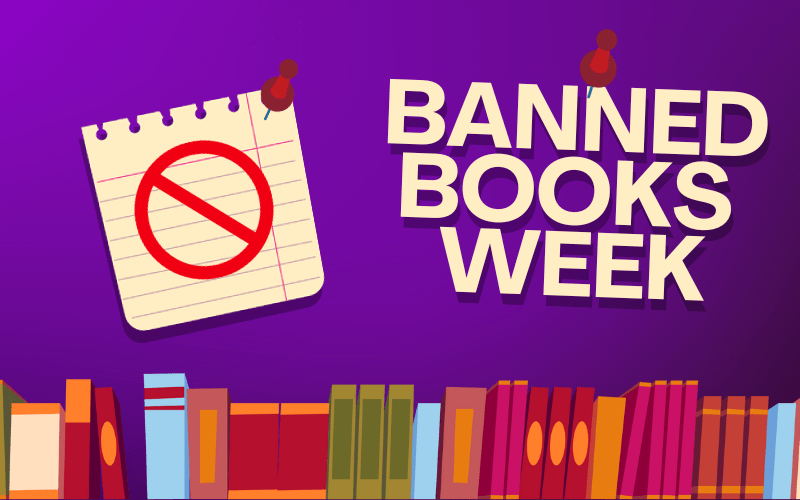
    The buzz about Banned Book Week has begun, even though officially the week doesn’t start until September 30th.  Search the topic, and you’ll find websites, readings, and other events to promote books that have been banned or restricted from schools.   
    At first I thought, “What’s the big deal?”  Then I saw the lists of titles that have been challenged and/or banned.

    You won’t believe this list!

    I expected to find Huckleberry Finn, but not so many of my favorite reads, including:
    • Harry Potter
    • Bridge to Terebithia
    • To Kill a Mockingbird
    • I Know Why the Caged Bird Sings
    • A Wrinkle in Time
    • The Outsiders

    I had to learn more.

    Why are books banned or challenged?

    According to the American Library Association website, groups or individuals request restrictions on books with the intention to protect children.  Frequently, complaints are made based on offensive language or sexual content.  For example, To Kill a Mockingbird uses “the n word”.  Holden Caulfield swears his way through Catcher in the Rye.  But why Harry Potter?  If Ron swears, I don’t know it (I’m not up to date on my English cursing- can someone please tell me what “bloody” equates to in American English?).  I’m guessing HP makes the list because of the whole sorcery business.

    Now I’m upset about banned books too

    I’m a conservative mother, and I vigorously filter content.  My 12 year old hasn’t read The Hunger Games yet because I think its themes too violent and disturbing.  However, this information about banned books has me riled up.  I limit exposure to racy pop songs and violent TV shows because the whole point is sensationalism.  But Harper Lee didn’t use the language in To Kill a Mockingbird to promote sales; she used it to describe attitudes and perceptions about prejudice.   
    So now I wonder, how can I think that offensive content in books is acceptable when I don’t tolerate it in other media?  I’ve come up with three main reasons:
    • Inherent value– Does the book offer something relevant that overshadows the offensive material?  For all of the titles I’ve listed above, YES!  If the book as a whole explores relevant themes or issues, I can’t condemn it for a few ugly words or scenes. 
    • Audience–  Is the group reading the book mature enough to handle the content?  Books like To Kill A Mockingbird and The Chocolate War tackle difficult topics- racism, abuse, sexuality, bullys.  Do they belong in an elementary school library?  Probably not.  But can they be used with older students?  Yes.  See next point.
    • Accessibility–  Not all kids have word nerds for parents.  Or money to buy books.  So if they don’t read these books in school, they may never see them.  And that would be sad.  Well written literature can trigger insightful classroom discussions.   If the “n word” offends, let’s discuss why it offends. 

    Honestly, I have reservations about some of the books on the list, like Beloved.  When I read it, Toni Morrison shoved me into the shackles of slavery; I could feel the raised scars from whips on my back.  After one disturbing sexual scene, I closed the book and refused to pick it up again.  But I felt the horror of slavery more than I ever had before.  There’s value to that.
    Here’s what it comes down to.  As a mother, I must look out for the best interests of each of my children.  So it’s my job, not the government’s, to monitor the books my kids open.   (Tweet this if you agree!)
    Should I have the right to decide what your child reads?  No. 
    Whew, this is a tough topic!  I welcome your response in the comments below.  Come back during Banned Book Week (Oct 5) when I’ll post a review of The Kite Runner, a challenged title.  If you leave a comment on that post, you could win a free book off of the banned list!  If you are a blogger and want to post something on Banned Books Week, join the celebration with Book Journey

    Julia

    Why You Should Look Words Up: Confabulation

    Sometimes your gut instinct about a word’s meaning isn’t right, and you need to check the dictionary.  Or Google.
    Salacious had tricked me a few weeks ago.  Based on the context, I thought it meant “obnoxious.”  Well, that wasn’t exactly right.  Glad I looked it up!  (Do you know what it means?  Learn more about salacious.)
    Here’s another word that fooled me: confabulation.  When one of my friends used this in conversation, I thought it meant “a lie.”  I was focusing on the “fab” part, as in “fabricate”. 

    This week’s Word Nerd Word

    confabulation \kən-,fab-yə-‘lā-shən\ noun, from Latin com together + fabulari to talk, from fabulastory;  a discussion, casual conversation;

    also from psychology: the replacement of a gap in a person’s memory by a falsification that he or she believes to be true

    I wasn’t completely off with the fabrication idea, but I’m glad I took the time to look the word up and learn the subtle meanings.

    Word Nerd Workout

    Use confabulation in a sentence.  My example:

    After Gretchen slipped and fell in the middle of the lunchroom, confabulation about her mishap spread throughout the school. 

    This actually happened, but fortunately, Gretchen has a great sense of humor. 
    Your turn!  Leave your sentence in the comments below, and thanks for stopping by!

    Other Word Nerd Words:

    Julia

    How to Find Book Blogs to Follow

    I get overwhelmed easily.  You might not expect to hear that from a mother of four energetic, noisy children. Or maybe you do.

    But if I see too many options at once, or contemplate too many tasks together, my head starts to throb.  Right between my temples.  Panic sets in.

    The book blogging world overwhelms me

    Have you ever navigated the complex and unending line of book blogs on the internet?  You could spend hours.  And these people read A TON of books; upwards of 150 a year. I love books too, but I’m lucky to read 15. ( I tell myself that I savor my reads more.)  
    So, the good news is, if you’re looking for reading suggestions, you have LOTS of options.  The tough part: how to find a book blogger, besides me, of course, who provides helpful information for your needs/interests.  
    Luckily for me, book blogger Joy Weese Moll introduced me to Book Blogger Appreciation Week, which was established a few years ago to celebrate and promote book bloggers and the helpful information they provide.  I have spent a lot of time browsing book blogs this week, trying to find a few more to follow, and I’ve formulated some criteria.

    How to find a book blog you can enjoy

    Here’s what I’ve decided I need from a book blog:
    • concise, yet informative, posts about the content, style, and overall feel of a book
    • a personal reaction to books
    • a well organized blog so that I can find books I’ve already read easily and look up ones I’m interested in
    • uncluttered, clean style without too many ads or distracting side bars

    My suggestions 

    I’ve discovered the following blogs this week and would like to share them with you.    Check them out and see what you think!
    • Sarah Reads Too Much  You can find Sarah’s reviews by author and genre, and she has read a lot of the books and authors that I’m interested in.  Today’s post is on To Kill a Mockingbird, one of my favorites!  She says she absolutely loves it, which makes me want to visit her blog more!
    • The Well Read Red Head  If you can’t tell from my pic up in the right hand corner of my blog, I’m a red head.  (strawberry blonde, to get technical).  Also well read.  So how could I not like this blog?  Kelly shared in a BBAW interview that The Time Traveler’s Wife is one of her favorites.  I had to check her out.  She’s a blogging veteran, but new to book blogging.
    • The Relentless Reader  Ok, I actually found Jennifer before this week, but she also participated in BBAW, and I’ve enjoyed getting to know her a little better.  She also loves To Kill a Mockingbird, and she includes other “bookish” posts on her blog, like 20 Proven Benefits of Being an Avid Reader.
    • A Room of One’s Own  Jillian’s blog has an impressionist painting as its background, and a lovely quote from Thoreau in the banner.  Her posts tend to focus on classic and children’s literature, and she  brought it to my attention that September 22 is Hobbit Day!  How about that!
    Thanks to Book Blogger Appreciation Week, and Joy, for leading me to these gems!
    What do you look for in a book blog?  Do you have any that you can recommend?  

    Julia

    Why Obfuscation Is the Perfect Vocab Word for “Paper Towns”

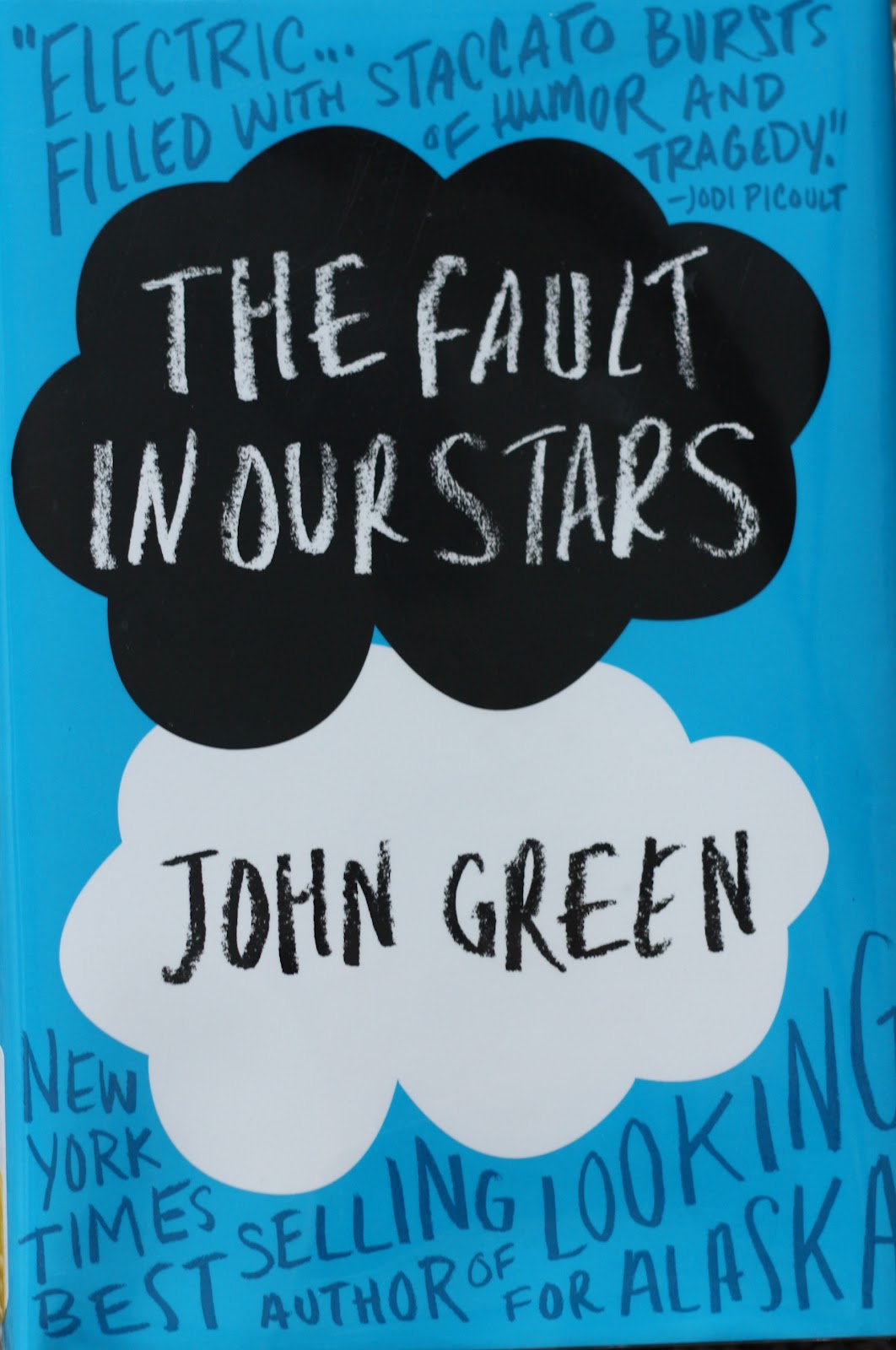
    John Green’s PaperTowns is about a boy named Quentin and his quest to find the girl of his dreams, Margo Roth Spiegleman.   He already knows her; she lives next door.  But she has this thing about running away and disappearing.  
    And Quentin wants to bring her back.
     
    He learns a lot along the way.  About himself and the girl.
    About midway through the book, one of Margo’s “close” friends confesses:

    “She had [the notebook] with her all the time.  I never saw her write in it, but I just figured it was like a day planner or whatever.   God, I never asked about it.”

    “She wouldn’t have answered anyway,” I said.  It was dishonest to act like Margo hadn’t participated in her own obfuscation.

    Wow, that’s a mouthful.  Try to say it. 

    New Word Nerd Word:

    obfuscation \,äb-fəs-‘kā-shən\  noun from Latin –ob in the way + fuscusdark brown; confusion, darkness, obscurity

    The word itself sounds elusive, just like Margo.  And nerdy, like Quentin, her pursuer.  A perfect choice by Mr. Green once again.

    Word Nerd Workout

    Use obfuscation in a sentence.  That’s tricky, I know, so I give you permission to use another form of the word, like obfuscate or obfuscatory.  Since I picked it, I’ll use the noun form.

    The Republican candidate for Governor spent a significant amount of time generating obfuscation around his relationship with the CEO of Warden Products International. 

    Have I obfuscated you today?  Hope not!  Looking forward to your sentences!

    Other Word Nerd Words:

    Julia