Welcome to Wondrous Words Wednesday! Time to learn something new. Visit Kathy at Bermudaonion.net for more intellectually stimulating words.
My word comes from the October 2013 issue of Writers Digest. In an article called, “Using Figurative Language Effectively,” Theodore A. Rees Cheney reviews the basic tools for figurative language: simile, metaphor, analogy, and personification.
But then he covered one I’d never heard of: metonymy.
Metonymies single out a quality of a an object and focus attention upon it.
metonymy \mə-‘tän-ə-mē\ noun; from Greek meta– change + onyma/onoma name, literally meaning a change of name. A figure of speech consisting of the use of the name of one thing for that of another of which it is an attribute or with which it is associated.
Here are some examples:
“The White House” for the president and his administration
“The Bench” for a judge
“The Vatican” for the pope and his administration
In his article, Cheney argues that figurative language brings depth and engagement to writing; readers have to participate to appreciate what the writer conveys.
Eager to improve my writing, I searched my current WIP**, Redefined, for metonymies. Yippee! I found one:
Dad wanted privacy, so he built our house away from the eyes and ears in town.
Word Nerd Workout
Can you come up with your own example of metonymy, or can you find one in fiction/media to share? And, make a word nerd feel better- have you heard of this term before? I knew the concept; I didn’t realize it actually had a name!
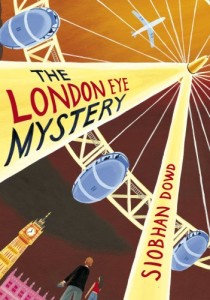
I’d been bugging my kids for weeks to read The London Eye Mystery. And then, while child #3 sat in the barber shop chair, I held the novel for him. It’s a small, squarish book. I’m supposed to be looking at my phone less, so I read.
The pages turned quickly. And I giggled. Fortunately, no one in the barber shop seemed to notice, especially not my children. Kids #1, 2 and 4 all had their noses in books. (Hurrah!)
An Interesting Character
The London Eye Mystery is told from the unusual prospective of Ted. He suffers from a “syndrome”, probably Asperger’s, although nobody ever comes out and says that. Ted explains that his brain “runs on a different operating system.” His issues? He takes words literally, has trouble reading other people’s emotions, shakes out his hand a lot, and is obsessed with the weather.
Here’s an example of his literal thinking, one that made me giggle:
It was like the time I’d asked why footballers were still being kept as slaves when slavery had been abolished, after a newsreader announced that a Manchester United star had been bought by another club for twelve million pounds.
The cool thing about The London Eye Mystery is that Ted’s unusual perspective on the world actually helps him solve the case when the police and his sister cannot. He puts all the pieces together by looking at the clues differently:
I remembered a picture Kat had once shown me of a waterfall. Only, the way it was painted, it looked as if the water was flowing upwards. Perhaps this was a clue to Salim’s disappearance. Perhaps Kat and I were looking at things the wrong way up, or the wrong way round.
An Enjoyable Mystery
Here’s what happens. Kat and Ted take their cousin Salim into London to ride The London Eye, the largest observation wheel ever built. A mysterious man offers Salim a ticket, and he takes it, disappearing into one of the pods on the “giant bicycle wheel in the sky.” Thirty minutes later, when the pod comes back around, Kat and Ted watch for their cousin to get out. But he never does.
Much like Sherlock Holmes, Ted doesn’t reveal how he’s pulled the clues together until the end of the story. He drops hints along the way, but I was too dense to notice. Maybe if I read more mystery I could have seen what was coming.
Besides having all the necessary components for kid lit sleuthing,The London Eye Mystery also touches on the importance of family and the difficulties of communicating well with family members, whether you have Asperger’s Syndrome or not!
Recommendation
All three of my kids (aged 9-13) who read The London Eye Mystery enjoyed it. (The youngest didn’t read it because he’s just in first grade and is plowing his way through The Magic Tree House series.) There’s nothing scary, and yet tension moves the plot along. It also gives kids insight into people who are “different.” Although Ted has his quirks, he wants to help, and he ends up a hero. That’s a character every kid can relate to.
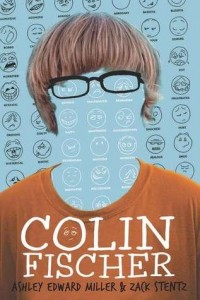
Soon, I hope to tackle Colin Fischer, which is about an older kid with Asperger’s who solves a mystery at his high school.
Can you recommend other books about kids with disabilities or other kid lit mysteries?
Welcome to Wondrous Words Wednesday! Ready to learn something new? Visit Kathy at Bermudaonion.net for links to more interesting words.
My word comes from a fun piece of kid lit called The London Eye Mystery, by Siobhan Dowd. (By the way, if anyone can help me pronounce the author’s first name, I’d really appreciate it.) In it Ted and his sister Kat must solve the mystery of their cousin’s disappearance.
Early on in the search for clues, Ted finds his cousin’s camera:
‘I wish it was digital like Dad’s,’ [Kat] said. ‘Then we’d be able to see the pictures now. With this old-fashioned kind, you’ve to open it somehow.’ She shook the camera and shrugged… ‘You get the film out and take it to the camera shop to have it developed. It costs money and you have to wait. What a bloody palaver.’
First, I have to chuckle at the phrase “old-fashioned kind.” I still have film lying around my house! Next, what’s a palaver?
palaver \pə-‘lav-ər\ noun, from Latin parabola, parable, speech
A long parley usually between two people of different levels of sophistication; a conference or discussion
Idle talk; misleading speech
Neither one of these fits the context exactly; I guess Kat means that because they can’t see the pictures inside, the camera was a misleading clue, at least until they can get photos developed.
Word Nerd Workout
Think of another word for palaver using the definitions above. My example is one of my previous word nerd words: confabulation
Good luck! Also, any Spanish students out there? Did you notice the Latin basis for palaver can also explain the Spanish word palabra? (It means “word”!)
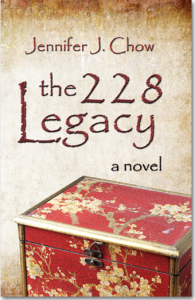
I’m excited to feature Jennifer Chow today. She is a writer and fellow member of Wordsmithstudio.org, and this summer she published her first novel, The 228 Legacy. The novel explores the struggles of three generations of Asian-American women living in California.
The narrative of The 228 Legacy has four points of view. Silk, the oldest character and the one who lived through the 228 Massacre in Taiwan, interested me the most. I wish the book had even more details about Taiwanese culture and history and how they shaped Silk’s view of life.
Jennifer is busy now that her book has been released, but she was kind enough to share some insights into her writing process.
Julia: What inspired you to start writing?
Jennifer: I’ve always wanted to be a writer, ever since I borrowed my dad’s typewriter as a child and started making up stories. The 228 Legacy, though, was inspired by speaking with and witnessing the emotion of my relatives as they relayed a part of their history which was kept secret for decades.
Julia: Are any of the characters from The 228 Legacy based on people in your own life? If so, which ones?
Jennifer: I think the characters are all culled from various sources. Silk’s tenacity to life and her ability to adapt is definitely an homage to the Taiwanese people I’ve met who survived 228, and to all immigrants who decide to move to a new country and start over. There’s also a piece of me in every one of the main characters: Silk’s desire to pass on her culture, Lisa’s struggle with finding a solid identity, Abbey’s problems fitting in at school, and Jack’s perception on aging.
Julia: Where could readers go for more information on Taiwan and the 228 Massacre?
Jennifer: The best possible solution would be to visit Taiwan. There are multiple monuments and museums dedicated to the history of the massacre. Thankfully, there now also exists online information sources about 228; there’s even a Wikipedia entry on it. For more detailed information, you can check out the major resources I used for my research here: http://jenniferjchow.com/books/
Julia: What were important things that you learned on your journey to publication? How did you find your publisher?
Jennifer Chow: “It’s essential to have that support …. on your writing journey.”
Jennifer: I learned to keep trying. Hand-in-hand with persevering is being part of a writers’community. It’s essential to have that support when you’re facing rejection (a normal thing) on your writing journey. It was great to have colleagues, in-person and online, to provide feedback and encouragement.
Personally, it took me a year to find a publisher. During that time I queried multiple literary agents, entered the Amazon Breakthrough Novel Award (where The 228 Legacy landed in the second rounds), and eventually got picked up by an independent press, Martin Sisters Publishing.
Julia: I love the design of your website and how it ties in to the theme of your book; how did you achieve such a beautiful look?
Jennifer: I take no credit for that. The design was through the beautiful work of the talented Janet at Izzy Design. We talked back and forth about the themes in my book and my vision for the website. I also showed her the book cover’s artwork, so she was able to tie similar visual elements into the design.
Julia: What are your future projects?
Jennifer: I am currently revising a cozy mystery. It’s a light-hearted novel featuring an Asian-American protagonist. He’s called to investigate a potential crime at a local senior home.
Thanks Jennifer! You can find out more about Jennifer and her work at jenniferjchow.com.
Have you heard of the 228 Massacre or Jennifer’s book?What have you learned about history from your family?
Welcome to Wondrous Words Wednesday! It’s a great way to boost your vocabulary. Visit Kathy at Bermudaonion.net for links to more wondrous words!
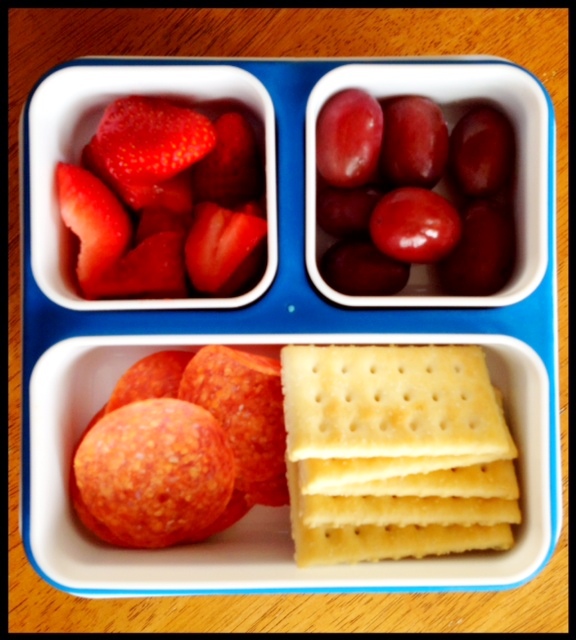
After packing lunches for eight years, I’m trying to make things more interesting. My husband can eat PBJ every day without variation, but the kids crave something different every now and again.
So, with the help of Pinterest and some Bento boxes, I’m spicing up the mid-day meal.
What is a bento box, you ask?
A bento box packed for lunch
This clever little container, that comes with its own ice pack, can hold all kinds of yummy, non-sandwich treats. I found it at Wal-Mart. My kids like “homemade pizza lunchables.” We also want to try pancakes, sausage, and syrup, but I hope the kids realize everything will be cold.
I got really excited when I found “bento box” in a book I recently read, The 228 Legacy, by Jennifer Chow.
Silk recalls packing a bento box of rice and picked radish for him the morning he vanished.
Bento \’ben-tō\ noun; origin: Japanese; a lacquered or decorated wooden Japanese lunchbox; (special usage) a Japanese-style packed lunch, consisting of such items as rice, vegetables, and sashimi (raw fish with condiments)
Word Nerd Note:
This definition comes from the English Oxford Dictionary loaded on my Kindle. (So handy!) Also, I must clarify that The 228 Legacy is about Taiwanese culture, not Japanese. Come back Friday to learn more about The 228 Legacy and its author, Jennifer Chow.
Word Nerd Workout
Share a word that you use that comes from another culture, preferably something interesting or unique. (aka skip “taco” and “burrito” 🙂 ).
I didn’t think I would like this book at first. I was afraid it would be dark and depressing, like something Oprah would select for her book club.
But the beauty of the prose encouraged me to read, and I’m so glad I did.
The premise
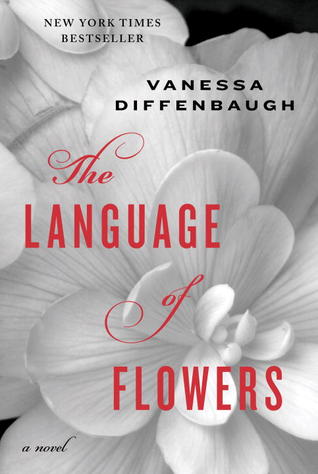
The Language of Flowers tells the story of an intriguing young woman named Victoria. She has lived her entire life in foster care, and at 18, she is “emancipated” into the “real world” without money, friends, or formal education. She has spent her life building a protective barrier between herself and other people, but she knows the language of flowers, and she uses that to overcome her fears and heal.
What I liked
The story opens with Victoria waking to a fire in her bed.
Standing in the middle of the room, I located the source… A neat row of wooden matches lined the foot of the bed… Watching them light, I felt a terror unequal to the size of the flickering flames, and for a paralyzing moment I was ten years old again, desperate and hopeful in a way I had never been before and would never be again.
I thought, Oh, no. This is going to be a book about abuse. Granted, the novel describes bleak situations in the foster care system, and Victoria has lots of issues. But, more importantly, her story is one of hope.
One of the many thistles on my farm; note the prickles!
Here are the best parts:
The author, Vanessa Diffenbaugh, cleverly weaves two plot lines together: one told by 10-year-old Victoria and one told by 18-year-old Victoria. The two stories accelerate to an intersection and climax that does not disappoint.
Victoria is prickly, like thistle. (meaning: misanthropy) She’s so unemotional, she’s hard to like, but her perseverance inspires. I like inspiring characters.
The prose is lovely.
I enjoyed learning about flowers and their meanings. For example, sun flower means false riches, so Victoria hates it when brides choose this flower for weddings.
It has a happy ending. I’m a sucker for those.
What I didn’t like
I don’t have much to complain about. At a few key points, I thought that the characterization wasn’t consistent. For example, a character does something that clearly adds to the tension of the story but the action doesn’t really fit the character.
Recommendation
The Language of Flowers is one of the best books I’ve read this year. It’s the perfect blend of bitter and sweet, and I encourage anyone who likes stories about rising above difficult circumstances to pick it up. There is darkness, but it doesn’t overwhelm.
Also, if you read about Vanessa Diffenbaugh on Goodreads, you’ll learn she has very interesting experience with foster care and helping underprivileged youth.
Have you ever started a book that you thought would be depressing but turned out to be a great read? Tell us about it! If you have read The Language of Flowers, what did you think of it?


 Welcome to Wondrous Words Wednesday! Time to learn something new. Visit Kathy at Bermudaonion.net for more intellectually stimulating words.
 Here are some examples: